
SCOTUS Once Again Reads the FAA’s Transportation Worker Exception Broadly
From bakeries in nineteen states, Flowers Foods, Inc. (Flowers) distributes baked goods, including most prominently Wonder Bread, across the country. Angelo Brock is a Flowers franchisee who distributes Flowers’ products exclusively within the state of Colorado. When Mr. Brock sued, alleging that Flowers had underpaid him and other franchisees in violation of state and federal law, Flowers, relying on an arbitration clause in Mr. Brock’s distribution agreement, moved to compel arbitration. The District Court denied the motion to compel, and the 10th Circuit Court of Appeals affirmed, relying on the exception in § 1 of the Federal Arbitration Act (FAA) for workers engaged in interstate commerce.

In a remarkably short opinion, Justice Gorsuch (below) addressed Flowers’ question on atiorari: whether someone can qualify as a worker “engaged in . . . interstate commerce” under §1 if he never crosses state lines and never interacts with vehicles that do. If you were born after the Court’s decision in Wickard v. Filburn in 1942, you might think the answer obvious from the facts already given. Mr. Brock and his delivery vehicles may never have crossed state lines, but the goods they carry certainly have. So, duh, Mr. Brock would seem to be a worker engaged in interstate commerce.
Mind you, Wickard could provide the relevant context. There are lots of scholarly perspectives on this. For my money, Margaret Moses laid it out best in 2006. There are smart, careful, but to my mind unconvincing counterarguments from Christopher Drahozal and Stephen Ware. The story that Professor Moses lays out goes more or less as follows: The FAA, which dates from 1925, was one part of a three-pronged arbitration reform project. It was intended to address disputes among “men of business,” to adopt the language of the time. Ordinary labor disputes were separate, as the labor unions would never have supported the FAA otherwise, and they did support it. Nor was the FAA to cover asymmetrical contracts such as ordinary employment contracts and consumer contracts, Such other matters were either covered under collective bargaining regimes or under two additional bodies of arbitration law, what became the New York Convention on the enforcement of international arbitration awards and state arbitration acts, some of which had already been enacted.
Congress’s Commerce-Clause powers were relatively limited in the 1920s, and some Senators insisted on an express carve-out to make clear that the FAA was not to apply to employment contracts. The result was § 1, which exempts the most obvious categories of workers engaged in interstate commerce as the term was understood at the time but also includes more capacious language covering all workers engaged in interstate commerce. The point was not to limit the § 1 exemption to certain categories of workers; it was to clarify that the FAA would not apply to employment agreements, and Congress had no power to regulate employment agreements other than those involving interstate commerce. Today, Congress’s powers are far more capacious, but the § 1 exemption should have developed in parallel to the expansion of congressional Commerce Clause powers.
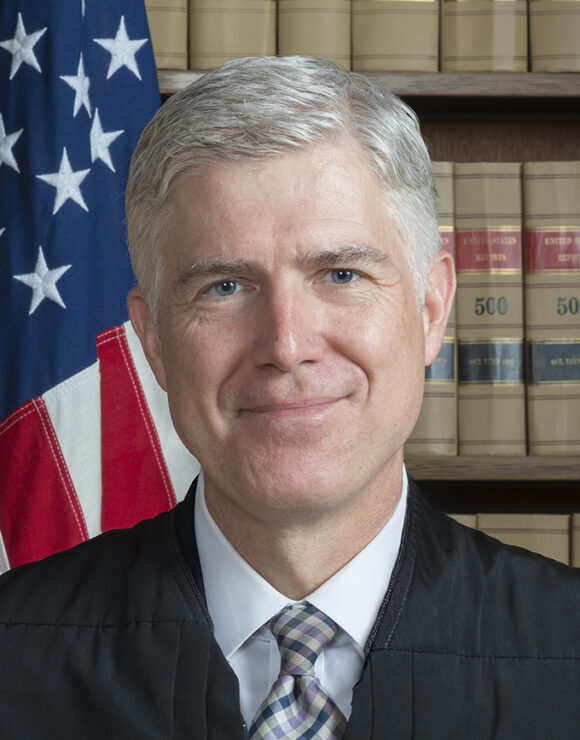
Associate Justice Neil M. Gorsuch; photograph by Franz Jantzen, 2017.
But Wickard and the legislative history behind the FAA do not provide the most relevant context. Rather, Justice Gorsuch looks at three recent cases in which the Court has held that: (1) independent contractors can also qualify for the exemption (New Prime Inc. v. Oliveira); (2) airline workers who load and unload cargo can qualify as transportation workers (Southwest Airlines Co. v. Saxon); and (3) that workers can qualify for the § 1 exemption so long as their work “play[s] a direct and necessary role in the free flow of goods across borders” (Bissonnette v. LePage Bakeries Park St., LLC). It seems like we already have our answer. Under the language of Bissonnette, it seems pretty clear that Mr. Brock is a worker engaged in interstate commerce.
However, we live in the age of textualism, and so Justice Gorsuch consults dictionaries to pinpoint the meaning of “commerce” and Black’s Law Dictionary for the meaning of “interstate commerce.” No surprises there. Interstate commerce still seems to mean today what it meant to Chief Justice Marshall. Justice Gorsuch provides some examples from caselaw, ranging from 1871 (The Daniel Ball) to 1906 (Rearick v. Pennsylvania) with a couple cases in between, to show that Chief Justice Marshall’s view of commerce was no passing fad or idiosyncrasy.
Flowers has a textualist response. Those cases are about the meaning of “interstate commerce” as a constitutional matter. Here, we are interpreting the FAA, which applies to “transportation workers” “engaged in interstate commerce.” Justice Gorsuch does not engage this argument with his usual enthusiasm for textual nuance. Instead, we get hand-waving. “We can hardly blind ourselves to what this Court’s cases said, both before and around the time of the FAA’s adoption, about what it means to be ‘engaged in commerce between the States.’” It’s not that I think Justice Gorsuch’s response is wrong; it’s just not as rigorous an exercise of textualism as I would expect from him. No matter. I would have arrived at the same conclusion through the purposive approach to the aims of FAA § 1 summarized above.
Flowers has a second argument, which I actually find tougher. Perhaps this isn’t an employment agreement at all. It’s a distribution agreement and so perhaps the kind of commercial agreement between “men of business” that was properly subject to the FAA. For whatever reason, Flowers did not really pursue that argument, and Justice Gorsuch won’t do the work for a litigant that “ventures all upon one cast.”
I suppose we may be back at the Supreme Court again arising from similar circumstances. At one point in the opinion, the Court refers to Mr. Brock as a franchisee. I don’t think of a franchisee as being a worker, but perhaps that needs to be a fact-specific determination. At other points, the Court refers to him as a distributor. In UCC contexts, some jurisdictions treat distribution agreements as contracts for the sale of goods, even when they are primarily service contracts. It seems like there’s a lot to untangle here, and on my reading of § 1, outcomes ought to turn on whether these agreements are substantively employment agreements or agreements among “men of business” who can be expected to resolve their disputes in arbitral bodies.