
Bad Judicial Writing
Another Plea for Judicial Sentencing Reform
Sidney W. DeLong
I had this nagging memory that somewhere in my contracts materials I encountered what I thought must have been the worst sentence ever to issue from a judge’s pen. By serendipity, thumbing aimlessly through Summers and Hillman’s casebook, I rediscovered it, lurking in Bloomgarden v Coyer, 479 F.2d 201 (D.C. Cir. 1973) a case involving a restitutionary claim for a broker’s commission. In the short space of three sentences, the author managed to violate virtually all of the principles of clear writing.
The court wrote the passage under review while evaluating the defense that, although the broker/plaintiff did introduce the buyer and seller, neither of them had agreed to pay the broker a finder’s fee for doing so.
I think that the judge meant to write, “People sometimes do beneficial things for other people without either party expecting there to be payment.” Perhaps wishing to dress up that everyday observation, what he wrote instead was:
Activities beneficial to a party frequently proceed on behalf of another. Often they are engaged in without thought of remuneration. An agreement to pay for services defies implication where the recipient not unreasonably fails to realize that the services were rendered for him in contemplation of quid pro quo for value conferred.
I hope that passage made you cringe, although I fear that exposure to awful judicial prose may have benumbed you to its awfulness. But even as you sense that something is wrong with it, you may not be able to say exactly why it made you cringe. That is the problem I had back in 1985 when I began teaching Legal Writing. I knew that what students were writing was awful but I could not diagnose what mistakes they were making and most of my early advice to the weak writers among them was worse than useless. For enlightenment, I needed the insights of my colleagues and of Joe Williams, a Chicago professor of Language and Literature at the University of Chicago.
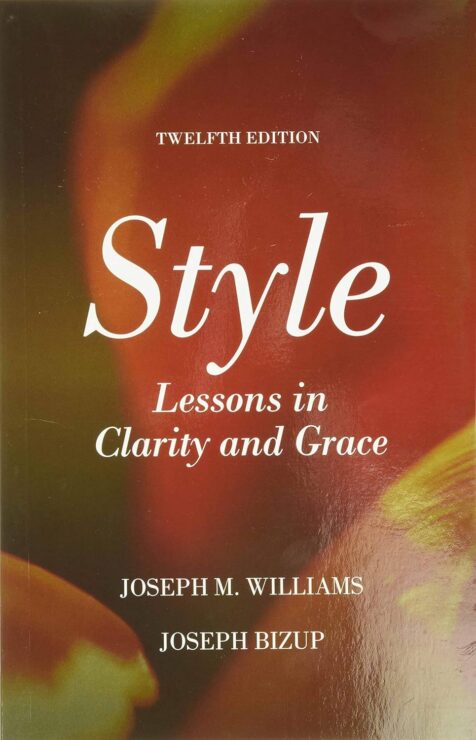
Williams set out the principles of clear writing in his classic Style: Lessons in Clarity and Grace. (The reader who is unfamiliar with that text should stop reading right now and acquire a copy, because reading it will be far more valuable to you than reading the rest of this).
Williams’ first principle of clarity in writing is “State who’s doing what in the subject of your sentence, and state what that ‘who’ is doing in your verb.” The reason for this rule is based on reader expectations. Your reader will expect your sentence to be about the agent that you name in the subject slot of your sentence and will expect the verb to describe the action that you want to tell him about. You should not disappoint these expectations by concealing the real subject of your sentence in a prepositional phrase or a subordinate clause or, even worse, not naming it at all. Clear writing requires that this rule be followed unless good reasons require the use of the passive voice, as e.g. when neither you nor your reader care about the identity of the agent.
The passage quoted from Bloomgarden is cringeworthy for its blatant violation of these principles and its frustration of reader expectations. Let’s do what literary critics might call a “close reading” with a hypothetical reader’s response in italics.
“Activities beneficial to a party [okay so far: this is going to be a sentence about beneficial activities, although I haven’t any idea of what “to a party” refers to.
Frequently proceed: Activities proceed. Rather an odd thing to say. Is this going to be something about activities proceeding?
On behalf of another: What?? The activities are proceeding on behalf of another? Another than who? I guess other than the party to whom they are beneficial. But what could it possibly mean that activities “proceed” “on behalf” of someone? Do all activities proceed on behalf of the actor? Are some activities proceeding in order to benefit people other than the actors, i.e., “on behalf” of third-party beneficiaries? But aren’t we talking about an activity (commercial match-making) that is proceeding on behalf of the party to whom it is beneficial rather than on behalf of “another”?
If we ask, with Joe Williams, what or who is the true subject of this first sentence, we realize that it is people like Bloomgarden, the plaintiff in the case. What is the action that these actors are said to perform? Brokerage, match-making, introducing strangers and suggesting a deal. But instead of being about people doing things, the sentence purports to be about disembodied, free-floating “activities” that are simply “proceeding”.
The second sentence abolishes its subject altogether in an exemplary illustration of the pointless passive voice. “Often they are engaged in without thought of remuneration. Who is doing what in this sentence? It seems to be about activities being engaged in without thought of compensation instead of people doing things without thought of compensation. The actors have left the stage and only the actions remain, like the grin on the Cheshire cat.
The reader is told that there are activities out there and they are all being engaged in. Okay, but what is the sentence about? “People often do beneficial things for others without expecting to be paid for them.” Or “It is common in the business world for a person to act in ways that benefit another person without either party expecting payment for the benefits.” The passage prompts what must be the most common question in a student writing conference: “If that’s what you meant, why didn’t you just say it?” It’s sad when it has to be asked of a judge rather than a student. But I can say from personal experience that exposure to Williams’ insights can be humbling.
Back to the Bloomgarden quotation, we encounter the payoff, the reason the court has been telling us about activities proceeding:
An agreement to pay for services defies implication where the recipient not unreasonably fails to realize that the services were rendered for him in contemplation of quid pro quo for value conferred.
“An agreement to pay for services defies implication” Who is the actor in this sentence, its subject? “An agreement.” What is it doing?: It is defying? What is it defying? Implication.. Another sentence whose subject is AWOL. Which is ironic because the real subject of this sentence will turn out to be the judge himself.
Get me rewrite! Instead of “defies implication” how about “Cannot be inferred”? Clearer, but changing “defies” to “cannot be inferred” changes an active to a passive voice, exposing the real agent of the sentence. Take agency, Judge! Why not write “This court will not infer an agreement to pay for services” or even, (gasp!) “I will not infer. . . “ See how easy and natural it is?
“. . . where the recipient not unreasonably fails to realize that the services were rendered for him in contemplation of quid pro quo for value conferred.”
As if to demonstrate the full range of obscurantist technique, the writer resorts to a series of embedded negatives (not unreasonably fails) that would challenge an algebra student to parse. I think three negatives in a row end up as a negative because the “not unreasonably” is roughly equivalent to “reasonably” but that sin pales in comparison to the legal errors hiding in these words. Lest the reader surmount these formidable barriers, just for extra security against understanding, the writer throws a bit of law Latin in his path and misdirects his gaze by citing two factors that are not technically relevant to the restitution claim (the recipient’s actual realization and the “contemplation” of the broker).
These sentences are like the script of a modernist play in which all the actors are offstage and the audience must strain to hear them mumbling behind the curtain. Its vagueness is excused only because it also misstates the law, and so would do more harm if it were clearer.
Why do judges write like this? Are they trying to state timeless truths not tied to the specific circumstances of the case before them? That surely is part of it. Sadly, however, they write like this because they were never taught how to write clearly. Better writing teachers would produce better judges. Williams’ lessons, once learned, tend to last a lifetime.
And unclear judicial writing is a growing threat. In a time of waning student literacy, law students are even now able to understand only the clearest legal prose. Almost none of them would understand the Bloomgarden quotation. Judges should take note.