
Texas Tech’s $5 Million Quarterback Reportedly Has a Gambling Addiction
We posted about this transaction before here. Here’s the short version:
Texas Tech is paying up to $5 million to Brendan Sorsby (below), who played last season for the University of Cincinnati and was committed to playing for them again in 2026. The University of Cincinnati is not taking the news lying down; it is suing to enforce a $1 million liquidated damages provision in its revenue-sharing agreement with Mr. Sorsby. . . .
[T]he enforcement guidelines of the College Sports Commission, which oversees revenue sharing, requires that Texas Tech account for the $1 million buyout that Mr. Sorsby is obligated to pay Cincinnati. I’m not sure what that means. Does the $1 million automatically count against Texas Tech’s $20.5 million revenue-sharing cap whether Texas Tech covers for Mr. Sorsby or not? I am already gobsmacked that a university would blow nearly 1/5 of its revenue-sharing budget on one player, but if Texas Tech pays an additional $1 million for Mr. Sorsby’s buyout, it is spending nearly 1/4 of its revenue-sharing budget on one guy.
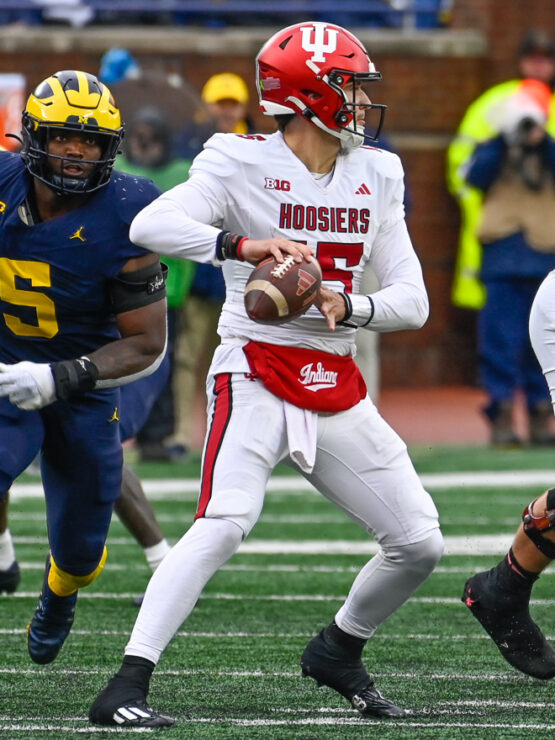
Now there is news from Pete Thamel, writing for ESPN, that Mr. Sorsby has checked into a residential treatment program for a gambling addiction. ESPN’s reporting toggles unnervingly between a discussion of NCAA rules, Mr. Sorsby’s contracts with Texas Tech and his former team, and accounts of Mr. Sorsby’s stats as a player. The story of a young man confronting an addiction deserves to be a story of its own or at least presented without all the toggling. The fault likely lies more with ESPN’s editors than with Mr. Thamel’s reporting. They are trying to reach an audience whose interest in Mr. Sorsby’s difficulties is directly tied to his stat line, but the editors could have used this as an opportunity to suggest that maybe there are more important things in life than college football.
Mr. Sorsby was allegedly using a gambling app to place thousands of bets on sporting events. Such conduct violates an NCAA policy that prohibits players from gambling on college or professional sports. Wait, the NCAA still has policies and the clout to enforce them?!? Texas Tech reportedly supports Mr. Sorsby and his efforts to get treatment for his condition.
There are allegations that Mr. Sorsby bet on an Indiana football game while he was a member of the team in 2022. The NCAA guidelines provide that a student who gambles on their own team can face a permanent loss of eligibility.
What lessons might we draw from one person’s struggles with a gambling addiction enabled by a culture suffused with temptation and apps designed to exploit human proclivities for profits? Is the NCAA up to policing this problem, or do we need a more ambitious response? It’s nice that the team is supporting its player, but is there anything more that they can do? Maybe, just maybe, it’s not great for people to have unlimited access to gambling. And maybe, just maybe, government agencies should regulate gambling on political events.
I wish that I had come across this news in The Onion, but no, Lauren McGaughy, Campbell Robertson, and Corina Knoll report in The New York Times that Kalshi discovered that three candidates for political office who tried to enter prediction markets relating to their own races. Kalshi imposed small fines on two of the offenders and a larger one on the third, who refused to cooperate with Kalshi’s investigation. At least two of them had their trading privileges with Kalshi suspended. Gosh. Perhaps there should be other repercussions for these guys, one of whom is currently a state senator.
Meanwhile, based on reporting from Hallie Golden, Konstantin Toropin, Hannah Schoenbaum, and The Associated Press, which appeared in Fortune, it appears that both the U.S. Department of Justice and the Commodity Futures Trading Commission (CFTC) are bringing charges against a U.S. special forces soldier who made $400,000 on Polymarket because of remarkably well-time predictions about the ouster of Nicolas Maduro from Venezuela, in which the soldier played a role.
We now have strong evidence that prediction markets are bad for individuals — feeding unhealthy addictions. They are also unhealthy markets, prone to manipulation. Yahoo reports that a staggeringly high percentage of the profits (67%) on prediction markets go to a tiny faction of the accounts (0.1%). Most participants lose money. The numbers are a strong indicator of insider trading or manipulation. And now we also know that they can pose a threat to national security, as our enemies can follow prediction markets if they want advance warning of our military plans. They don’t even have to check Signal chats anymore!