
New Arguments on the Illegality of University Deals with the Federal Government
Heidi Kitrosser and Paul Gowder (the Authors) have posted their arguments for the illegality of Northwestern University’s (the University) proposed agreement (Agreement) with the federal government. The Authors lay out multiple reasons why there is no legal basis for the government to withhold funds from the University.
We wrote earlier about Dave Hoffman’s exploration, on his Substack Contracts’ Empire, of whether universities could challenge the enforceability of their settlement agreements with the government based on a duress defense. Professor Hoffman reached no firm conclusion on whether such a challenge could succeed. The Authors are far more confident. Writing of their own University’s settlement to free up $790 million in frozen research funds, the Authors proclaim: “The Agreement itself is the product of federal government coercion.”

Heidi Kitrosser, Northwestern Pritzker School of Law Professor of Law
(Photo credit: Randy Belice for Northwestern University)
First, while the government has not been explicit about its grounds for withholding funds, it can be surmised that the government views its action as a penalty imposed on the University for its failure to comply with civil rights laws — specifically its failure to address problems with anti-Semitism on campus. However the Authors note, the remedy provided for under Civil Rights law is not the withholding of funding but notice to the University and allowance for the University to remedy its non-compliance. The remedy that the government has chosen, which conditions the return of funding on compliance with restrictions on expression, violates the First Amendment.
The coercive nature of the government’s conduct is clear in this instance, say the Authors, because the Settlement was not predicated on conduct associated with specific funding mechanisms. The University had to agree to a global limitation on expression in order to free up funds unrelated to that expression. The government’s vague, overbroad demands, combined with stringent monitoring and reporting requirements, are designed to chill speech unconstitutionally.
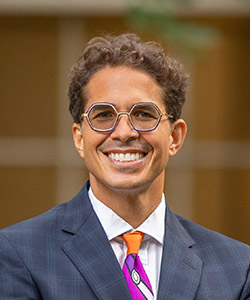
Paul A. Gowder, Northwestern Pritzker School of Law Professor of Law
(Photo credit: Randy Belice for Northwestern University)
The Authors also claim that the Agreement violates anti-discrimination law. The Agreement seeks to control the University’s admissions practices in ways that go beyond what the Supreme Court required in Students for Fair Admissions v. Harvard. The executive branch lacks the authority to impose its interpretation of Title VI or Title IX on private institutions.
The Authors conclude by pointing out that they have pointed out a few litigation strategies that parties affiliated with the University might pursue in seeking to challenge the Agreement. They have limited themselves to identifying some key legal bases for such challenges, but there are others.