
Trade Usage vs. Express Terms in Lawsuit Against Hardware Stores
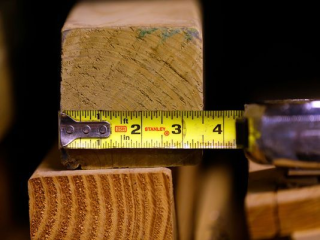
At least one litigant would disagree with my characterization of the lumber example as being obvious. This story in the Des Moines Register describes a lawsuit in which hardware chains Home Depot and Menards are accused of deceiving buyers by selling “four-by-four” lumber that is not four inches by four inches in dimension:
Rather, the retailers say, those are “nominal” designations accepted in government-approved industry standards, which also specify actual minimum dimensions — 1½ inches by 3½ inches for a two-by-four, for example, and 3½ inches by 3½ inches for a four-by-four.
“Anybody who’s in the trades or construction knows that,” said Tim Stich, a carpentry instructor at Milwaukee Area Technical College.
True enough, said Yevgeniy (Eugene) Turin of McGuire Law, the firm that represents the plaintiffs in both cases.
However, Turin and his clients dispute that the differences between nominal descriptions and actual dimensions are common knowledge.
“It’s difficult to say that for a reasonable consumer, when they walk into a store and they see a label that says four-by-four, that that’s simply — quote unquote — a trade name,” Turin said in an interview.
Turin said his clients don’t argue that the retailers’ four-by-fours (and, in the Menards’ case, a one-by-six board as well) are not the correct size under the standards published by the U.S. Department of Commerce. The product labels, however, should disclose that those are “nominal” designations and not actual sizes, Turin said.
With some of Menards’ lumber products, both the nominal and actual size are shown, a document Turin filed in the case against Menards says. But the lumber in question is labeled only with a nominal size — “4 x 4 — 10’,” for example — that consists of numbers “arranged in a way to represent the dimensions of the products,” the document says. That leaves the “average consumer” to conclude that the pieces measure four inches by four inches, Turin said.
Some Menards customers aren’t buying it.
“They haven’t measured four inches by four inches since the ‘50s,” said Scott Sunila after loading purchases into his pickup.
“My God, that’s crazy,” the 60-year-old bulldozer operator said of the lawsuits. “Let me on the jury. They ain’t winning. And they’re gonna pay me extra for my time.”
But an unscientific survey of 18 Menards shoppers found that about a third were unaware that “four-by-four” doesn’t represent actual dimensions of that piece of lumber.
The problem with defining terms by usage of trade is that the term usage must have “such regularity of observance in a place, vocation, or trade as to justify an expectation that it will be observed with respect to the transaction in question.” UCC § 1-303(c). The existence of the trade usage is not a question of law, but a question of fact when (as here) it is not embodied in a trade code, such codes rarely being applicable to or ratified by consumers. If a party cannot establish the existence of trade usage terminology, then express terms will typically prevail over trade usage. UCC § 1-303(e).
My initial take was that this lawsuit was a clear loser, but the fact that the burden of proof lies with the hardware stores suggests that the plaintiffs at least have a chance. Now, would I take this case on a contingent fee basis? Er… no.