
Six degrees of separation: The case of Feinberg v. Pfeiffer Co.
From the forthcoming issue of the AALS Contracts Newsletter, the curious connections between the well-known promissory estoppel case of Feinberg v. Pfeiffer Co., Ernest Hemingway, the Warner-Lambert Pharmaceutical Company, Frank Lloyd Wright, Marisa Berenson, and The Metropolitan Museum of Art . . . .
Mrs. Feinberg’s Pension, Ernest Hemingway, Warner-Lambert, Frank Lloyd Wright, Marisa Berenson, and the Metropolitan Museum of Art
by Frank Snyder
Texas Wesleyan University School of Law
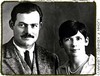 For most Contracts teachers, the Pfeiffer Company is best known as the outfit that refused to pay the pension it promised to its bookkeeper in Feinberg v. Pfeiffer Co. But the Pfeiffer clan is known for many other things.
The story of the Pfeiffer Company begins when Paul, Henry, and Gustavus Pfeiffer and their families (including Paul’s six-year-old daughter Pauline) move from Parkersburg, Iowa, to St. Louis in 1901. They start a fledgling pharmaceutical company that is immediately successful. In 1908 they buy a little Philadelphia company called William Warner & Co., and their local business goes national. The Pfeiffer company will in the course of time make other acquisitions (including a company called Lambert that makes “Listerine”), and will later become the mighty Warner-Lambert Pharmaceutical Company.
 Wealth comes to the Pfeiffers. In 1918, the same year young Pauline Pfeiffer graduates from a select Catholic high school in St. Louis, her father Paul buys a home (left) on 63,000 acres of land in Piggott, Arkansas.
Already a very wealthy young woman through the creation of family trusts, Pauline majors in journalism at the University of Missouri, and goes on to become a successful reporter for the Cleveland Press, the New York Herald, and Vanity Fair. She ultimately becomes a fashion editor for Vogue in Paris. Intelligent, wealthy, fashionable, and accomplished, dark-haired and grave, a devout Catholic, she has a great many suitors—and naturally falls for the least suitable, a struggling and already married writer named Ernest Hemingway.
Pauline becomes a close friend of Hemingway and his then-wife Hadley. Ernest, never a model of domestic virtue, manages to divorce Hadley, and Pauline marries him in 1927, seven months after his first big success, The Sun Also Rises—ironically dedicated to Hadley. Ernest goes on to write much of A Farewell to Arms in Piggott, Arkansas.
The couple have two children, Patrick and Gregory. Pauline, desperate to keep the philandering Hemingway with her, often leaves the children at their home in Key West to follow Papa to Europe, Africa, Cuba, and Wyoming. But it doesn’t work. Ernest gets a divorce in 1940, a month after For Whom the Bell Tolls. Meanwhile the children will blame her, not their glamorous father, for their abandonment and will resent her all their lives.
 Pauline will die of a brain hemorrhage and be buried in an unmarked grave in Hollywood, California. In the 1988 film Hemingway, she will be played by Marisa Berenson (left).
Today, the Hemingway-Pfeiffer Museum and Educational Center is operated in the old Pfeiffer home by Arkansas State University.
Meanwhile, uncle Gus Pfeiffer has moved to New York. He enjoys occasional marlin fishing with Hemingway, but he is an astute businessman and the company prospers. He and his wife will become notable philanthropists. The Gustavus and Louise Pfeiffer Research Foundation will support numerous medical and educational projects, including endowment of a major chair in medicine at Stanford and in pharmacology at Texas, and will still make substantial medical research grants today.
Gus’s hobby, besides fishing, will come to be chess. He will become the foremost collector of chess sets in the world. His collection is now the property of the Metropolitan Museum of Art.
Uncle Henry Pfeiffer, childless, will also engage in substantial philanthropy. He and his wife Annie will make major gifts to a little Methodist school in Misenheimer, North Carolina, called Mitchell Junior College. The college will be renamed in their honor and will later become Pfeiffer University. They will also endow many other colleges, including (among other things) a library and a chapel at MacMurray College, a science building at Bennett College, and two dormitories at Cornell College.
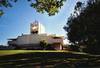 They will also be responsible for what may be the most hideous college chapel in America, a disappointing Frank Lloyd Wright effort (left) at Florida Southern College named for Annie.
The Pfeiffer company will cease to exist in 2000, when Warner-Lambert is acquired by Pfizer.