
Today in history—January 10
1863: The North Metropolitan Railway Co. opens the world’s first subway, the London Underground, to fare-paying passengers.
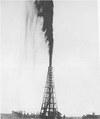 1901: The Gladys City Oil, Gas, & Mfg. Co. hits oil at Spindletop, near Beaumont, Texas. “The startled roughnecks fled as six tons of four-inch drilling pipe came shooting up out of the ground. After several minutes of quiet, mud, then gas, then oil spurted out. The Lucas geyser [left], found at a depth of 1,139 feet, blew a stream of oil over 100 feet high until it was capped nine days later and flowed an estimated 100,000 barrels a day.” Over the next few years Spindletop will give birth to Texaco, Gulf Oil, Sun Oil, and Humble (now Exxon).
1910: Norman Heatley is born at Woodbridge, Suffolk. Although it is Alexander Fleming who will discover penicillin, it is Heatley who will discover how to produce it in mass quantities so that it can be used as an antibiotic.
1919: The man who developed the science of acoustics by his experiments in the Fogg Lecture Room at Harvard—itself a candidate for the Trojan Doctrine—dies at Cambridge, Massachusetts. His masterpiece is Symphony Hall, Boston.
1937: The first issue of the news magazine Look hits the stands—and sells 700,000 copies.
1944: General Electric delivers the first fully-portable electric power plant to the United States Navy. The plant, which can generate 10,000 watts of power, fits on six specially designed rail cars and can be set up almost anywhere in 24 hours.
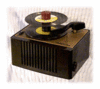 1949: RCA records launches the 7″ 45-rpm record. Together with the 33-1/3 LP introduced the year before, it will wipe out the old 78-rpm records. The 45 is superior to the 78 because its center is thicker than its edges, allowing stacks of records to be played without the grooves rubbing against each other.
1960: Marty Robbins’ El Paso (at 5 minutes, 19 seconds) becomes the longest song to that time ever to reach number 1 on the charts. It’s popular in part because disk jockeys appreciate the fact that five minutes allows for a toilet break.
1969: After 147 years of publishing, the Saturday Evening Post folds its tent.
1972: Billionaire Howard Hughes puts the brakes on one of the most audacious commercial frauds of all time, breaking his silence to tell reporters by telephone that his purported autobiography was a fake. Clifford Irving and his wife had received a $750,000 advance from McGraw-Hill for the book.
1978: Singer Johnny Paycheck hits the top of the charts with Take This Job and Shove It.
1990: Warner Communications buys Time, Inc. To avoid angry shareholders, the deal is structured as a takeover of Warner by Time for $14.1 billion.
2000: Speaking of Time, at the apex of the NASDAQ frenzy, AOL announces one of the best deals of all time, its purchase of Time-Warner for a really, really big pile of worthless paper.