
Thaumatropes and good faith
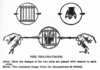 It’s an article about corporate law, not contracts law, but Sean Griffith’s new article The Good Faith Thaumatrope: A Model of Rhetoric in Corporate Law Jurisprudence is interesting if only because the idea of the thaumatrope (left): a spinning disk that has on its opposite faces two different objects, or halves of the same object (such as a bird on one side and a cage on the other) which when spun creates the illusion that they are combined in a single picture (the bird is in the cage). It’s a great metaphor for law.
For those who are interested in the contract doctrine of “good faith,” his exploration of how the similar concept has been applied in corporate law is also worth checking out. Click on the link for the abstract.
ABSTRACT:
This paper develops a model of rhetoric in corporate law jurisprudence. It begins by examining a recent innovation in Delaware case-law: the emerging principle of good faith. Good faith is an old notion in law generally, but it offers to bring significant change to corporate law, including realignment of the business judgment rule and a shift in the traditional balance between board authority and judicial accountability.
Tracing the development of this new doctrine, the paper argues that good faith operates like a thaumatrope, oscillating between the traditional standards of care and loyalty, lowering the doctrinal hurdles of each without adding any distinct substantive content to the law. In this way, good faith functions as a rhetorical device rather than a substantive standard. That is, it operates as a speech-act, a performance, as opposed to a structured mode of analysis. Building upon political science theories and the recent work of Professor Roe and others in modeling Delaware law as a function of the twin threats of corporate migration and federal preemption, the paper argues that the judiciary employs such rhetorical devices to mitigate threats to its authority. This, then, is the rhetorical structure of corporate law. In periods of crisis and scandal, the judiciary employs rhetorical devices to reduce the pressure, typically with the effect of increasing board accountability, only to return, once the pressure recedes, to a position of board deference. The paper finds several examples of this rhetorical structure in corporate law history and argues, ultimately, that the good faith thaumatrope is merely the latest such device and is likely to follow a similar evolutionary path.