
Today in history—January 25
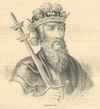 1327: Fourteen-year-old Edward III (left) becomes King of England when his mother Isabella and her lover Roger Mortimer depose and then murder his father, Edward II. Three years later the young king will have Mortimer hanged without trial at Tyburn and his mother banished to a convent.
1755: The Tsarina Elizabeth founds Moscow State University, the oldest university in Russia.
1791: The British Parliament splits the old province of Quebec into Upper (Western) and Lower (Eastern) Canada. Upper Canada, which at this time has only 10,000 residents, mostly refugees from the U.S., will come to be known as Ontario.
1812: English mathematician William Shanks is born. He will spend a good part of his life calculating pi—eventually reaching 707 decimal places by 1873. In 1944, it will be found that he made an error in the 528th decimal place.
1839: At a meeting of the Friday Evening Discourse at the Royal Institution in London, Michael Faraday announces the discover of photography.
1858: A tradition is born when Britain’s Princess Victoria selects the “Bridal Chorus” from Richard Wagner’s Lohengrin (a/k/a “Here Comes the Bride”) to be played at her wedding to Frederick, Crown Prince of Prussia.
1881: Alexander Graham Bell and Thomas Edison form the Oriental Telephone Co., Ltd., to sell telephones in Greece, Turkey, South Africa, India, Japan, China, and other Asian countries.
1890: The United Mine Workers of America is formed at Columbus, Ohio, by a merger of the Knights of Labor Trade Assembly No. 135 and the National Progressive Union of Miners and Mine Laborers.
1890: Working for Joseph Pulitzer’s New York World, reporter Nellie Bly (born Elizabeth Jane Cochran) finishes her highly publicized around-the-world trip in 72 days, 6 hours, 11 minutes, 14 seconds, breaking Phineas Fogg’s record.
1915: Speaking of Alexander Graham Bell, in a ceremony held by AT&T, the inventor, in New York, makes the first transcontinental telephone call to his old assistant Thomas Watson, in San Francisco. Bell repeats the words he said in the first-ever call—”Watson, come here, I need you.” Watson quips, “This time it will take me a week or so.”
1921: The New York Court of Appeals announces the modern doctrine of substantial performance in Jacob & Youngs v. Kent.
1937: Proctor & Gamble’s The Guiding Light begins its stint as the longest-running drama of all time when it debuts on NBC Radio. It will reach television in 1952.
1945: Grand Rapids, Michigan, becomes the first U.S. city to add fluoride to its drinking water.
 1949: The Academy of Television Arts & Sciences awards its first Emmy awards. Top television program is Mike Sotkey’s Pantomime Quiz Time. Top TV personality is Shirley Dinsdale’s puppet, Judy Splinters (left).
1963: Sir Isaac Shoenberg, who as head of the research group at Electronic & Musical Industries (EMI) will develop the first high-definition television for the BBC in 1936, dies at age 73.
1985: Heisman Trophy winner Doug Flutie of Boston College signs a $7 million contract with the New Jersey Generals of the upstart United States Football League. It makes him the highest-paid football player, but the league later folds.