
Boilerplate Symposium II: Theresa Amato on Remedies to the Problems Posed by Boilerplate

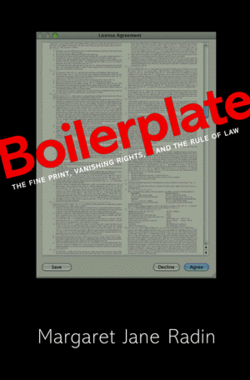
This is the second in a series of posts reviewing Margaret Jane Radin’s Boilerplate: The Fine Print, Vanishing Rights and the Rule of Law.
Theresa Amato, a public interest lawyer, is the executive director of Citizen Works, and the director of the Fair Contracts Project (faircontracts.org).
ProfessorRadin’s masterpiece Boilerplate setsforth the intellectual underpinnings for an energetic movement to correct theimbalance of power between corporations and consumers in fine print contracts. Her explanations of the degradation of consentand the resulting diminishment of the rule of law should incite all those whoread it to not merely nod in accord, but to take action.
Radincalls for a new legal way to analyze the boilerplate that she painstakinglyshows fails to merit the term “contract” —and therefore should not be evaluatedunder contract law. Instead, shesuggests we evaluate these mice-print monstrosities as a product itself thatcan cause harm. The boilerplate shouldbe considered a potential inflictor of consumer harm through massive “rightsdeletion,” or “rights strip mining,” as Ralph Nader says, and thus should beaddressed in tort, or under a new legal rubric altogether. This bold suggestion alone elevates the bookto compulsory reading as most academic articles tend only to set forthdescriptions and analyses of the epic failure of the disclosure regulatoryparadigm, but then fall short on solutions and action.
Inboth academia and consumer advocacy, far too few people are focused on solvingthe problem—to create remedies beyond studying the problem or treating its symptomsin a legal aid, case-by-case manner. Thoughthere may be disagreement on the exact contours or how to solve the problems ofboilerplate, there does seem to be some movement in recognition, at least, thatthere is a problem in need of solution.
A surveyof the academia and advocacy landscape reveals:
- Thefine print qua fine print has grown longer and mutates more frequently, as NYU Schoolof Law Professor Florencia Marotta-Wurgler has documented, for example, withon-line contracts;
- Businessesare not self-policing on boilerplate, or making market corrections for theconsumer’s benefit. To the contrary,recent Supreme Court decisions have spurred rights-reducing action, by sanctioning,for example, mandatory arbitration and class action waivers;
- Consumerabuses in fine print will not be solved with financial literacy courses and byblaming consumers for not reading unilaterally-imposed contracts, which they cannotunderstand if they do, and then don’t necessarily use to make decisions, asLoyola Law School Los Angeles Professor Lauren Willis and others have ably documented;
- Despitedecades of computer use, inadequate corporate transparency regulation meansthat in many industries terms of service are still not online; it is oftendifficult to obtain copies of the contracts—until after becoming a customer forthe underlying product or service. Thishas the additional potential to skew academic research to on line industries,and not necessarily where some of the gravest rights-reducing behavior mayexist, e.g., in harder-to-obtain nursing home or employment contracts.
- The judiciaryapplies antiquated tenets of contract law—in a legal fiction—that upholds abusiveprovisions in a case-by-case unconscionability analysis, primarily enforcingthem by continuing to place the outdated “duty to read” on consumers, includingthose who patently cannot. Consumersface a curtailed potential for redress, especially when coupled withdisappearing class action potential.
- Federaland state agencies to date have not allocated significant resources for a muchneeded focus on the corporate fine print—not even at the bully pulpit level—norhave they posited suitable alternatives.
- Insteadof Congress doling out more regulatory authority to agencies (as they did withthe CFPB and the SEC and as they should to help fix this), for example, memberscontinue to contest the CFPB, have failed to grant the Federal Trade CommissionAdministrative Procedures Act rulemaking authority, leaving it hamstrung, andhave failed to hold hearings on the widespread abuses of boilerplate affectingtens of millions of Americans daily.
We at Fair Contracts believe that there should be greaterfocus on seeking a systemic, upstream solution to boilerplate. Thoughsome would hang their hats on piecemeal “improved disclosure” as a leastinvasive means of correction, such a course of action alone is tepid and whollyinadequate to the serious problems documented by Radin and others.
Nor must we onlywait for the next glacial restatement of contract law, or a revolution ofcontract theory that reverses the legal presumption of enforcement of harmfulcontract terms, or a different way to analyze the legality of fine printcontracts, including treating them as torts as all of these are definitelylong, long, long-run solutions.
Intermediary, if admittedly only partial, remedial stepsexist that we should explore for innovationthat could lead to a better future for consumers, including:
- Dramatic elevation of public awareness of the rightsremoval hazards contained within the fine print, with a multi-pronged educationand media campaign;
- Significant increases in data collection ofcontracts and scholarship across multiple industries, with more empiricalresearch to ascertain the prevalence of harmful consumer provisions, theircollusive origins, and their negative economic consequences, with examples ofhow consumer harm is caused to large categories of people who forfeit theirrights without knowledge of doing so;
- Promulgation of a model set of principles forprovisions within, and reform of, the fine print;
- Outright legislative and regulatory bans (orworkarounds – through ombudsman consumer review boards) on contract provisionsthat undermine the rule of law, fair competition and democracy, including thedeprivation of consumers of the civil justice system and their First Amendmentrights, vendor assertions of noaccountability (thus allowing contract law to eat tort law alive) and consumerdisadvantageous unilateral modification powers;
- Development of model state and federallegislation to ensure a fair regulatory playing-field;
- Development of a “fair trade” or “hypoallergenic”or “green-star energy-efficient”-type seal that does not necessarily signal a“fair contract” but does signal the absence of a known set of provisions thatreduce consumer rights for those consumers who care about them, which should bemost if the educational goals were attained, and thus obviate the need to readthrough the fine print for at least that standardized set of terms symbolizedby the seal. This would permit consumersan actual market within which to shop, should government fail to act topreserve their rights; and
- Studying the consequences from other countrieswhich are ahead in consumer protection. There is a reason that the EU black and grey lists terms, as doesAustralia: They are unfair to consumersand their governments do not let corporations dictate all the terms, rewritingand undermining in a private ordering those public policies passed aslegislation. In early April 2013, The ConsumerCouncil of Hong Kong urged businesses to produce short and simple contractsthat eliminate unfair terms and is starting to provide model contracts. See: http://www.consumer.org.hk/website/ws_en/competition_issues/policy_position/2012040301.print
We should be debating thesematters in the United States. We needan organized consumer constituency to reverse the contract peonage so reformefforts may gain the momentum needed to create alternatives to the unilateral,corporate-dictated status quo.
[Posted, on Theresa Amato’s behalf, by JT]