
Boilerplate Symposium V: Ethan Leib on the Fetishization of Consent
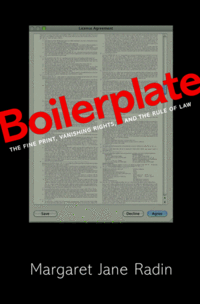
This is the fifth in a series of posts reviewing Margaret Jane Radin’s Boilerplate: The Fine Print, Vanishing Rights and the Rule of Law.

People tend to begin withpraise. In this case, it isn’t justthroat-clearing. Although one could beforgiven for thinking that the subject of consumer form contracts has beenmined to death, much impresses in Peggy Radin’s Boilerplate. Although Idon’t agree with all of them, here are just a few of the book’s productiveinterventions:
- Radininvites us to consider whether tort law rather than contract law would makebetter sense of the consumer form contract gone wrong in which someone isharmed, “out of the blue, by the unexpected actions of another” (23);
- Radininvites us to think about how complicity with certain types of boilerplate thatdivests important procedural and substantive rights has had the systematiceffect of converting property rules to liability rules, unilaterally priced byform drafters (75);
- Radinquestions whether we should be allowing contract to undermine the value of“fair use” of intellectual property or the value of free expression, since someseemingly enforceable boilerplate purports to limit consumers’ permission touse or criticize the products they buy (172-76);
- Radinreminds us that when consumers’ reasonable expectations are that they will beexploited by boilerplate, the judicial doctrine allowing enforcement of onlyconsumers’ “reasonable expectations” will prove inadequate in addressing theproblems with boilerplate (highlighting the ambiguity in the doctrine betweenpositive and normative expectations) (85);
- Radinprovokes us by characterizing consumer form contracts as “sturdyindefensibles:” we might need to use them even though they don’t fit the“‘grammar’ of the legal infrastructure of contract law” (143); and
- Radinargues that boilerplate should be judged based on the nature of the rightinvolved, the quality of consent provided by those bound, and the disseminationof the right that is purportedly infringed (155).
But I had one quite basic problemwith the book, which cuts to the very core of Radin’s approach.
Most importantly, she really triesto train the reader not to consider boilerplate instruments as actually contractual. Indeed, if hereditor had allowed it, she might very well have used scare quotes throughoutthe whole book (rather than just the beginning) to highlight that consumer formcontracts with boilerplate are not reallycontracts. The reason for theirexclusion from the world of contract: because of the routine absence of consent in transactions using boilerplate. It is the lack of consent (or the severely attenuatedconsent) in consumer form contracting which underwrites her claim that boilerplatecontributes to “normative [and] democratic degradation,” a central trope thatrecurs throughout the book.
Admittedly, it seems intuitive toroot contract in consent. The liberaltheory of autonomy to which many versions of contract theory owe their genesispromotes consent as a principal virtue. So it is no surprise that Radin seeks to maintain the liberal theory ofautonomy and contract with it.
But there is a whiff of fetishizing ofconsent in Radin’s rendering. Absenceand attenuation of consent is everywhere in the transactional world of contract:in employment, long-term corporate relationships, in franchises, in marriage. Contract is a multifarious enterprise thatultimately governs many modalities of exchange. Radin surely attempts to explore the fine line between the consensualand non-consensual. But excluding a hugeportion of voluntary exchange from the domain of contract seems unlikely to betrue to the rich practice that has, from time immemorial, been a method ofchanneling and regulating complex relationships in which transactionsoccur. I fear a “purer” contract – onewithout boilerplate and one which squeezes out all attenuated consent – will ultimatelyleave us with a more ideological product, one that undergirds, reinforces, andgrows out of a libertarian rather than a liberal theory of autonomy. And that may lead to more substantial normativedegradation than would fighting bad contracts with some contract law.
[Posted, on behalf of Ethan Leib, by JT]