
Daniel Barnhizer Reviews Ken Adams’ Manual of Style for Contract Drafting (3d ed.)

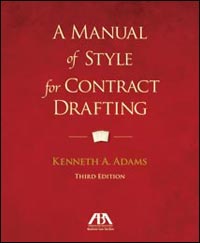
Kenneth Adams’ thirdedition to the Manual of Style for Contract Drafting[1] (“ContractDrafting”) delivers invaluable advice to any attorney or professionalwho drafts contracts or contract terms. The book is also highly suitable forlaw school classroom use in drafting classes, business school, or undergraduatebusiness courses. This book has found a permanent place on my shelf among mygo-to style manuals.
Introduction
ContractDrafting is a style manual that goeswell beyond explicating basic contract conventions, admonishing attorneys touse “plain English” and avoid “legalese,” and providing lists of awkward orambiguous words and phrases to excise from the drafting lexicon. Adams does allof these things effectively and efficiently, butContract Drafting delivers on many more levels.
Audience
Like previous editions,this book will be useful across a wide range of applications. As Adams notes inthe introduction:
This manual should be of use to readers in every contractecosystem—a solo or small-firm general practitioner handling a broad range ofcontracts . . ., a contract-management professional responsible for negotiatingcontracts with customers; a big-law associate drafting mergers-and-acquisitionscontracts; an in-house lawyer overhauling the company’s template salescontract; a paralegal reviewing confidentiality agreements a company is askedto sign; a judge trying to make sense of a confusing contract provision.[2]
In this list, Adams omitsanother important audience – law students. ContractDrafting is a nearly ideal tool for teaching a contract drafting course.As discussed below, the content of the manual goes beyond listing blackletterprinciples and providing tables of words and phrases to avoid. In this mostrecent edition of Contract Drafting, Adamscarefully walks the reader through detailed explanations of his draftingprinciples while at the same time presenting an extraordinarily complete manualthat teaches the inexperienced and informs the senior practitioner. Anyprofessional – lawyer or non-lawyer – or law student who deals with contractsin any manner should keep this book near at hand.
Content

But for the vast majorityof users who still draft from samples passed through generations of law firmlawyers, the Adams’s Contract Draftingwill only reach its full potential if they actually read the book. Mystudents—and many practitioners, based on some of the clauses I have seen outin the wild—often have difficulty with drafting general release clauses, forexample. Attempting to use the book for a quick check on how to draft a generalrelease clause will be fruitless. ContractDrafting contains excellent advice that applies to the different phrasesuseful to drafting such a clause, such as use of common terms from suchreleases including “arising out of or relating to” and “from the beginning oftime.”[3]But if a practitioner is facing a clause such as the one I inherited from oneof my supervisors early in my career, these are merely helpful Band-Aids:
[Party B] discharges and acquits [Party A], theirsubsidiaries, affiliates, successors and any persons or entities taking throughthem, of and from any and all claims, liabilities, and choses in action of anykind whatsoever, whether known or unknown and whether asserted or not, arisingout of or relating to the [current action] from the beginning of time to thedate of these presents, including the [current action].
Reforming that riot oflegalese and opacity requires not a Band-Aid but major surgery. To get to thepoint where the drafter can effectively spot the problems inherent in suchprovisions and efficiently rewrite the term without breaking the bank requirestraining and practice. Contract Draftingprovides the basis for the training as long as the reader is willing to put inthe time necessary to assimilate its lessons.
Taking a simple examplefrom Chapter 1, “The Characteristics of Optimal Contract Language,” ¶¶1.42-1.54 address the need to “Limit the Use of Strings.”[4]A beginning drafter or even an experienced drafter who lacks systematictraining in modern contract drafting and legal writing principles likely willnot even be able to recognize “strings” – redundant series of synonymous termssuch as “goods and chattels,” “sell, convey, assign, transfer, and deliver,”and “indemnify and hold harmless,” – much less know that they are in most casesunnecessary and potentially ambiguous.
Later chapters address morespecific contracting issues that a drafter might refer to on a one-off basis.Chapter 6, for instance, deals with the proper use of defined terms. Chapters 8and 9 address the commonly used terms “Reasonable Efforts,” “Material,” and“Material Adverse Change.” Chapter 10 explains proper techniques for referringto time in a contract. But even these more specific sections deserve the 30minutes of attention it would take to read through each and assimilate Adams’ssystematic and detailed treatment of their subjects so that the drafter willrecognize the issues when they arise.[7]
Fortunately, despite thatappreciating the full value of the book requires assimilating the text, Adams’sstyle is highly readable. Adams writing is explicative and does not merely setforth a list of rules with bare admonitions for the drafter. For example, inthe section on limiting the use of redundant phrases, Adams advises the drafteragainst needlessly redundant language such as “goods and chattels,” or “sell,convey, assign, transfer, and deliver.”[8]But Adams also identifies the situations in which a drafter may legitimatelychoose to retain terms with subtly different meanings or accepted legalphrases. Importantly, Adams explains the arbitrary origins of such redundanciesboth in reference to medieval English practices that incorporated identicallegal terms from English, French, and Latin and in connection with the“rhythmical appeal” of these terms. By explaining how such redundanciesdeveloped, Adams reemphasizes the rule in a manner that is memorable andprovides comfort to an unsure contract drafter considering a departure from aform.[9]
Within each chapter, theorganization is excellent and logically approaches the subject matter so thatthe reader may efficiently begin incorporating the principles of contractdrafting immediately after encountering them. Adams also judiciously salts hisexplanations with clear and concise examples of both proper and problematiccontract usages. Chapter 12, for example, dealing with syntactical ambiguity,provides series of permutations of contract terms in which modifiers and commasare moved within the term to effectively demonstrate the sources and resolutionof ambiguities. And throughout the book Adams includes specific judicialdecisions relating to the contract drafting at issue to demonstrate hisprinciples and to impeach many traditional justifications for bad draftingpractices.[10]
Finally, the “before,”“before with footnotes,” and “after” versions of a sample executive goldenparachute contract in Appendices 1-A, 1-B, and 1-C clearly show the value ofthe book and the potential benefits of adopting Adams’s principles of contractdrafting.[11]The “before” version is a dense, confusing, potentially ambiguous, anddefinitely unclear example of a typical termination agreement that isconsistent with similar agreements I have seen in my own practice. The “beforewith footnotes” version in Appendix 1-B is worth its weight in gold as Adamssystematically lists the individual shortcomings in the before contract. Thisversion convicted me of several of my own contract drafting sins, and shouldclearly demonstrate to any reader the need for rigorous and consistentapplication of a manual of style for contract drafting. The finalversion—“after”—shows what the contract could look like if drafted according tothe principles laid out in ContractDrafting. These three versions provide invaluable demonstrations of thebenefits of the book and for students and colleagues make a convincing argumentin favor of adopting and learning a style manual.
Using Contract Drafting
In developing this review,I considered several of the contract drafting issues that had come up in my ownclasses and past drafting practice. Adams’s treatment of each issue was correctand complete. Had I been addressing those concerns from scratch in the draftingstage, Adams’s treatment would have informed the beginning drafting student,the sales officer, and the transactional lawyer alike.
For example, my studentsoften struggle with when and how to use “time is of the essence” clauses. Theindex contains an entry for “time is of the essence” clauses.[12]Adams’s substantive treatment begins with the basic rule: “time is of theessence clauses” are necessary in some contexts because “courts tend to holdthat late performance isn’t grounds for termination unless the purpose of thecontract or the circumstances surrounding it indicate that the parties intendedfor that to be the case.”[13]The remainder of the discussion on this issue addresses pitfalls relating toimproper use of the clause. These include the inclusion of general statementsthat fail to link the clause to a specific performance for which time is trulyessential, failure to identify the consequences of untimeliness, failure torecognize that the term may be inconsistent with other terms in the contract,and failure to recognize that some jurisdictions may refuse to enforce suchclauses for trivial breaches after substantial performance. Finally, afterexploring general usage and the pitfalls awaiting the unwary drafter, Adamsprovides an alternative drafting convention – with an example – that woulddeliver the precise meaning that most drafters would be seeking in using suchclauses.[14]
Organization
The overall organization ofthe book is the only problematic area, albeit one that should be relativelyinnocuous to a regular user. In attempting to find treatments of particularcontracting issues during my first read of the book, I found it frustrating tonavigate different sections and the organization was not intuitive. Chapters 1(“The Characteristics of Optimal Contract Language”), 3 (“Categories ofContract Language”), 4, (“Layout”), 7 (“Sources of Uncertainty in ContractLanguage”), 11 (“Ambiguity of the Part Versus the Whole”), 12 (“SyntacticAmbiguity”), and 16 (“Typography”) address what I consider “strategic” contractdrafting issues that apply generally to the process of drafting the contract asa whole. Chapter 17 also likely fits in this category as it contains a shorttreatment of general writing principles applicable to drafting, although thematerial in this chapter seems better suited for inclusion in Chapter 1.
Interspersed within thosestrategic treatments are chapters on various “tactical” issues. Chapters 2 and5 respectively concern specific terms and elements of the front and back matterof the contract like identification of the parties, recitals, and signatureblocks. As noted above, Chapters 8 and 9 discuss specific contractterms—“Reasonable Efforts” and “‘Material’ and ‘Material Adverse Change’”clauses. Chapter 13 provides a lengthy list of problematic usages in thisregard, similar to that found in other style manuals such as chapters 11 and 12of Bryan Garner’s well-known general legal style manual “The Redbook.”[15]Chapter 14 and Chapter 15 describe drafting provisions relating to numbers andformulas and drafting conventions.
The organization of thebook will be a problem only for the reader who picks up the book looking for asingle specific answer to a specific type of contract question. Those answersare there and the book will often be of assistance to such questions. But asnoted above, the reader will benefit from the book far more after spending thetime to read it cover to cover and assimilating the principles Adamsexplicates. Once the reader has familiarity with the structure and with thecontents of the book, the organization issue will be de minimis.
Final Thoughts
ContractDrafting has nearly everything I couldask for in a style manual. Kenneth Adams’s coverage of the field iscomprehensive. All of the substantive material is presented in ahighly-readable form that teaches good drafting through rules followed bydetailed explanations and examples. Indeed, a skilled contract draftinginstructor could build an entire semester-long course out of this text and asmall number of actual contracts or case studies. Preparation for this reviewalone gave me substantial food for thought and showed areas where my owndrafting practices can be improved significantly. For the student, this is aperfect book.
It is also anextraordinarily useful book for the practitioner. The book can, however, onlydeliver its full potential if the practitioner recognizes the need for ashort-term trade of otherwise billable hours (or free time) for long-termprofessional development. The short-term costs are not insubstantial—my initialreading of the book in preparation for this review took approximately twelvehours, although much of that was note taking. Afterwards, drafters will incuradditional time and transaction costs in redrafting contracts previously seenas “good enough” because they cut and pasted terms that had “worked” or beentested in past contracts. It will take time to reach the point that the bank ofnew contract forms contains sufficient well-drafted terms and the principlesfrom Contract Drafting becomesufficiently second nature that the practitioner will begin to profit from theinvestment.
In the final analysis,though, the investment is not optional. The economics of the legal market arechanging rapidly. As Richard Susskind’s TheEnd of Lawyers suggests, the winners in the new legal marketplace willbe those who can offer high-quality mass-produced services that look like“bespoke” or custom-made work.[16] Kenneth Adams himself has founded acontract assembly firm, Koncision Contract Automation, that uses computeralgorithms to build contracts using the principles described in Contract Drafting based upon a detailedquestionnaire that permits clients to develop sophisticated and high-qualitycontracts that address their needs at a mass-production level price schedule.[17]
It is unlikely that contractand other document automation firms such as Koncision or form banks likeLegalZoom.com will entirely replace contract drafting by individual practitionersor firms, but it is certain that clients will continue to demand more andbetter contracts for less. Lawyers engage in cut-and-paste contract draftingbecause it is fast and cheap (at least for them) on the front end. But as legalmarkets becomes more transparent, sophisticated consumers will notice theback-end costs associated with poorly-drafted contracts and be able to associate those costs with the lawyers, firms, andcontracting practices that caused them. Contract drafting practitioners andother professionals who do not move beyond contract language and techniques ofthe last century will become non-competitive for drafting business in these newlegal markets. Contract Draftingprovides a great basis for developing modern contract drafting skills andpractices.
[Posted, on Daniel Barnhizer’s behalf, by JT]
[1]Kenneth A. Adams, A Manual of Style forContract Drafting (3d ed. 2013) [hereinafter “Contract Drafting”].
[2]Id. at xxix.
[3]Id. at 250, 280.
[4]Id. at 6.
[5]See WesleyNewcomb Hohfeld, Fundamental Legal Conceptions As Applied in Judicial Reasoningand Other Legal Essays (Walter Wheeler Cook, ed.) (1923).
[6]See ContractDrafting, supra note 1at 37-98.
[7]Of all the chapters in Contract Drafting,only Chapter 13, “Selected Usages,” is specifically adapted for immediate andoccasional reference. This section arranges common contract terms, such as“force and effect,” “incorporated by reference,” “mutatis mutandis,” and“provided that,” alphabetically for easy reference and provides detailedexplanations regarding whether and how drafters should employ those terms. See id. at 247-360.
[8]Id. at 6.
[9]See id. at 6.
[10]See, e.g., Contract Drafting,supra, note 1,at 87 (Aspect Systems, Inc. v. LamResearch Corp., No. CV 06-1620-PHX-NVW, 2008 WL 2705154, at *9 (D. Ariz.June 26, 2008) (case law does not support the proposition that there is anydifference in remedy for a “representation” in a contract than for a“warranty”)), 154 (listing cases addressing lexical ambiguity), and 246 (Telenor Mobile Communications AS v. StormLLC, 587 F. Supp. 2d 594, 605-08 (S.D.N.Y. 2008) (syntactical ambiguityarising from lack of a serial comma)).
[11]Contract Drafting, supra, note 1, at 425-450.
[12]Id. at 474.
[13]Id.at 348.
[14]Contract Drafting, supra, note 1 at 348-49.
[15]Bryan A. Garner, The Redbook: A Manual ofLegal Style 183 – 318 (2d ed.) (2002).
[16]See generally Richard Susskind, The End of Lawyers? Rethinking the Nature ofLegal Services (2008).
[17]See “Why Koncision?,” available at http://www.koncision.com/why-koncision/advantages/.