
What the Terms and Conditions Don’t Cover
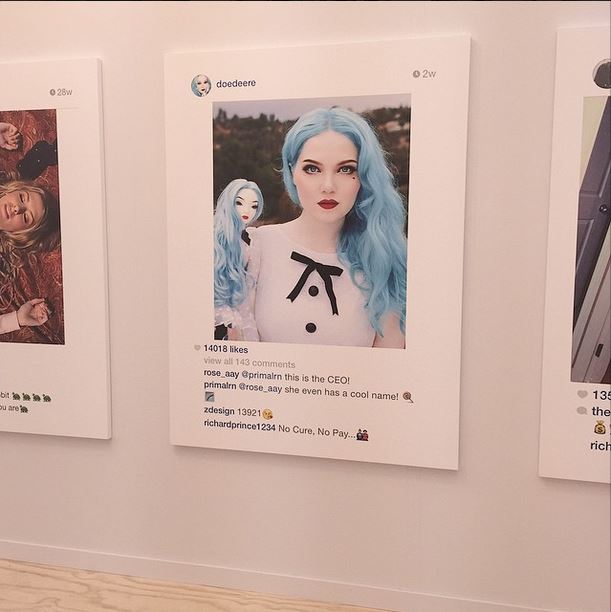
Photo Source: Instagram user @doedeere
Everyone’s been talking about it: successful appropriation artist Richard Prince selling other people’s Instagram photos. It’s sparked–as he doubtless intended it to–an enormous debate about what is art and what is authorship.
And it made me think of the periodic kerfuffles I’ve noticed on social media sites about the copyright clauses in the terms and conditions of the sites. I’m sure you’ve seen it go around on Facebook, the quasi-legal notice with the weird citations that purports to prevent Facebook from owning your content. On Tumblr–the site that apparently inspired Richard Prince’s exhibit–there are occasional panics every time Tumblr modifies its terms of service at all.
And, whenever I read the terms causing the hysteria, I’ve always struck by the fact that what the terms and conditions of sites like Facebook and Tumblr are really doing are allowing the sites to exist at all. You grant Facebook and Tumblr non-exclusive licenses to use your content for the purposes of their sites’ functioning, basically. You still own your content, but they ask you to give them the ability to do stuff with it without worrying about a fair use analysis or something of that sort. This is especially vital on Tumblr, which operates almost entirely on a concept called “reblogging.” As the Tumblr terms try to make clear, you give them a license for reblogging to happen. Without that, life on Tumblr would be even more legally murky than it already is.
Richard Prince’s recent exhibition, however, importantly reiterates that it isn’t necessarily the terms and conditions you need to worry about. Or, rather, that’s not all you need to worry about, because you should definitely be worrying about those, too. But, when you make your IP publicly available, on Facebook or Instagram or Tumblr or, say, this blog, you’re running the risk that someone’s going to take it and make “art” of it. And that has nothing to do with the terms and conditions. People have asked Instagram about Richard Prince’s art exhibit, and Instagram has rightly pointed out that Instagram runs Instagram; Instagram doesn’t run the whole world. Copyright infringement taking place off of Instagram isn’t Instagram’s domain.
There’s a lot about the legalese of our everyday lives that is misunderstood. And with good reason, because I’ve made a career out of copyright law and mostly what I’ve learned is how much about it is unclear. As has been discussed before, most of us don’t even read the terms and conditions of the sites we use, anyway. And very few of us think about possible copyright infringement as we’re posting a link to Facebook or reblogging a post on Tumblr or reposting a photo on Instagram or retweeting on Twitter. Because of that, I think, most of us don’t even think about the fact that that’s some of the stuff that the websites’ terms and conditions are worrying about. They are literally trying to find a way to allow us to continue all of the questionable copyright infringement that our use of the sites depends upon.
Copyright law, like so much of our lives, is increasingly defined by contracts like these, and it’s almost made us forget that the contracts don’t cover every use of our content. The Richard Prince story has been a potent reminder of that. People have seemed to instinctively think that the Instagram terms and conditions must have something to do with this, forgetting that this is existing in the part of our lives unbordered by explicit contract terms.
None of which answers the real question of the hour in the Richard Prince discussion, though: If it’s not governed by the contract, are the enlarged Instagram photos protected by fair use? But I think asking that question obscures the question I’d rather ask: Are selfies art? Should selfies receive the same level of intellectual debate as Richard Prince’s exhibit of them? Because isn’t there something troubling about the fact that selfies are frequently dismissed as silly when presented as the creation of younger females, but those very same selfies are considered art worth $90,000 if a man’s name is put on them?