Looking Toward Asia’s Contract Law
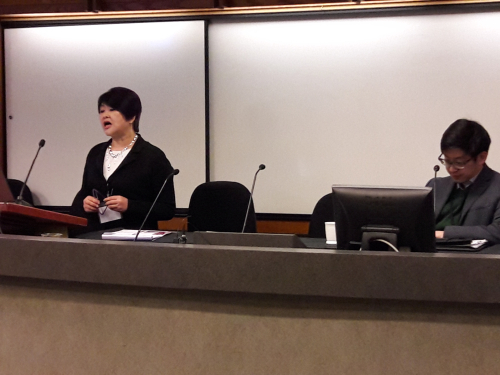
Mindy Chen-Wishart (Oxford University): In a plenary session, Professor Chen-Wishart described the massive multi-volume project, Studies in the Contract Laws of Asia, of which she is co-editor, to create an English-language resource on modern contract law in Asian jurisdictions. As countries seek to harmonize contract law internationally, Asian law is often left out of the discussion due to its inaccessibility. Major Asian jurisdictions, however, due to the colonial era, have legal systems that share a great deal with European contract law, both continental civil law and English common law. China is a particularly interesting hybrid system that was codified in 1999 with an eye toward international harmonization. The most recent codification of Asian law is in Cambodia, which draws heavily from Japanese legal experts. Indonesia is the most diverse and complex jurisdiction, drawing from tribal law, Islamic law, and Dutch law–which is still in Dutch and has never been translated into local language, despite the fact that most judges don’t speak judge. Such a massive comparative law project has raised many interesting (and conflicting) theoretical issues about the nature of legal-system transplantation. Asia is an amazing laboratory for learning the process of legal transplant, and the transplanted law morphs when transplanted into new soil.
A particular challenge arises from editing authors whose native language is not English, and translation issues were particularly problematic when using legal technical terms. Differing cultural norms caused problems in the editing process, working with authors who were used to high deference in their local cultures. On the substance, comparing jurisdictions has required ferreting out real differences and similarities from actual differences. Both civil and common law seek to put the non-breaching party is the same position as performance, but civil law places a great focus on cure and performance. Exceptions and concepts like good faith mitigate some of the surface differences. Authors would reach similar results on the same hypotheticals, despite the fact that the reasoning to get to that result differed. Objective approaches have been subjectified (and vice-versa) across jurisdictions. Human communication is actually “inter-subjective” and putting together this project exemplified this truth.
Legal transplant has led to divergences as well as convergences: In Singapore cases purporting to apply the exact same English law on undue influence reached different results, with the Singapore courts far less likely to find uindue influence due to Confucianist culture. In the East, a rigid hierarchy of titles, gender, and other positions creates legal soil in which the same doctrine will play out. “Person” and “roles” play different roles, with Western cultures focused on the person while Eastern cultures focused on roles–where respect, obligation, and duties are owed based on roles. Power is understood as more derivative–roles are inherently correct and not to be challenged. Individualism and collectivism play different parts–Asian cultures and law focus on identity as part of community and family, not as individuality. Eastern culture tends to control by shame where Western culture tends to control by guilt. Finding undue influence in a family setting would be counter-cultural. omparison with and among Asian legal jurisdictions shows that law on the books is not the same as law in action. Application of the law will differ based on the soil where a legal system is transplanted.
Volume 1 has just been published by Oxford University Press, entitled Remedies for Breach of Contract covering the law of contract remedies in China, India, Japan, Korea, Taiwan, Singapore, Malaysia, Hong Kong, and Thailand.
Tan Zhong Xing (Moderator, National University of Singapore)