
Judge Amy Coney Barrett and Contracts

Fortunately for us, the SCOTUSBlog has done its usual outstanding job of reviewing all aspects of Judge Barrett’s record as a judge on the 7th Circuit. You can find their work here.
Here are excerpts from their summary of Judge Barrett’s record on contracts and commercial law:
One area that many people are concerned with is her business decisions. These were coded broadly as decisions affecting business liability, contracts and deals.
An example of such a decision was in the case Burlaka v. Contract Transport Services LLC, where Barrett authored the majority opinion for the panel. In Burlaka, “truck drivers … brought individual, collective, and class action claims against Contract Transport Services (CTS), their former employer, for failing to provide overtime pay in violation of the Fair Labor Standards Act (FLSA), which requires overtime pay for any employee who works more than forty hours in a workweek.” The district court ruled against the drivers on the grounds that they were engaged in interstate commerce and thus exempt from FLSA. In her opinion, Barrett resoundingly agreed: “These facts plainly demonstrate that at least some spotters drove trailers carrying finalized goods destined for out-of-state delivery. Such a service, even if purely intrastate and interrupted briefly, would nevertheless constitute ‘driving in interstate commerce’ because it would be part of the goods’ continuous interstate journey.” This case presents an example of one of Barrett’s pro-business decisions in which she ruled against the employees and in favor of the business entity.
Barrett’s decisions were coded as pro-big business when a business entity was the clear victor or when a large corporate entity was successful against a much smaller business entity. Barrett’s decisions in this domain were split into opinions she authored, opinions she joined, unsigned orders and unsigned per curiam opinions.
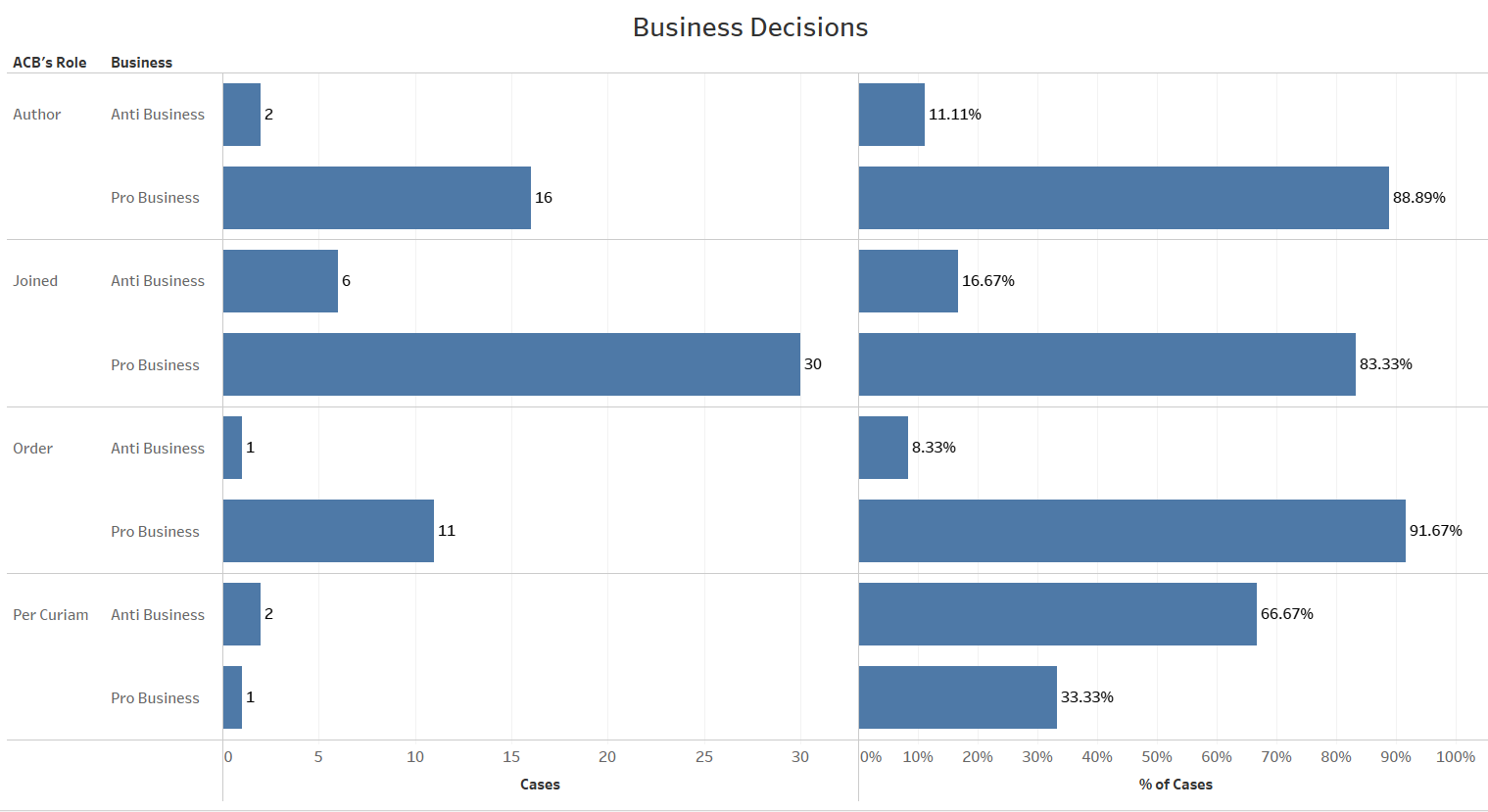
Barrett was pro-business in all opinion types except per curiam opinions, of which there were only three. This puts her in territory similar to many of the current Supreme Court justices. Conservative judges tend to rule more frequently in favor of big business, although the reason for this differs a bit between Supreme Court justices and court of appeals judges. On the Supreme Court, there is more gray area, due to the many petitions filed at the court and the justices’ wide discretion as to which cases they hear. Conversely, court of appeals judges hear many more cases on mandatory appeal and affirm lower-court decisions more often. This fact, along with the percentage of Republican-nominated judges on the 7th Circuit, might help explain Barrett’s high likelihood of ruling in favor of big business.
Mark Tushnet, in his recent book, Taking Back the Constitution, provides a nuanced view. The Roberts Court is pro-business, he contends, but that general attitude does not always dictate the outcome of cases, as many business cases pit large business interests against small business interests, and in such cases, even pro-business Justices might not agree. The conservatives on the Court, Tushnet argues, favor business interests over the policies supported by government regulation, but they have a hard time dealing with state regulation of business because of their commitment to federalism.
I find Tushnet persuasive on this point, which means that the voting patterns of pro-business conservatives, if that is what Judge Barrett is, can be hard to predict in cases that implicate contractual relations. Still, on issues that have been of concern to this blog before, such as the enforceability of arbitration clauses and class-action waivers, there is no reason to think that the Court will reverse its decade-long record of siding with businesses, even in the face of state laws designed to protect consumers against what Peggy Radin has identified as the democratic degradation effected through boilerplate contracts.
* In another capacity, I might be tempted to comment on Judge Barrett’s originalism, but I think Eric Segall has that area covered. My position on originalism is not the same as Eric’s but I think we agree that she was not nominated and will not be affirmed because of some abstract commitment to an interpretive methodology. She was nominated and will be affirmed because her writings and record as an appellate judge are a strong indication that she will strengthen the conservative majority on the Court.