
Anat Rosenberg and the History of Puffery

One unique contribution of the piece is Professor Rosenberg’s concept of “legal ridicule.” The doctrine of puffery aids advertisers by shielding them from liability, but this legal protection comes at the cost of not taking advertising seriously and of delegitimizing a form of commercial speech. The doctrine offered legal protection, enabling the advertising industry to take wing, but the industry was protected precisely because it was not to be taken seriously.
I. History of the Term
While the verb “to puff” has its origins in the 16th century, its debut as a term of legal significance came in 1776 when Lord Mansfield treated as a form of fraud the use of “puffers” in auctions to bid up sale prices. While Mansfield treated puffing as effective and therefore actionable, after the 1820s, the law regarding puffery as ineffectual and therefore legally benign. “My client was just puffing” became a legal defense in criminal law, contracts law, and intellectual property law. This shift corresponded to broader cultural changes, away from auctions and towards mass marketing; away from face-to-face communications and towards anonymous print ads. At the same time, puffery no longer involved concealment. Puffers in auctions were engaged in fraud because they concealed their relationship to the seller. Consumers are assumed to know that advertising puffery serves the seller, and so readers are effectively on notice that statements of quality are likely to be exaggerated.
The contours of the doctrine were unclear. Courts attempted, without much success, to protect puffery when it involved mere opinions, as opposed to statements of fact. Professor Rosenberg argues that the literature of puffery, which connects it with the doctrine of caveat emptor, tells only part of the story and overlooks the importance of legal ridicule.
II. Quackery and Puffery
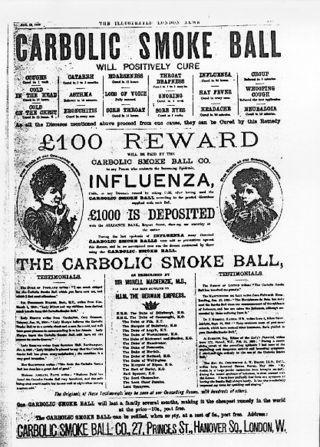
Enter Carlill v. Carbolic Smoke Ball Company, which we have previously covered here and here. As is often the case with such old chestnuts, Carlill fits uneasily into the doctrine. It does not illustrate puffery; the company’s statement that it had put £1000 on deposit indicated serious intent to be bound. The court could thus bind the company without bothering to consider its claims regarding the efficacy of its product. As in other puffery cases, the court was indifferent to the truth of falsity of the advertising claims, but it took very seriously the company’s unilateral offer.
The delightful Scottish case, Bile Bean Manufacturing Co., Limited v. Davidson, is similar. Bile Beans claimed that its product cured all sorts of ailments, especially biliousness. They brought suit against Davidson, who was passing off his own concoctions as Bile Beans. The courts sided with Davidson, not because Bile Beans did not cure any of the ailments the company claimed they could cure, but because the company’s advertising scheme was based on fraudulent claims that the beans made use of a fictional Australian herb allegedly discovered by an equally fictional “eminent” Australian scientist. As in Carlill, the inefficacy of the product never entered into the analysis. Advertising puffery is fine; but a false origins story, that is a legally cognizable wrong. The court may well have believed that there’s nothing like Bile Beans for biliousness, just as there’s nothing like hay for sneezing and nothing like Ivermectin for COVID-19. Yeah, yeah, but there’s nothing like hay or Ivermectin. The point is, regardless of its efficacy Bile Beans continued to sell into the 1980s.
But the two-sidedness of the puffing sword was on display in the case of Arthur Lewis Pointing, who advertised “invisible elevators,” cork shoe inserts that he claimed would increase height by up to four inches. They did no such thing, and they hurt. His attorney persuaded the court that Pointing was engaged in mere puffery, no more harmful than various quack remedies that may have tasted awful but otherwise left consumers no worse off than they were before. Pointing himself bristled that the criminal case against him was dismissed before he could defend the merits of his product.
III. Legal Ridicule
In White v. Mellin, Mellin had developed a health food for infants. White marketed that product under his own label, but with the following notice, referencing his brand:
Notice: the public are recommended to try Dr. Vance’s prepared food for infants and invalids, it being far more nutritious and healthful than any other preparation yet offered.

The outcome benefitted White, but it was not well received in the advertising community. They did not consider their claims ridiculous, and they resented a court that accorded the same respect to facially misleading advertisement, such as White’s, as it did to the claims of “scientific” formulas, such as Mellin’s. The law constructed an ideal consumer who would shake his head and chuckle ruefully when reading ads, dismissing their authors as companionable scamps.
The Upshot
In her conclusion, Professor Rosenberg references a rich literature on advertising, ranging from the Frankfurt School’s critique of the culture industry to Colin Campbell’s work juxtaposing Weber’s spirit of capitalism to the romantic ethic of modern consumerism, which combines quasi-religious irrationalism and ventures into fantasy and the imaginary. The advertising world is threatening to the world of law, which still wants to take as its point of departure a world of rational actors. The logic of puffery as a legal doctrine that credits consumers with the ability to see through the fantasy world that advertising offers, created a legal realm in which the advertising industry could escape legal accountability. The law determined to take the needs of industry seriously without taking their advertisements literally.