
A World in Which People Don’t Know Contracts Law
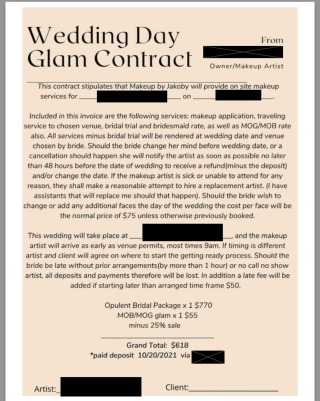
[S]hould the client change their mind before wedding date or a cancellation should happen, they will notify the artist as soon as possible, no later than 48 hours before date to receive a refund (minus deposit or $50 admin fee) and/or change the date.”
Given the transaction as described, this language is a bit confusing. As the clients are said to have paid in advance, it is not clear what deposit they might recover, but the best reading, I think, would be that they are entitled to recovery of full payment minus $50.
The contracts at issue in the story were apparently silent about what should happen were the make-up artist to cancel. The language in the contract above right is also somewhat confusing.
If the makeup artist is sick or unable to attend for any reason, they shall make a reasonable attempt to hire a replacement artist. (I have assistants that will replace me should that happen).

That question did not arise in the cases reported on, because there seem to have been no attempts, reasonable or otherwise, to find a replacement. Rather, the artist canceled with very little notice. On one occasion, the artist double-booked and then offered to do make-up at 1 PM instead of 10 AM as provided for in the contract. The artist said that it is heartbreaking when they have to cancel on a client. Apparently not as heartbreaking as providing a refund. I assume it is much more heartbreaking for the client. Imagine learning two days before your wedding that, in addition everything else you have to do, you now also have to scramble for a new make-up artist. And then you have to live with the knowledge that you hired somebody so inconsiderate that they would ask you to reschedule your wedding because they had double-booked.
On the other occasion, the artist claimed to be unable to do the work because they had become infected with COVID. The bride in question, who had just over two-days’ notice, claims that the artist posted pictures on social media indicating that they had in fact double-booked again and provided make-up services for another event the day they were supposedly incapacitated with COVID. The artist has withheld part of the contract price because they had a provided a trial for the clients.
Where a contract provides for no special remedy for breach, the standard remedy should be available. The artist was unjustly enriched when they accepted payment for services that they did not provide. It follows that the money must be returned in full, as the contract makes no mention of treating the cost of a trial as a deposit. On the contrary, where the contract provides that a client cannot recover a deposit if they cancel, the absence of language relating to the deposit if the artist cancels suggests that the default remedy, restitution, should apply. So if you did not contract in advance for a fee for the trial, you do not get paid for that lost leader.
One of the brides was able to mitigate her damages by finding a substitute make-up artist. If that last-minute substitute was more expensive than the original artist, in addition to restitution, she is also entitled to expectation damages, amounting to the difference between what she paid for the replacement and the original contract price.
On Facebook, the artist acknowledges “mistakes” and complains about “completely false and untrue accusations of scamming.” Well, perhaps such accusations exist somewhere on the web, but the KFOR report is just about breach of contract. People get upset about breaches of contracts for personal services. If you don’t pay appropriate damages, you should not be surprised if your clients complain about you publicly. In these cases, amounts in controversy are quite small and thus probably not worth the hassle of a law suit. But social norms supplement legal norms. The brides thus appropriately chose naming and shaming as their remedy.
The artist could have avoided all of this with a more even-handed remedies provision or by simply doing the obviously just thing of providing a full refund to the people on whom they canceled without reasonable notice.