
SCOTUS Returns to Form with a Pro-Arbitration Decision, but J. Thomas Joins the Dissenters
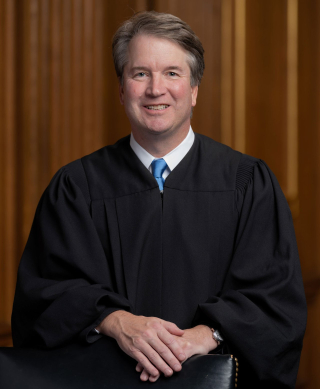
In Coinbase, Inc. v. Bielski, the U.S. Supreme Court faced the simple question of whether a district court must stay its pre-trial and trial proceedings while the moving party appeals an unsuccessful motion to compel arbitration. Five Justices said yes, concurring in an opinion by Justice Kavanaugh (right). Tamar Meshel previewed the case for us previously.
The underlying facts are interesting, but they do not really matter for the purposes of deciding the legal issue before the court. Plaintiffs sued, alleging that Coinbase had failed to replace funds fraudulently removed from Coinbase users’ accounts. Coinbase moved to compel arbitration, but the District Court denied that motion. It also denied Coinbase’s motion to stay the proceedings while it appealed, but the District Court denied the stay, and the Ninth Circuit, following its own precedent, deferred to the District Court. Other Circuit Courts have held that district courts must stay proceedings pending appeal of the denial of the motion to compel.
The majority opinion first looks to the Federal Arbitration Act (FAA) for guidance but finds none. It therefore relies on Griggs v. Provident Consumer Discount Co., which states the “Griggs principle” that interlocutory appeals divest “the district court of its control over those aspects of the case involved in the appeal.” That principle decides the case and it also accords with common sense, according to the majority.
If the district court could move forward with pre-trial and trial proceedings while the appeal on arbitrability was ongoing, then many of the asserted benefits of arbitration (efficiency, less expense, less intrusive discovery, and the like) would be irretrievably lost—even if the court of appeals later concluded that the case actually had belonged in arbitration all along.
Allowing a stay also preserves judicial resources. Given the Griggs principle, there is no need for the FAA to address whether or not proceedings are stayed.
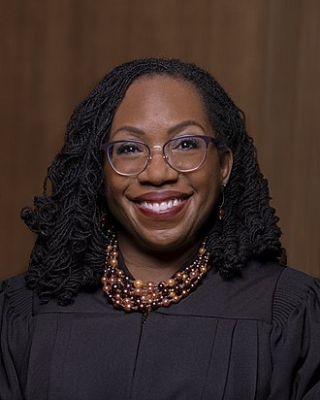
Justice Thomas does not join Part I of the dissenting opinion, which sounds in textualism. We are left to ponder his reasons for sitting out this debate. In that section, Justice Jackson (left) observes that Congress expressed its will to stay proceedings pending interlocutory appeals in another part of the 1988 law that created § 16 of the FAA and yet was silent on the issue in § 16 itself. Section 3 of the FAA also provides for stays pending appeal, but there is no parallel language in § 16. Applying basic textualist principles, the dissenters conclude that Congress intended for no per se rule on stays in connection with § 16.
In Part II, Justice Jackson and the dissenters argue that there was no “background rule” to fill in the silence of § 16 on the subject of stays pending interlocutory appeals. In Part III, the dissenters characterize Griggs, the 1982 case that provides the doctrinal basis for the majority’s reasoning, as standing for a very narrow rule: two courts should not exercise jurisdiction over the same issue simultaneously. But in this case, the only issue on appeal would be whether to compel arbitration. Consistent with Griggs, the district court can proceed to the merits of the case, so long as it does not re-visit its ruling on the motion to compel arbitration. That seems consistent with everything quoted in the majority opinion about Griggs. It is also notable that when the majority cites to Griggs as “a longstanding tenet of American procedure,” its only citation is to a three-person dissent from a denial of certiorari. Hardly compelling.
In Part IV, Justice Jackson pokes holes in the majority’s policy-based reasoning. After all, the majority requires a stay in all cases, even when appellant’s likelihood of success on the merits is vanishingly small. That is hardly efficient. It is much more efficient to allow the lower courts to police their own dockets and make their own determinations about when a stay is appropriate. Staying the proceedings can serve the interests of pro-arbitration parties.
While Justice Jackson begins by saying that she “respectfully” dissents, in Part V, not joined by Justice Thomas, she observes that the Court “ventures down an uncharted path—and that way lies madness.” Strong stuff. I wonder what she says when she does not respectfully dissent. The madness that she is concerned about is that stays of proceedings might now be necessary whenever an interlocutory appeal raises jurisdictional questions, such as a challenge to a forum-selection clause. Indeed, from that perspective, Justice Jackson makes a strong argument that the majority is not treating arbitration provisions neutrally; rather, it is granting special protections for pro-arbitration parties.