
Sid DeLong on Sam Bankman Fried, The Sequel
The Deadly Combination of Radical Utilitarianism and Expected Value Reasoning: More on the Moral Education of Sam Bankman-Fried
Sidney W. DeLong
The FTX trial has many lessons for theories of law and ethics. Consider what it can tell us about the moral philosophy of utilitarianism, which defines the “good” as that which produces the “most” human happiness (or utility) and defines moral obligation as the duty to act so as to produce the greatest happiness for the greatest number. It is safe to say that some form of utilitarianism is the default moral philosophy of lawyers and jurists and certainly for those interested in contracts.
It has also been referenced in the criminal trial of Sam Bankman-Fried arising from the collapse of the crypto firm FTX that he founded and controlled. While he received his formal education at MIT, Bankman-Fried was homeschooled in the radical utilitarianism of philosopher Peter Singer (left) by his parents, law professors at Stanford. The reader may recognize Singer as the philosopher who achieved notoriety for his advocacy of infanticide as a logical consequence of his utilitarianism. Singer is the inspiration for Effective Altruism, a utilitarian-based movement to which SBF and others subscribed in their operation of the FTX financial empire.
SBF seems to have learned the lesson well. Describing his attitude toward risk taking, his friend and associate, Caroline Ellison, testified that he once told her that he would be willing to subject the Earth to a 50% chance of total destruction if it also meant a 50% chance that everyone on Earth would be twice as happy. It is the sort of thing a person in the business of making money from risk might well say. Successful poker players and speculators always try to place bets that have a positive expected value. They know that even though they will lose some bets, as the odds operate over time, they will win enough to show a profit.
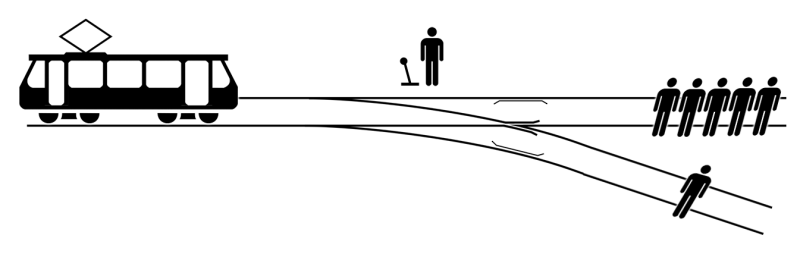
To SBF, the expected value of the Earth bet was positive in utilitarian terms: Even after subtracting the expected utilitarian cost of losing the Earth, (50% of its utilitarian value) the expected value of winning the bet, 50% of the total quantum of happiness or utility on offer, would be positive. Indeed, because we are all under a constant, positive, moral duty to maximize total happiness, utility, or welfare, the Earth-bet should not only be taken if it is offered, it should be sought out if it is not. (This distinguishes the situation from the moral dilemma forced on the agent in the Trolly Problem (below).)
But SBF made a big mistake. In fairness to both poker players and rational utilitarians, the positive expectancy principle applies only to a large series of bets of relatively small amounts, during which the odds have a chance to operate. Very few would bet their life or even all their money on a 50+% or even a 90+% chance of gain. They understand what economists do, that the marginal cost of losing everything infinitely exceeds the marginal value of gaining a lot more. This risk aversion appears to be a common human intuition that would have to be a side constraint fixed into any artificial intelligence programmed simply to maximize happiness.
The limitations of the expected value principle seem to be one of the side constraints that SBF missed in his moral education. He may not have noticed its absence in his financial life, perhaps because bet-the-company plays are not uncommon in the world of high finance and diversified risks
But then again, perhaps SBF never learned that rhetorical principle either. After all, the absurdity of advocating infanticide did not persuade Peter Singer that his philosophical premises were in error. It appears then that Bankman-Fried was inspired by Peter Singer in much the same way that Leopold and Loeb were inspired by Nietzsche. In SBF’s case, the results were less deadly but only because he was never actually in a position to make the Earth-bet. That may not be the case with the next trillionaire.
To end on a lighter note: Those economics-minded theorists who find the idea of expected value to be obvious in more mundane contexts than destruction of the Earth might enjoy a puzzle from John Allen Paulos’s book Innumeracy:
Suppose you were offered a choice of two bags of money and were told only that one of them contained twice as much as the other. After you choose bag A and before opening it, you are offered to exchange it for bag B. Should you trade?
Expected value reasoning seems to say “yes.” For example, assume that Bag A contains X dollars. Bag B then contains either 2x or .5 x dollars and the odds of either are 50%. The trade would produce a combined expected value of 50% of 2x and 50% of .5x, which sums to 1.25 x dollars. 1.25x dollars is 25% more than the x dollars you have in bag A.
So you should trade, right?
But how can that be? How can you have a positive expectancy if you trade any bag that you selected for the other? Especially since after trading for bag B, the same reasoning would dictate re-trading for bag A, which now contains either twice as much or half as much as bag B.
Whether or not you can figure out what is wrong with this argument, it should make you skeptical of intuitive arguments based on expected value. Like Bankman-Fried’s.