
Teaching Assistants: Shawn Bayern on The Analytical Failures of Law & Economics

I know, I know, we already know that law and economics (L&E) is wrong, so why do we need a new book about that? Well, hitherto existing critiques of L&E have merely questioned its underlying assumptions; Shawn’s book highlights analytical problems or incompleteness in the economic arguments underlying L&E. He does not mince his words. More precisely, Shawn takes aim at “adults in positions of power” who “take high-school-level economics too seriously” and appear “to prioritize callous, senseless, inhuman policies in the name of supposedly hard-hitting theoretical economic reasoning.” (x) Shawn takes on hyper-rationalism that introduces new rhetoric but is merely a “sleight of hand” (xi) for reaching the same conclusions one could just as easily have reached without the thin veneer of social scientism (id.) through good old-fashioned contextual analysis. (xi-xii)
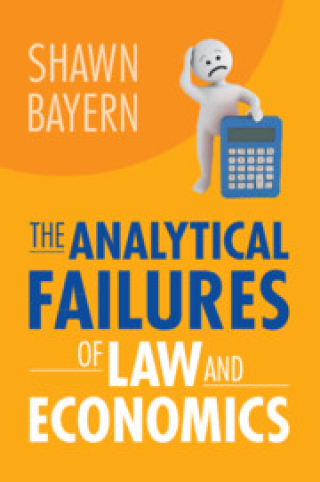
After an introduction, the book proceeds through torts law, contract law, and property. For obvious reasons, this brief review will focus on contracts.
The polemical tone continues in the introductory chapter. L&E is a creature of the US legal academy. Shawn credits L&E’s success to the acumen of the marketing department of the Chicago school rather than to the theoretical accomplishment of its adherents. L&E is “naive, fuzzy, and unprincipled.” ( 2) Although economic analysis is far from alien to legal reasoning, it took Chicago-style E&L to give it a conservative political valence. Borrowing from no less an authority than Richard Posner, Shawn concludes that L&E offers only “beguiling arguments” that should not “carry the day.” (4) But Shawn’s point is not to question whether efficiency is a legitimate end of the law. Rather, he contends that the L&E movement provides a poor means of achieving efficiency. Moreover, efficiency “is not the law’s only goal.” (5)
Shawn identifies seven basic analytical failures in L&E. The first, he calls ungraceful degradation. It is possible for a theoretical model to be a bit off and yet still prove a useful predictor of outcomes, but L&E’s core assumption are off in ways that render them “unable to interact usefully with the world in any way.” (13) Second, L&E cannot develop models to account for conflicting economic forces — for example, how to balance the parties’ desire to maximize surplus against their desire to reduce agency costs. In the real world, there might be multiple factors to consider, but L&E prefers global theories based on one variable to focused, contextual analysis. (16) Third and fourth, L&E tends to confuse the sufficient with the necessary (17), and it neglects alternatives — it allows the good to be the enemy of the better. (18-19) At the same time (fifth), L&E lives in terror of externalities. Here again, Shawn’s argument is that L&E analysis focuses on one set of economic costs but loses track of the larger context, a context in which those costs might be trivial or offset by benefits that the model does not acknowledge. (20-21) Sixth, L&E scholarship often tries to dazzle with counter-intuitive arguments, but those arguments are only convincing if one ignores context. (22) Finally, L&E suffers from a general myopia. L&E analysis looks only to optimize one particular feature of the world (say efficiency or welfare), but it ignores other values (say conservation or education), and the arbitrary choice of what we are trying to optimize renders the analysis of limited value in the real world. (22-23)

With respect to contracts, Shawn addresses: efficient breach, other remedial matters, interpretation, unconscionability, excuse and disclosure. His overall message is not that economic reasoning provides no insights into contact law but that American L&E tends to lead to unjust outcomes that are not even as efficient as the doctrines they would replace. (86)
Efficient breach is low-hanging fruit for Shawn. Academics love it, but courts never embrace it. For that reason, the Restatements reject it. (86-89) They reject it because it does not adequately account for the way parties value the transaction, because it ignores alternatives, and because it ignores the costs of litigation. (90-94)
On damages in general, Shawn argues that “economic analysis is as indeterminate as any other open-ended analysis that looks at a variety of considerations. . . ” (95) In particular, he looks at L&E defenses of the “new business rule.” The approach “treats everything as a statistical aggregation rather than an individual sample.” (97) Courts decide the cases in front of them, and if mitigation happened or could have happened, defendant can show it. (98)
On interpretation, Shawn first identifies the textualist/non-textualist divide in approaches. For various reasons, L&E scholars favor textualism, giving weight to written agreements, while Shawn (no surprise here) favors contextual approaches that use all available means to get at the intentions of the parties. (99) Parties, the L&E argument goes, prefer textualism, because it reduces transactions costs. Shawn’s critique of this position is lengthy and I can’t do it justice here beyond saying that it flows from the basic problems with L&E that Shawn identified in his introduction. L&E’s textualism proceeds from arbitrary assumptions not grounded in the particularities of any case and thus leads to arbitrary conclusion that have no predictive value in any particular case. (100-32)
The L&E critique of unconscionability is a subject we have treated recently on the blog in reviewing Duncan Kennedy’s defense of Judge Skelly-Wright’s opinion in Williams v. Walker-Thomas Furniture. Shawn begins by noting L&E scholars’ skepticism regarding procedural unconscionability. As usual, L&E objections to the concept are based on bizarre assumptions about the informational environment in which contracts are formed. In any case, courts pay no mind to these arguments and continue to recognize that procedural unconscionability exists and can negate consent. (133-34) Shawn’s main focus in on substantive unconscionability. L&E errs by arguing for the benefits to A & B from a substantively unconscionable agreement. Shawn points out that there are societal effects that flow from allowing for substantively unfair transactions that cause global distortions and inefficiencies. L&E loses sight of that because it does not consider alternatives to the bilateral contract that it regards in isolation. (135-41) Nor does it consider what the party on the short end of an unconscionable contract would have done in a world that did not permit them. (141-44)
While there are some non-Chicago L&E analyses of excuse doctrine, the influential Chicago-style L&E work on excuse suffers from some of the basic analytical failures. This work adopts a least-cost avoider approach that creates a perverse incentive for parties to be unable to handle the risks of the contracts into which they enter. (145) They also focus on one arbitrary consideration (efficiency in risk allocation), leading to an arbitrary result. The model assumes that parties would undertake negotiations of risk allocation in each contract, but contracting doesn’t work that way. Contracts are drawn up with an eye to a multitude of factors, and creating default rules based on one of those factors would yield arbitrary and inefficient results. (146-48)
On disclosure, Shawn makes three points in response to the L&E argument that parties should not be required to disclose even material information. First, L&E scholars are inconsistent in rejecting fraud but not non-disclosure while also rejecting the distinction between acts and omissions. (149) Second, the L&E non-disclosure rule is not necessary to encourage productivity. (149-50) Third, as usual, the model refuses to look at alternatives, including possible benefits to a rule requiring disclosure. (150)
In conclusion, Shawn argues L&E reasoning provides very little of value to what we get through good, old-fashioned, contextual legal reasoning. This is a delightfully well-reasoned and lively book. Shawn’s arguments are the culmination of scholarly work that now spans two decades. It is exceedingly valuable to have the outlines of his arguments, elaborated at greater length in law review articles, available in one book, distilled, and thematized according to the major subjects and most common analytical failures of L&E reasoning.