
Brian Bix, Reflections on Charles Fried’s Contract as Promise
Charles Fried and Contract as Promise
Brian Bix

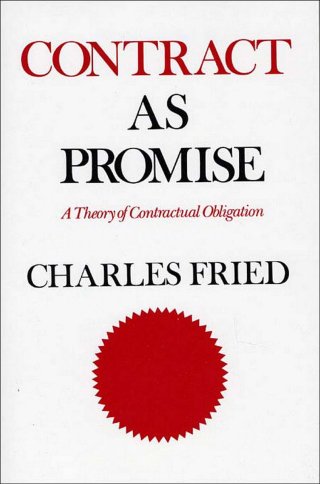
Charles Fried (1935-2024) (left) passed away recently, and the achievements of his life have been widely recounted: a long-time professor at the Harvard Law School who also fit in service at different times as Solicitor General and as an Associate Justice of the Massachusetts Supreme Judicial Court. He wrote important works across a wide range of topics, including constitutional law, general ethical theory and professional ethics. However, for private law theorists, he may be best remembered for his 1981 book, Contract as Promise: A Theory of Contractual Obligation (Harvard U. Pr.).
It may be hard for a younger generation (that is, pretty much anyone who is currently below retirement age) to recall how important Contract as Promise was. There was little American contract law theory prior to Fried’s book (in the UK, Patrick Atiyah had published The Rise and Fall of Freedom of Contract two years before, but that work has never received, either at the time or since, much attention on this side of the Atlantic). As Fried pointed out, much of the discussion of contract law in his time came from law and economics on one side and critical legal studies on the other (along with the semi-serious provocation of Grant Gilmore’s 1974 The Death of Contract).
In Contract as Promise, Fried sets out to explain and justify contract law in moral terms – not merely as a product of efficiency or class struggle. Fried asserts: “The obligation to keep a promise is grounded not in arguments of utility but in respect for individual autonomy and in trust.” To focus on promise is to focus on how social and legal institutions grant individuals powers they would not otherwise have. Fried states that in societies in which there is a social institution of promising, one can create reasonable reliance in another by making a promise: a promise which can induce behavior or sometimes a decision not to act.
Undoubtedly, there is an aspect of a promise-based approach which rings true to the ideal of freedom of contract: that contractual rights and duties, unlike most other legal rights and duties, are, to a large extent, if not entirely, a matter of choice, self-generated, rather than simply imposed by the state. However, there are also obvious differences between promises and contracts, at least from the perspective of American law. Most saliently, promises, on their own are distinctly not enforceable under contract law principles (though some may be enforceable under promissory estoppel or other equitable doctrines). Fried notes this divergence; it is the primary ground of his objection to the doctrine of consideration, and in Contract as Promise he optimistically predicts that the doctrine will be abandoned in due course (though, of course, to date this has not happened).
An additional line of objections is that reference to the general principles of promise (or to the related principles of consent or autonomy) are insufficiently precise to fill out the details of contract doctrine. Even among promissory theorists, there is a disagreement about what, if anything, a promise to perform entails regarding what remedies should be available for defective performance. Also, it is hard to see the many details of contract formation, interpretation, and excuse as magically incorporated into our promises to pay a certain amount of money for a good or service, or to sell a good or service for a certain amount of money, etc.
In recent years, Fried revisited, reflected upon, and offered some revisions to the argument of Contract as Promise: in a Harvard Law Review Forum (2007) commentary on an article by Seana Shiffrin, in symposia in Suffolk University Law Review (2012) and Theoretical Inquiries in Law (2019), in a chapter in Philosophical Foundations of Contract Law (Klass, Letsas and Saprai, eds., Oxford U. Pr., 2014), and, in a chapter added to the second edition of Contract as Promise (Oxford U. Pr., 2015). These supplements added nuance to the earlier argument, without significantly changing its basic direction.
To readers, there is something that may seem unsatisfying about a theory that states: “promise explains (and justifies) contract law … except for the (numerous and often significant) parts that it doesn’t explain.” At the same time, the argument that contract law is – at the end, at bottom, essentially – about the enforcement of promises still seems to say something important, even with all the conditions, supplements, and caveats that need to be added. And, perhaps, most importantly, Charles Fried’s Contract as Promise remains, 40-plus years later, the consensus starting point for anyone who wants to write about, or just think about, contracts and contract law theory.