
In Memory of Barbara Ehrenreich, Reflections on the Professional Managerial Class

Barbara Ehrenreich and her husband at the time John started publishing about the PMC in 1977. They introduced the topic in two articles that appeared in Radical America, “The Professional Managerial Class,” and “A Case-Study in Professional Managerial Class Radicalism.” Those two essays and a 2019 interview that Alex Press conducted with Ms. Ehrenreich in 2019 and published in Dissent magazine are my source materials I take a certain pleasure in revisiting the older material. Even the fonts are outdated. Ehrenreich herself describes the material from Radical America as having been written in a “rather tedious” way. I am indebted to the KYE hosts, Matthew Sitman and Sam Adler-Bell and their guests on the Ehrenreich episode, Alex Press and Gabriel Winant, for giving me a framework in which to situate the Ehrenreichs’ approach to the PMC. There’s a lot to unpack here, so I will keep things brief, at the risk of oversimplifying.

The Ehrenreichs developed their concept of the PMC in response to a crisis in leftist theory after the collapse of the student movement of the 1960s. The working class had not developed into a revolutionary force along the lines predicted by Marxist theory. The New Left embraced student revolts as presenting the possibility of a vanguard of a new revolutionary class — radicalized university students. The revolution, which for the Ehrenreichs would have been a democratic, non-violent one, did not materialize. The question for the left was, why not?
The Ehrenreichs’ answer was that students belong to neither of the class categories then available to Marxist theory. They are neither a part of the bourgeoisie, nor are they part of the proletariat. They also are not petty bourgeois. Rather they are part of a fluid category, the PMC, which is caught in late-stage capitalism between those with genuine economic power and the working class. The PMC consists of “salaried mental workers who do not own the means of production and whose major function . . . [is] the reproduction of capitalist culture and capitalist class relations.” As such, the PMC is a problematic vehicle for radical social change, and the path forward is an alliance between the PMC and the working class.
Members of the PMC are not manual laborers, and they can become part of the managing class. However, jumping ahead a few decades, they are increasingly subject to deskilling and proletarianization through what a friend of mine called the “crappification of work.” At the turn of the 21st century, my friend was a computer programmer working for an investment bank. It was a pretty good job, and then it was an okay job, and then it was a bad job that paid okay and had decent benefits, and then it slowly became a demeaning job, and then it evolved into a soul-crushing job that one would not wish upon one’s bitterest foe. Eventually, the investment bank outsourced her department, and she never again found rewarding work in her field. Her politics grew emphatically leftist.
Teachers are the first category of workers associated with the PMC, according to the Ehrenreichs. Their role is social control or the production and propagation of ideology. I feel seen.
Not really. Either the Marxist categories associating socio-economic roles and relation to the mode of production from the 1970s do no map well onto current realities or I am no longer persuaded by the New Left reasoning that shaped my political identity in young adulthood. In the alternative, perhaps after decades in the PMC, I have become blind to my role in reifying existing socio-economic hierarchies. That’s what I’m trying to work out.
In any case, despite the Ehrenreichs’ rhetoric assigning to teachers a role in developing and disseminating the ideology of late capitalism, with all the chauvinisms that entails, it is not as if they regard members of the PMC as ineluctably aligned with the forces of oppression. After all, they have to account for their over-educated, bookish, skilled selves. The relationship between the PMC and workers is “objectively antagonistic,” but so is the relationship between the PMC and the capitalist class. Ehrenreich rejects the use of PMC as a slur. PMC members have a service ethic. They are genuinely committed to making positive contributions to their communities. But workers are motivated by a version of the same ethic, and the fact that it is ever harder for members of both groups to take pride in their work should be a source of unity.
Workers earned some protections through unionization; the PMC used the jargon of professionalism to establish their monopolies in markets for services. The KYE folks share an anecdote that illustrates both the difference in self-conception between PMC members and workers and the crappification of mental work. One of them (hard to keep four male voices straight when none of them are Ira Glass) shared a story of trying to organize graduate students into a union. They met resistance, in part because the graduate students did not feel like they needed unions to protect their interests in the same way that workers did. It felt false. The organizers pointed out that they had been sent by the university workers’ union. The union workers wanted the graduate students to join them. And, the organizers added, the union workers got paid far better than the graduate students did.

The KYE podcast recounts an incident where one of Barbara Ehrenreich’s co-workers injures her ankle. She was then working for a house-cleaning service. The injured woman was also pregnant. She needed time off, but they were paid hourly. Ehrenreich’s solution is that the workers should organize and strike, demanding, among other things, paid time off for injuries sustained at the workplace. Her c0-workers, exhibiting what to Ehrenreich must have seemed like a textbook example of false consciousness, protested that they could not let down their employer, who was counting on them to clean houses that day. Ah, the cooptation of the service ethic to benefit capital! True to her own habitus, Ehrenreich found a middle ground. She advocated for her co-worker and persuaded the employer to give her a day off with pay so that she could recover from her ankle injury. Reflecting on the incident, Ehrenreich might have been reminded of Bertolt Brecht’s “A Bed for the Night.” A more upbeat liberal might think of the starfish story. But after her grim slog through working-class misery, Ehrenreich’s worldview likely was a more inclined towards Brecht.
Ehrenreich understood the importance of habitus (although she did not use the word) in ways that others on the left didn’t. She tells of “Twinkie wars,” when PMC-types would try to unite with workers to form food co-ops. The workers wanted the co-ops to carry the sorts of processed foods that they were used to eating and found in their local groceries. The PMC-types took “principled” stands against unhealthy foods, and these differences led to genuine conflicts.
The limitations of the New Left and student radicalism became clear, say the Ehrenreichs, when students radicalized by their opposition to the Vietnam War attempted to combine forces with Black radicalism. While PMC students may have been prepared to embrace the calls of the Black working class to demolish elite institutions and return power to the people, older members of the PMC denounced student radicalism as misdirected and directionless post-adolescent rebellion or the harbinger of a new kind of leftist authoritarianism.
As a law professor, at least where I teach, I am a beneficiary of professionalization. My status remains very high, even within the university, compared to that of staff and even legal writing or clinical professors, to say nothing of our own adjuncts, or the professors, adjuncts, and staff in the rest of the university. The crappification of work has eroded my quality of life at the margins. University bureaucrats treat me like a cog and are far more concerned about my how much revenue I generate for the university (measured in FTEs) than they are in either my scholarly output or the quality of my teaching. If it weren’t for ABA accreditation requirements, law students would mostly be taught by adjuncts earning $1500/credit hour taught. Other parts of the university are already crumbling under economic strain. I would not want the life of my colleagues in the humanities at small colleges and non-flagship state universities. When young people tell me that they want to be professors, I am inclined to advise them to do something else with their lives. But what?
Listening to the KYE episode in the context of renewed student protests and my own position as an un-reconstructed Jewish New Leftist with close familial ties to Israel made me think about my PMC status in connection with those student protests. It’s a theoretical matter for me, because there were no student protests at my law school, and as far as I know there were no student encampments or mass arrests of student protests anywhere in Oklahoma, my adopted home state.
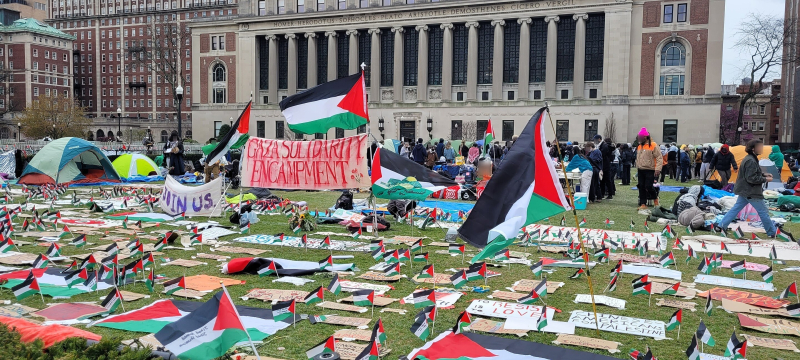
Image by عباد ديرانية – Own work, CC0
This post has gone on too long, so this part will be brief.
My inclination has always been to admire radical protestors for calling attention to very important issues. But I’ve never felt comfortable joining them. Part of the problem is the lack of fit between my own leftism, which is based on class analysis, and the identity politics that has come to dominate the left. Part of the problem is that I am a left-wing pragmatist. Political action has to be targeted and has to have clear goals in order to be effective. You have to have a strategy for winning and something tangible to show for it at the end of the day. Finally, I think people get caught up in the theater of acting out injustice in ways that draws attention away from addressing actual injustices. When you occupy a building on a college campus, your goal is to be arrested. The people who are arrested want it to be as ugly as possible. But once they are released with a few bruises, what is the next step?
I have multiple ambivalences about the pro-Palestinian protests even while I admire the courage, discipline, and sacrifice of the students involved. I think their efforts will come to nought. Nothing good, that is. Smart university administrations will play along, promising to look at investment strategies, but they won’t stop investing in companies based in countries with horrible human rights records. But even if universities did divest from Israel, that would not help Palestinians. Meanwhile, the protests drive pro-Palestinian voters away from support for Biden and drive pro-Israel voters into the Trump camp, and my view is that a Trump Presidency will exacerbate the conflict and just bring more misery to the region.
For my part, if I have to choose between the self-defeating excesses of the Netanyahu government and a Palestinian movement led by Hamas, I choose neither. I am for peace, and peace means that everybody stops fighting, recognizes the other party’s right to self-determination, and all that has to happen without pre-conditions and without delay.
I used to lead study abroad programs about the conflict. Students would come because they wanted to see “the Holy Land.” We hired a “dual narrative” touring company that provided us with one Jewish Israeli and one Arab Israeli guide. Students would tell me in their final evaluations that they emerged from the program confused about the conflict. I would consider that a win, because I’ve been immersed in the conflict since childhood, and I’m confused.
From my perspective as a member of the PMC, all I can do is teach about the conflict. But will students come willing to listen, not only to me but to each other, and learn?