
Sidney DeLong on Contracts in Moby Dick — Warning: Thar Be Spoilers!
Ahab’s Doubloon: A Contracts Analysis
Sidney W. DeLong
As he showed in Billy Budd, Herman Melville (right) knew his way around the law of the sea. Moby Dick is not generally thought of as a text on the common law but upon whales and whaling. Yet one of its central episodes invites a contract analysis.

I was already aware that in the whaling business they paid no wages; but all hands, including the captain, received certain shares of the profits called lays, and that these lays were proportioned to the degree of importance pertaining to the respective duties of the ship’s company. I was also aware that being a green hand at whaling, my own lay would not be very large; but considering that I was used to the sea, could steer a ship, splice a rope, and all that, I made no doubt that from all I had heard I should be offered at least the 275th lay—that is, the 275th part of the clear net proceeds of the voyage, whatever that might eventually amount to.
The lay of a crewmember was often so little that after two or three years voyage, it might not cover the cost of liquor and other articles purchased on credit from the ship.
Shortly after the Pequod had set sail, Captain Ahab appeared on deck and addressed the assembled crew, beginning with a sort of catechism:
“What do ye do when ye see a whale, men?”
“Sing out for him!” was the impulsive rejoinder from a score of clubbed voices. . . .
“And what do ye next, men?”
“Lower away, and after him!”
“And what tune is it ye pull to, men?”
“A dead whale or a stove boat!” . . . .
These answers faithfully recited the duties undertaken by all the crew, in return for which they were to be paid their modest lays.
Ahab then made his offer:
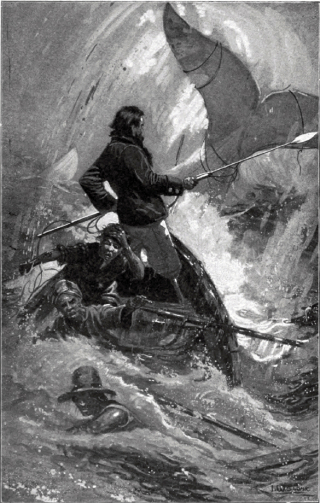
. . . Receiving the top-maul from Starbuck, he advanced towards the main-mast with the hammer uplifted in one hand, exhibiting the gold with the other, and with a high raised voice exclaiming: “Whosoever of ye raises me a white-headed whale with a wrinkled brow and a crooked jaw; whosoever of ye raises me that white-headed whale, with three holes punctured in his starboard fluke- look ye, whosoever of ye raises me that same white whale, he shall have this gold ounce, my boys!”
“Huzza! huzza!” cried the seamen, as with swinging tarpaulins they hailed the act of nailing the gold to the mast . . . .
As things turned out, it was Ahab himself who first sighted Moby Dick. But then, to keep the crew motivated, he enlarged his offer:
“[A]dvancing toward the doubloon in the main mast – ‘Men, this gold is mine, for I earned it; but I shall let it abide here till the white whale is dead; and then, whosoever of ye first raises him, upon the day he shall be killed, this gold is that man’s; and if on that day I shall again raise him, then, ten times its sum shall be divided among all of ye! Away now!’”
Suppose it was not Ahab but a crew member who first raised Moby Dick: Could he have enforced the promise of the doubloon upon returning safely to port? Or suppose the conditions of the second promise had been fulfilled: Could the crew enforce the second promise of ten times the sum?
Alas, Melville made sure that we will never know whether the promises Ahab made to the crew of the Pequod would have stood up in a Nantucket courtroom at the end of the voyage. Moby Dick was “raised” but never killed. Ahab’s doubloon went to the bottom nailed to the main mast of the Pequod , while Ahab’s fate was to die affixed to the curse´d whale, entangled in his harpoon line, leaving the contracts questions unanswered.
Until now.
The Pre-Existing Duty Rule, Then and Now. There is a good reason that older contracts casebooks illustrate the law of contract modification with cases drawn from the 19th century history of seafaring. After the crew members signed their employment contracts (“articles”), they embarked on a journey that could, in the case of whaling vessels, last for years. Once at sea, the parties were locked in a bilateral monopoly: the crew could not quit their jobs and the shipowner could not hire replacements. Under these conditions, a sea captain’s promise to raise the crew’s wages became especially suspect when they returned to port.
In America, judicial hostility to mid-course modifications of seamen’s wages continued into the 20th Century and applied even when the crew was not at sea but only at a remote land location. In the familiar case of Alaska Packers Ass’n v Domenico, 117 F. 99 (9th Cir. 1902) the court refused to enforce a contract modification raising the crew’s rate of compensation for salmon fishing after the crew complained of bad nets. Law and economics scholars later justified Alaska Packers by its tendency to forestall the “hold-up game” otherwise made possible in locations remote from labor markets. As an added bonus, the mechanical pre-existing duty rule was far less costly to administer than a rule requiring a finding of duress or bad faith as a condition to non-enforcement.
Alaska Packers also found seamen’s wage claims under modified contracts to be unenforceable under agency law. The captain or master of the ship did not have actual or apparent authority to make promises binding on the owners. The captain himself was only a higher-paid employee of the owners.
The crew might argue that their duty was owed to the Pequod’s owners, but the offer came from Ahab, to whom the crew owed no pre-existing duties. The doubloon represented a side deal. But this argument might have outraged the court even more than the modification argument and for stronger public policy reasons. McDevitt v Stokes 192 S.W. 681 (Ky. 1917) refused to enforce a bettor’s promise of extra pay to a jockey if his horse won a race. Kentucky judges didn’t fancy enforcing bribes of jockeys by racing touts. Likewise, a Nantucket court concerned with protecting the whaling industry would have refused enforcement of a captain’s promise of extra wages to achieve a personal vendetta as tending to divert the crew from their primary mission, as it disastrously did in the case of the Pequod.
The Pre-Existing Duty Rule Today.
The strong public policies associated with marine commerce that led courts to refuse enforcement of promises of extra pay made on the high seas did not persist into land-based commercial contracts in the 20th Century. Employers’ fears of employee duress have been replaced by employers’ need for flexibility in the rapid modification of ongoing employee contracts. Employers now value the ability to make binding promises of extra compensation in circumstances in which they have a need to increase employee incentives.
The application of the pre-existing duty rule to modifications was modified in Restatement (Second) of the Law: Contracts. Retrospectively applying modern law to Moby Dick, if the bonus offers had been made by the owners, they might well have passed muster as modifications of the crew’s articles.
Section 89 Modification of executory contract.
A promise modifying a duty under a contract not fully performed on either side is binding
- a) If the modification is fair and equitable in view of circumstances not anticipated by the parties when the contract was made; or
- b) to the extent provided by statute; or
- c) to the extent that justice requires enforcement and view of material change of position in reliance on the promise.
The crew might have argued that, even though killing Moby Dick was within the literal definition of their duties, nevertheless the additional reward for raising Moby Dick was fair and equitable in light of the extraordinary risk involved, a risk that was not anticipated when they signed on. Indeed, Ahab’s mad quest for the whale destroyed the Pequod and cost the crew their lives. Moreover, once the Pequod had given chase to the deadly whale, the men had indeed incurred a “material change” in their safety in reliance on the promise of the doubloon.
Their reliance might also make Ahab’s later promise of ten times the original bonus enforceable as a gift promise under the modern principle of promissory estoppel, Their reliance was both foreseeable and detrimental. Refusal of enforcement would have been unjust in light of the risks the crew incurred in reliance on the promise.

The crew would still face the agency argument, however. But the claim for the doubloon against its owner, Ahab, should have been enforceable both as a unilateral contract and under the promissory estoppel principle. The crew foreseeably endangered themselves, as they were intended to do, in reliance on the promise and justice surely requires that their reliance made the promise enforceable.
But even if by some rationale the crew (or their survivors) should be deemed to have earned the doubloon, the problem would remain of collecting their bounty. In the literary undersea world, the doubloon remains forever affixed the mast of the Pequod.