
Massachusetts Supreme Judicial Court Upholds Uber’s Terms of Service & Compels Arbitration
After his injury, Mr. Good sued the driver and Uber. Uber duly moved to compel arbitration, but the trial court denied that motion on the ground that Mr. Good had no reasonable notice of its terms and had not manifested assent to them.
In June, in Good v. Uber Technologies, Inc., the Supreme Judicial Court of Massachusetts reversed, and ordered the trial court to grant Uber’s motion to compel arbitration. The opinion is extraordinarily lengthy, and there was also a lengthy dissent.
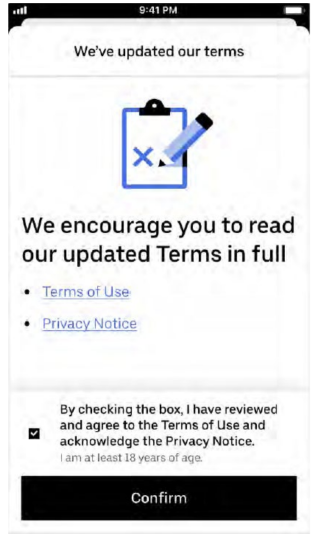
The Court begins by noting that Mr. Good did not have actual notice of the terms to which he agreed. The Court cites scholarship establishing that consumers do not read terms of service. The Court then stressed the importance of reasonable notice of terms in situations such as this one, where the service being contracted for is not particularly costly and one would not expect complex terms. Notwithstanding the exacting standard for notice, the Court found that Uber had provided sufficient warning to put Mr. Good on reasonable notice of its terms. The hyperlink to Uber’s terms of service was conspicuous. Just one click would have taken him there, and then he would only have had to read five paragraphs into the document to learn of the arbitration clause. Mr. Good had to consent to the terms in order to proceed to order a ride.
Mr. Good argued that the Court ought to require more. The Court could require scrollwrap, a version of wrap contracting in which the user has to scroll through the terms of service in order to get to the box indicating assent to terms at the end. In the alternative, it could require that users be forced to actually click on the hyperlink before they can be said to have assented to terms. According to the Court, to do so would be to require actual assent. The law requires only reasonable notice of terms. Nor would the Court require that vendors highlight key terms to enhance the users’ notice of terms that they would not read in full. The duty to read governs even in situations where we know that very few people read.
The dissent maintains that, “This case is not in any way ordinary, as the court contends.” Mr. Good thought he was just signing up for a ride. He had no way of knowing that Uber, a sophisticated technology company, was disclaiming all liability for any injuries he might sustain during that ride. I think that is absolutely true, but I also think that it is perfectly ordinary, at least in the United States, for powerful business entities to use form contracts to escape liability for tortious conduct by the entities or their agents/employees/independent contractors. The dissent thinks that the law here is unsettled. I wish I could say that I agree, but we have reviewed multiple cases in this space that look an awful lot like this one. There is an outlier case from Pennsylvania, Chilutti, but the Pennsylvania Supreme Court is reviewing that case, and I suspect that it will reverse. Stay tuned.