
Reviewing Larry DiMatteo, Principles of Contract Law and Theory, Part IX
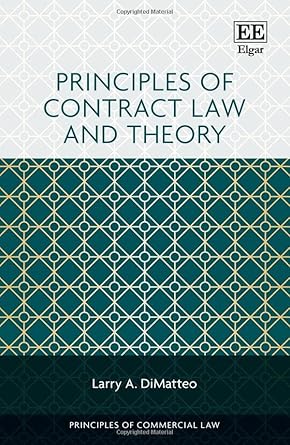
This is the ninth post in my series on Larry Di Matteo‘s Principles of Contract Law and Theory (Principles). The aim is to call some attention to this book while using it to stimulate my thinking as I once again consider how to teach contracts law to first-year students. Principles is a scholarly textbook addressing advanced topics at a very high level of sophistication.
Courts regulate express terms such as satisfaction clauses, exculpatory clauses, and limitations on damages. (214-15) Default rules ensure fairness and efficiency and place the risks and burdens on the party that can avoid at the least cost. (216) Many such rules, Professor DiMatteo notes, were imported into the common law from the law merchant. (219) Some contract terms have their origins in case law, like “best efforts” clauses in agency relationships, which derive from Judge Cardozo’s justly celebrated opinion in Wood v. Lucy, Lady-Duff Gordon. In other cases, default terms are created by statute, as in the UCC’s ¶¶ 2-305-310. (220-21)
Professor DiMatteo provides a brief history of standard form contracting and notes the potential, especially in consumer contracts, for their use to replace with actual, substantive assent with mere manifestations of assent. (222-23). As he frequently does, he reminds U.S. readers that, contrary to what law and economics might suggest, enforcing all such contracts that fall just short of unconscionability is not the only way to preserve efficiency in commercial contracting. Other states have special rule for consumer contracts and even Karl Llewellyn thought that consumers should only be bound by dickered terms in form contracts and non-dickered terms so long as they are reasonable. (223-24). There follows a short but suggestive exploration of the dangers of contracts of adhesion and rolling contracts. (224-25)
Finally, the chapter covers the growth of statutory law and its impact on the common law of contracts. In the U.S., the adoption of the Uniform Commercial Code is the most important development in this realm, and the modernization of contract law that Article 2 entails has greatly influenced the development of the common law in the United States since the 1960s. (225-28) In the UK, membership in the EU required the adoption of a range of consumer contract laws that are far more comprehensive than their U.S. counterparts. (230) Professor DiMatteo does not address whether the UK has walked back these protections since Brexit, but I would be very surprised it they did. Brexit presented itself as a populist movement, and the popularity of consumer protection, in my experience, extends across the political spectrum.
The first post in this series can be found here
Part II is here.
Part III is here.
Part IV is here.
Part V is here.
Part VI is here.
Part VII is here.
Part VIII is here.