
Reviewing Larry DiMatteo, Principles of Contract Law and Theory, Part XI
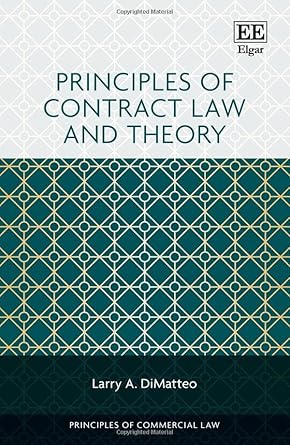
This is the eleventh post in my series on Larry Di Matteo‘s Principles of Contract Law and Theory (Principles). The aim is to call some attention to this book while using it to stimulate my thinking as I once again consider how to teach contracts law to first-year students. Principles is a scholarly textbook addressing advanced topics at a very high level of sophistication.
Chapter 11 of Principles covers classical contract theory. In the previous chapter, Professor DiMatteo reviewed various accounts of the history of law. Here, while Professor DiMatteo mentions 1870-1920 as the purported heyday of formalism (254), he is not committed to any periodization. Rather, in his chapter, he aims to describe the characteristics of the classical period. He associates the classical period with formalism and with the valorization of written expression over the inquiry into the intent of the parties. (248) The twin guiding principles of the classical era were freedom of contract and sanctity of contract. The former valorizes the power of private legislation; the latter calls for strict enforcement of written terms. (254) This formalism seems to have been a natural response to the uncertainty of the common law prior to the rise of comprehensive treatises. There being no one authoritative account of the law, contract law was riddled with inconsistencies and contradictions. (249)
Professor DiMatteo’s brief section on contract as promise illustrates the complexities of the relationship between law and morality. (258-59) In the classical period, expectation became the standard measure of damages even for purely executory contracts. A party to an agreement is entitled to their expectation, even if they have suffered no harm in reliance on a promise. On the one hand, this seems like a legal stricture for a moral failing — the broken promise. On the other hand enforcing a promise the breach of which has caused no harm also seems unjust. Professor DiMatteo resolves the difficulty by drawing on Steven Smith’s account of contracts as giving rise to a property right. (259)
Another aspect of classic contracts formalism was its empirical bent. Christopher Langdell’s 1871 casebook opens the era in which legal scholars attempted to derived legal principles through the case method. Joseph Beale’s 1935 Treatise on the Law of Conflicts marked an end or highpoint (259), although of course the on-going projects of restatements, treatises, and uniform laws continues the tradition. Yet the modern movement towards codification or classification is now free from the rhetoric of scientism in which legal scholars of the classical era indulged. That scientism rendered context irrelevant to the formalists. They were not seeking intents; they were enforcing legal principles attendant to the breach of promises. As Professor DiMatteo puts it, “[C]ontract interpretation was a purely conceptual inquiry into the words of the promise and not a contextual inquiry of what the parties meant by those words.” (261)
But the formalism of the classical period became untenable, Professor DiMatteo tells us, in the modern economy. Legal realists exposed the inevitable gaps in legal rules and the propensity of factual circumstances to fall between legal norms. Judges had to exercise discretion in deciding which norm was dispositive. (252-53) Moreover, the legal realists abandoned commitment to abstract principles in favor of legal rules embodied in the day-to-day customs of commercial practices. The bright-line rules of the classical period were displaced, in part, by the reasonableness standards with which the UCC abounds. (262-63) For legal realists, facts drive law, and this was both their description of how judges decided cases and their prescription for what the law ought to be. (263-64)
However, Professor DiMatteo emphasizes, the modern era did not sweep away all formalism. Modern law combines elements of both realism and formalism (264-65)
This chapter has some puzzling features. It does not proceed linearly. Rather, it toggles between discussions of the classical period, in which formalism prevails, and legal realism. Some repetition is inevitable. In the middle is a short excursus on Ronald Dworkin, in which Professor DiMatteo claims that Dworkin’s theory of interpretation “is the most influencial model of legal positivism” (253-54). I would have characterized Dworkin as among the most insightful critics of Hartian positivism, but I do not regard him as a positivist. I don’t have candidates for theories of interpretation that could best Dworkin’s as most influential, but I can’t say that I’ve ever seen him cited in a contracts case. I studied with Dworkin, and I found much of interest in his work, which did not persuade me, especially on the subject of interpretation. Having spent quite a lot of time in graduate school studying literary theory, Dworkin’s approach struck me as untethered from any serious tradition of interpretation, either in law or elsewhere. Perhaps I move in the wrong circles, but it seems to me his influence is fading extremely quickly.
The first post in this series, providing an introduction, covering history, law and equity, justifications for contract law, rules principles, and standards, specialized rules, and boundaries of contract, can be found here
Part II, a foray into comparative contracts law, is here.
Part III, a discussion of freedom of contract and five tensions through which contract law navigates, is here.
Part IV, on formalism, is here.
Part V, about substantive elements of contract, is here.
Part VI, remedies, excuse, and privity, is here.
Part VII, about defenses, is here.
Part VIII, on interpretation, is here.
Part IX, about standard terms and form contracting, is here.
Part X, on legal history and theories of legal development, is here.