
Reviewing Larry DiMatteo, Principles of Contract Law and Theory, Part XIII
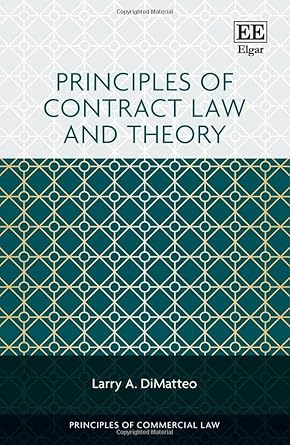
This is the Thirteenth post in my series on Larry Di Matteo‘s Principles of Contract Law and Theory (Principles). The aim is to call some attention to this book while using it to stimulate my thinking as I once again consider how to teach contracts law to first-year students. Principles is a scholarly textbook addressing advanced topics at a very high level of sophistication.
The concept of autonomy leads to theories of contract based on will, bargain, promise, or consent. Professor DiMatteo treats bargain theory as addressing gaps in will theory, which could not account for defenses or for damages flowing from executory contracts. But bargain theory does not account for why illegal bargains are unenforceable or for recovery based on reliance. (297) Professor DiMatteo associates Charles Fried’s contract as promise approach with German civil law, which provides for specific performance as a default remedy because it regards the keeping of a promise as an obligation. By way of contrast, Steven Smith gives voice to the positivist impulse which informs the common law: keeping promises is a virtue; not a legal obligation. (298)
Professor DiMatteo credits Richard Posner’s 1971 book on Law and Economics as launching a movement. (299). Guido Calibresi might object. He credits Judge Holmes with foreseeing the rise of economics, but Learned Hand did more than foresee things when he introduced his economic formula for determining negligence in 1947. Professor DiMatteo’s assessment of the Law and Economics (L&E) approach is that it has failed to “explain the general theory of contract law in a descriptive or normative way.” (301) Nor does he think it provides a model for the reform of contract law. (302) This seems a damning indictment of the most powerful theoretical model developed in the academy since legal realism. Compare, for example, impact of L&E to that of critical legal theory (CLT) or critical race theory (CRT). Judge Easterbrook (left) developed an L&E 
I am of two minds regarding Professor DiMatteo’s ultimate assessment of the success the L&E theory of contracts law. On the one hand, I think he understates the extent to which L&E has helped us appreciate how common law approaches often produce efficient results, and thus it is not necessarily a critique of L&E when Eric Posner posts that “no one seems to think there is anything wrong with the system of contract law that we have.” (303) Somehow, Eric Posner manages to be completely blind to CRT, CLT, and feminist jurisprudence and to miss the point of a lot of L&E scholarship. A typical opinion by Judge Posner carefully works out the proper economic solution to a common law problem and then often concludes that economics and the common law arrive at the same position. L&E often comes to praise the common law, not to bury it. Professor DiMatteo points out that L&E theorists have not reached a consensus on the best economic models for calculating damages. (302) If lack of consensus is evidence that a theoretical approach has failed, then all of have failed. On the other hand, I think the behavioral law and economics critique does pose fundamental challenges to the L&E movement, at least in its early iterations. That said, behavioral law and economics could also be seen as a second-generation L&E approach. (304-07)

The last form of descriptive or normative theory that Professor DiMatteo explores is empirical legal studies (ELS). (312-14) I regard ELS as a methodology rather than a theoretical approach, as ELS can be informed by any theoretical modality. But the topic is worthy of discussion, and perhaps this chapter is as good a place as any for it.
In discussing interpretation, Professor DiMatteo focuses on Ronald Dworkin’s work. (314-16) The choice is idiosyncratic, as I noted in discussing Chapter 11, but it is interesting to read Professor DiMatteo’s attempt at an application. In discussing “law’s inner morality,” (317), Professor DiMatteo links Lon Fuller’s work to John Rawls’s Theory of Justice in that both posit that procedural fairness is a predicate to substantive fairness. In the chapter’s penultimate section, Professor DiMatteo quickly notes that contracts theories may be utilitarian or deontological. Both approaches seem necessary, and neither can account for the whole of contract doctrine. (317-18) Echoing Robert Hillman, the chapter concludes by celebrating the richness of contract law, and predicting that contract law and theory will continue to adapt as new technological and regulatory challenges arise. (319)
The first post in this series, providing an introduction, covering history, law and equity, justifications for contract law, rules principles, and standards, specialized rules, and boundaries of contract, can be found here
Part II, a foray into comparative contracts law, is here.
Part III, a discussion of freedom of contract and five tensions through which contract law navigates, is here.
Part IV, on formalism, is here.
Part V, about substantive elements of contract, is here.
Part VI, remedies, excuse, and privity, is here.
Part VII, about defenses, is here.
Part VIII, on interpretation, is here.
Part IX, about standard terms and form contracting, is here.
Part X, on legal history and theories of legal development, is here.
Part XI, about classical contract theory, is here.
Part XII, about reliance and fault, is here.