
Reviewing Larry DiMatteo, Principles of Contract Law and Theory, Part XV
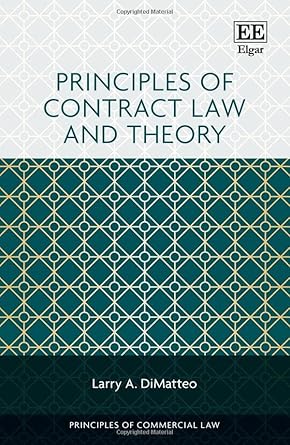
This is the fifteenth post in my series on Larry Di Matteo‘s Principles of Contract Law and Theory (Principles). The aim is to call some attention to this book while using it to stimulate my thinking as I once again consider how to teach contracts law to first-year students. Principles is a scholarly textbook addressing advanced topics at a very high level of sophistication.
But Professor DiMatteo also recognizes that the virtues of lag are a hard sell these days, as the traditional law has left consumers vulnerable to what Shmuel Becher and Uri Benoliel have called “dark patterns.” (348-49) We still teach contracts law as though transactions take place in the realm of what Peggy Radin called “World A,” the world of agreement, involving actual consent. In fact, World B, the world of boilerplate agreements, dominates commercial and especially consumer transactions, and objective manifestations of assent suffice in circumstances where at least one party has no idea of the contents of the contract beyond a few salient terms. Vendors and service-providers leverage our extremely limited requirements for indicia of consent to lard agreements with one-sided terms and to tether consumers and employees to broad arbitration provisions that expand vertically to all interactions with the seller/service provider/employer and horizontally to all interactions with related business entities. At the same time, commercial transactions are increasingly automated, posing challenges of digital agents, decentralized autonomous organizations, and entities that claim to exist everywhere and nowhere, thus claiming that no court has jurisdiction over them. By the time we work out how to regulate new technology, that technology has been superseded, and our legal constructs are outmoded.
The problem is not new. Professor DiMatteo’s draws on Roscoe Pound’s work highlighting the problems of law’s under-enforcement. One of the aims of legal realism as a movement for law reform was to bring law on the books more in line with experience. (350) Sometimes, the disconnect between the law and the books and the law in action is a product of judges applying legal rules differently in different contexts — e.g. strict enforcement of the parol evidence rule in commercial contexts but liberality in consumer contracts.
But sometimes the law on the books simply does not provide the best way to explain the outcome of cases. (351) Even so, law is not irrelevant. Parties work out their differences in the “shadow of the law;” legal norms lurk in the backgrounds as the parties work other their deals and the differences. (351-52) That said, Professor DiMatteo also uses the work of Stewart Macaulay, Ian Macneil, and Lisa Bernstein to illustrate how certain industries operate largely on a relational basis, dispensing with law courts, developing specialized contracts that are enforced through non-legal means, or as a last resort, through private arbitral bodies. (352-55)

The last few sections of the chapter sum up some of the themes of the book. First, Professor DiMatteo notes the considerable convergence of common law and civil law in action despite some seeming doctrinal divergence. Specifically, he addresses specific performance and enforcement of penalties. Civil law countries are supposed to favor specific performance, but courts prefer the “one-and-done” remedy of damages. Common law courts are not supposed to allow penalties, but the area is a often litigated and courts sometimes find justifications for enforcement. (358-59) He next reviews the CISG and uses it as an opportunity to compare civil law and common law approaches. (359-61) In this context, a comparison of the CISG and the UCC might also have been instructive, but Professor DiMatteo uses the CISG as a guide to continuing divergences between civil law and common law approaches, providing “an interesting exercise in comparative contract law.” (361)
Professor DiMatteo notes that contract scholarship, once a driver of doctrine, has had diminished influence since the early twentieth century. (362-63) He reiterates his view, following P.S. Atiyah, that there is no master theory that explains the entire realm of contracts law. (364-65) Finally, Professor DiMatteo returns to the theme of relational contracting. (365-67) Here, the prescription is not so much doctrinal as transactional. Parties who understand the relational nature of contracting can draft contracts with the flexibility necessary to both strengthen a partnership and allow it to develop without the resort to adversarial modes of dispute resolution.
I will return next week with some final thoughts out Professor DiMatteo’s work, summing up his themes and reflecting on how I will adjust my own approach to teaching contracts based on what I have learned from reading his book.
The first post in this series, providing an introduction, covering history, law and equity, justifications for contract law, rules principles, and standards, specialized rules, and boundaries of contract, can be found here
Part II, a foray into comparative contracts law, is here.
Part III, a discussion of freedom of contract and five tensions through which contract law navigates, is here.
Part IV, on formalism, is here.
Part V, about substantive elements of contract, is here.
Part VI, remedies, excuse, and privity, is here.
Part VII, about defenses, is here.
Part VIII, on interpretation, is here.
Part IX, about standard terms and form contracting, is here.
Part X, on legal history and theories of legal development, is here.
Part XI, about classical contract theory, is here.
Part XII, about reliance and fault, is here.
Part XIII, about legal theory, is here.
Part IV, on critical theory, is here