
Reviewing Larry DiMatteo, Principles of Contract Law and Theory, Part XVI: Recap
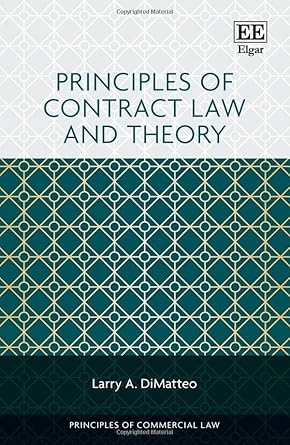
This is the sixteenth and final post in my series on Larry Di Matteo‘s Principles of Contract Law and Theory (Principles). The aim is to call some attention to this book while using it to stimulate my thinking as I once again consider how to teach contracts law to first-year students. Principles is a scholarly textbook addressing advanced topics at a very high level of sophistication.
Those who think more of symmetry and logic in the development of legal rules than of practical adaptation to the attainment of a just result will be troubled by a classification where the lines of division are so wavering and blurred. Something, doubtless, may be said on the score of consistency and certainty in favor of a stricter standard. The courts have balanced such considerations against those of equity and fairness, and found the latter to be the weightier. The decisions in this state commit us to the liberal view, which is making its way, nowadays, in jurisdictions slow to welcome it.
And yet, Judge Cardozo’s own New York State retains its decidedly Willistonian take on the parol evidence rule and extrinsic evidence more generally.

From the teaching perspective, Principles offers numerous fresh insights. I found Professor DiMatteo’s discussion of contracts’ “regulatory” function highly illuminating. In his view, contracts doctrine plays a role in regulating freedom of contract, sometimes overtly through affirmative defenses and excuses, sometimes more covertly through the wiles of interpretation and judicial discretion. In addition, you only have to think about matters for a moment to realize the truth of Professor DiMatteo’s observation that contracts often have unenforceable express terms, and all contracts have enforceable invisible terms. Stating the matter this boldly is a powerful way to combat some students’ ardent attachment to a bloody-minded textualism. We can all be grateful for the courts’ power to imply terms, as their ability to do so significantly reduces transaction costs. Complementing implied terms, part of the courts’ regulatory function, is to refuse to enforce penalties and unconscionable provisions inserted for their in terrorem effect.
Finally, on the subject of legal theory, Professor DiMatteo provides a wonderfully broad survey of different theoretical approaches to contracts law, and he takes pains to present them in their best light. As would be expected from a comparativist with an interest in the historical development of the law, he is a pluralist. He is sympathetic to legal realism and to critical theories, although I think he has his doubts about the ability of the latter to influence doctrine. On the other hand, I think he underestimates the impact of law and economics on legal doctrine, especially in the areas of form contracting and electronic contracting. One senses his deep affection for the progressive contextualists, especially Lord Denning and Judge Cardozo and for the work of the Wisconsin School of relational contracts theory. It is thus fitting that his book concludes with a chapter on law in action.
The first post in this series, providing an introduction, covering history, law and equity, justifications for contract law, rules principles, and standards, specialized rules, and boundaries of contract, can be found here
Part II, a foray into comparative contracts law, is here.
Part III, a discussion of freedom of contract and five tensions through which contract law navigates, is here.
Part IV, on formalism, is here.
Part V, about substantive elements of contract, is here.
Part VI, remedies, excuse, and privity, is here.
Part VII, about defenses, is here.
Part VIII, on interpretation, is here.
Part IX, about standard terms and form contracting, is here.
Part X, on legal history and theories of legal development, is here.
Part XI, about classical contract theory, is here.
Part XII, about reliance and fault, is here.
Part XIII, about legal theory, is here.
Part XIV, on critical theory, is here.
Part XV, on law in action, is here.