
NY Court of Appeals Sends Claims of Injured Uber User to Arbitration

In July 2020, Emily Wu make use of Uber’s services. Her driver allegedly discharged her in the middle of the roadway, where she was struck by another vehicle immediately upon exiting her Uber car. In November 2020, she commenced an action in New York state court, which included a claim against Uber for negligence. Uber, distracted by COVID, did not respond to the complaint within 30 days, as required under New York law. However, it did update its terms of service, and Ms. Wu, apparently dependent on Uber’s services, agreed to the new terms. The new terms provided for arbitration of any claims relating to the use of the service, even if the claims occurred prior to the user’s agreement to Uber’s new terms.
When Ms. Wu moved for a default judgment in March, 2021, Uber responded with a motion to compel arbitration. Her attorney responded (and I love this move!) by seeking sanctions against Uber because its updated terms constituted direct communications with Ms. Wu, a represented party. New York’s Supreme Court rejected the call for sactions and ordered arbitration. The Appellate Division affirmed.
In Wu v. Uber Techologies, Inc., New York’s Court of Appeals affirmed. The default judgment argument was not Ms. Wu’s only ground for challenging the motion to compel arbitration, but of course Uber’s terms provide that all threshold issues relating to arbitrability are for the arbiter to decide. After laying out the standard rules and policies governing courts’ application of the Federal Arbitration Act (FAA), the Court begins its substantive discussion by observing,
There is no sound reason why the contract principles described above should not be applied to web-based contracts in the same manner as they have long been applied to traditional written contracts.
The Court obviously does not read this blog or the work of Nancy Kim, Peggy Radin, Andrea Boyack, and myriad others. It would be one thing to consider and reject arguments for why web-based contracts should not be treated like traditional contracts. To refuse to even acknowledge that such arguments exist or to contend that they are not “sound” is far less than I would expect from the high court of the great state of New York.
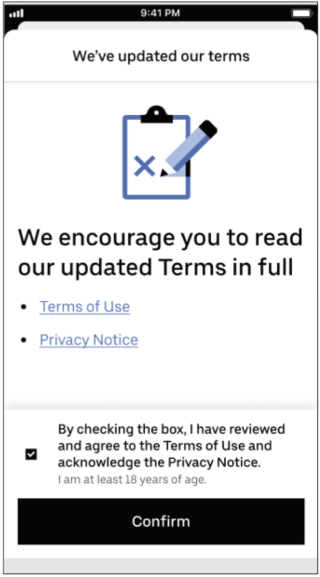
Judge Rivera, joined by Chief Judge Wilson, dissented. Judge Rivera found that Ms. Wu had never agreed to arbitrate the claim that she had already brought before she received Uber’s updated terms. The update that she received did not provide to her adequate notice that by agreement to a new arbitration provision she was agreeing that it would be given retroactive effect to her pending claim.Unexpected terms do not become part of an agreement unless the party agreeing to such terms had inquiry notice of those terms. Here, Ms. Wu had inquiry notice of an arbitration agreement but not of its retroactive effects. The update makes no reference to pending litigation or to the arbitration agreement’s effect on the venue of such litigation. The dissent concludes:
Uber would have this Court believe that by simply clicking a box on the Uber app while waiting for the car service, plaintiff, without benefit of counsel’s advice, forfeited her right to litigate her claims before the judiciary of the state of New York. That is nonsense.
There is a bitter irony to the outcome of this case. A plaintiff who has alleged that she was injured by the negligence of a company valued in the range of $100 billion is expected to read and understand a complex arbitration agreement before using a ride-sharing app. The company is excused from not having timely answered a complaint. We have to read documents that a layperson could not possibly understand. The company does not have to respond to straightforward legal documents that it has the personnel and expertise to handle. It’s excuse? COVID. That’s just lame. Uber should be laughed into court.