
Belatedly Introducing the Money Stuff Podcast, with Matt Levine and Katie Greifeld
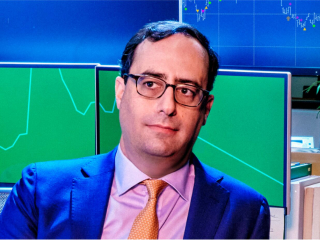
I recently discovered that Mr. Levine has taken to podcasting about his Money Stuff column, along with his co-host Katie Greifeld, (below right), who provides an intelligent conversation partner for Mr. Levine. There is a bit of a yin/yang thing between them, in that Matt likes markets to work efficiently and Katie likes chaos. But both like humor, and that is what makes Money Stuff not just educational but fun. I have gone back to the first episode and am catching up. I expect that I will have a lot of blog fodder from the podcast, as I learn so much form it and it gives me so many fresh ideas to write about.

The first episode has four segments, each of which provides blogworthy content. The first segment is about the Destiny Tech 100 Fund (DXYZ). Destiny gives investors the ability to purchase an interest in shares of privately-held tech companies. As of their most recent disclosure, about half of the portfolio is SpaceX. Money Stuff focuses on the odd fact that when Destiny went public, the valuation of the stock mushroomed to $500 million when the valuation of the portfolio was only $50 million. When the Money Stuff folks did their reporting one year ago, the stock had just peaked at $60/share. It then fell back to earth, mostly hovering between $10-15/share, but then it exploded again after the elections to $70/share. It’s now settled in at around $30/share.
One recurring theme on the podcast that I want to highlight is rational irrationality. Given the subject matter, it should not surprise that my observations are derivative [pause while you appreciate that joke]. I make no claims to original insights for the ranks of the professoriate, but some readers of this Blog may not think about such matters very often, so my rudimentary takes may be new to them or they may be a helpful reminder.
I thought that last week was a big week for rational irrationality. There was no real good financial news in the media, but the markets exploded on rumors of good news on the horizon. A rational person would not put much faith in this administration’s promises of new trade deals in the works or relaxations of tariffs rates. But the markets are not rational; they believe what they want to believe, so the rational money buys on the dip and will no doubt dump when the markets whipsaw with the next battle in the trade war.
My two cents to add on to this segment is that there are two possibilities. One is that these privately held tech start-ups are radically undervalued, which I doubt. The other is that a lot of people want in on these companies, and they are willing to pay far in excess of the companies’ valuation in order to do so. Economic theory tells us that stock prices should not respond to laws of supply and demand. If the value of a stock is $10/share, it should sell at that price, no matter how many people want to own it. But investors can be irrational. Rational investors know of that irrationality and are happy to exploit it, boosting the stock price well above the value of the underlying asset and then selling to the irrational marks once the stock has peaked.
The second segment is about Avi Eisenberg, who devised an incredibly simple trick for making $117 million in 2022 by manipulating positions (longs and shorts) in Mango Markets (MNGO), a decentralized finance platform. Matt Levine’s money quote [I pause again while you appreciate the joke] describes both this caper and the attitude of crypto capitalists generally. Matt and Katie focus on the tension between the regulators’ perspective that “law is law” and the crypto-investors perspective that “code is law.” Matt says, “As long as you’re the smart one, you’re like ‘Ahhhh, anything goes, you don’t need regulators,’ but then you get blown up and you’re like, ‘Ahhhhh, where were those regulators?” Worth a listen just to hear Matt’s “Ahhhh, which I can’t really translate into print.
Mr. Eisenberg was so confident that code is law that he took to Discord to brag about his “hack” and to defend it as completely consistent with the protocols that Mango had set up. Those protocols had a vulnerability; he exploited it. Things went a bit too well. Mango’s losses exceeded its insurance coverage, and the platform was in danger of collapse. Mr. Eisenberg agreed to return $67 million of his winnings in exchange for Mango’s promise not to press charges.
Well, federal prosecutors don’t think that code is law. They think law is law, and as Amin Ayan reports here on Cryptonews, prosecutors are now seeking a 6.5 year sentence for Mr. Eisenberg, who was convicted in April 2024 for wire fraud, commodities fraud, and market manipulation. I find the wire fraud and commodities fraud charges a bit puzzling, as one of the interesting features of this story is how open Mr. Eisenberg was about what he was doing. Market manipulation may be another matter. Having looked at the indictment, I see that he was charged under 7 USC § 13(a)(2), which makes it a felony for:
Any person to manipulate or attempt to manipulate the price of any commodity in interstate commerce, or for future delivery on or subject to the rules of any registered entity, or of any swap, or to corner or attempt to corner any such commodity or knowingly to deliver or cause to be delivered for transmission through the mails or interstate commerce by telegraph, telephone, wireless, or other means of communication false or misleading or knowingly inaccurate reports concerning crop or market information or conditions that affect or tend to affect the price of any commodity in interstate commerce, or knowingly [to violate various other provisions of the Code.]
The unusual thing about market manipulation is that it doesn’t require any deception, and it seems to apply on the facts here.
According to Alex Costa, reporting on DailyCoin, Mango Markets shut down in January, never having recovered from having its vulnerabilities exposed. Mango is seeking restitution of the remaining $47 million that Mr. Eisenberg kept from his scheme. He’s got other problems, as prosecutors found child pornography in his possession while investigating his other crimes.
Very few sectors of the economy are as risk-averse as academics. Law professors and perhaps business professors like to tell ourselves that we could have made a lot more money if we had stayed in private practice, and that is certainly true for some of us. But most of us have happily traded job security, status, and the ability to control our own lives for the pursuit of wealth. I admit, I don’t think I could have made huge sums as an attorney, because I could never work whole-heartedly on behalf of clients to whose fate I was largely indifferent. I lasted as long as I did because I always, with one exception, esteemed my client’s adversary somewhere below indifference. Being averse to risk and not really interested in vast wealth, I have a hard time understanding people who devote their lives to making something from nothing.
At my former law school, I had colleagues who viewed life from the perspective of a tax attorney looking for the lucrative loophole. They had something like mild contempt for people who were governed by norms rather than by law. And now an infinitely more extreme version of such people runs the country. We need to appreciate thee psychology and the worldviews of these people and do so fast.