
A Memory of Jürgen Habermas, 1929-2026
Jürgen Habermas was an important intellectual influence for me. The main theorists who informed my dissertation were Foucault, Bourdieu, and Habermas. The dissertation was a failure, but that wasn’t their fault. My Habermas was the Habermas of Strukturwandel der Öffentlichkeit (The Structural Transformation of the Public Sphere), published the year before I was born. By the time I was in graduate school, Habermas had moved on from historical sociology to linguistics, but I remained mired in the Habermas who fused Marx and Weber and grounded his analysis in the social sciences.
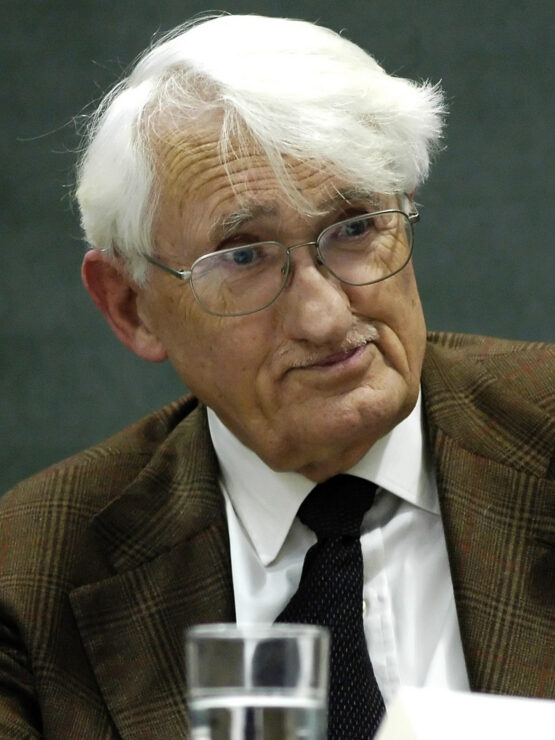
Photo by Wolfram Huke, CC BY-SA 3.0
Later, when I was in law school, I participated in Ronald Dworkin’s seminar and colloquium. I’m sure Professor Dworkin’s experience of the seminar was different from mine, but for me it was the semester-long struggle of a student trained in post-structuralism with a genial, well-intentioned, and brilliant legal philosopher who refused to take post-structuralist positions seriously.
Jürgen Habermas co-taught the seminar in the second half of the semester. I was barely able to control my excitement to sit in a seminar room with him every week for seven weeks. When I shared my excitement with a classmate at the start of the semester, he responded, “Habermas? Isn’t he dead?”
Once Habermas joined us, I felt like I had an ally in the classroom, but Habermas and Dworkin were both so genial, they seldom clashed openly. Still, I often caught, or thought I caught, a twinkle of wry skepticism in Habermas’s eye and a trace of bemusement at the corners of his habitual, misshaped grin. But one day, the gloves came off, and the seminar room turned into a sandbox. Dworkin was expounding on one of his hobby-horses — the existence of universal moral truths. Habermas expressed mild skepticism.
Dworkin: But there are universal moral truths.
Habermas: No, there are not.
Dworkin: But surely it is universally true and everybody would agree that intentional cruelty is wrong.
Habermas (smiling): No, they would not.
Dworkin (concerned): Who would not agree to that?
Habermas (as though reminded of a good friend): The Marquis de Sade would not agree.
Dworkin (genuinely flummoxed): But what would the Marquis de Sade call an intentional act of cruelty?
Habermas (radiating joy): A celebration!
Dworkin was dumbfounded and moved the conversation in another direction. I was so grateful to Habermas for that intervention. I had never seen a dispute between two philosophers settled more clearly in one side’s favor.
I don’t blame Ronald Dworkin for his idealism. These days, more and more, I wish I could live in Dworkin’s world — a world in which one can be confident that people worldwide share the same fundamental moral intuitions. Unfortunately, that is not how I experience the world. Habermas is gone, but world events daily evidence the profundity of his understanding of the human condition.