
Friday Frivolity: Another Day, Another NIL Suit
As Justin Williams reports for The New York Times, The Athletic, Texas Tech is paying up to $5 million to Brendan Sorsby (below), who played last season for the University of Cincinnati and was committed to playing for them again in 2026. The University of Cincinnati is not taking the news lying down; it is suing to enforce a $1 million liquidated damages provision in its revenue-sharing agreement with Mr. Sorsby.
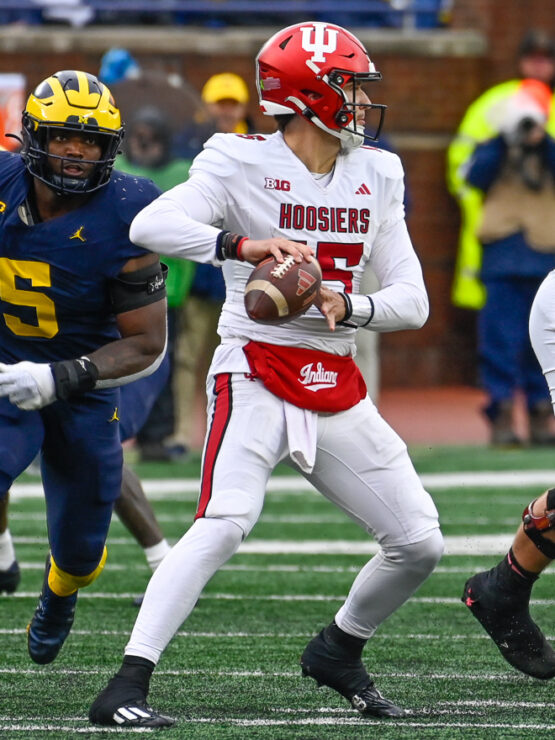
As indicated in Mr. Williams’ previous reporting, the enforcement guidelines of the College Sports Commission, which oversees revenue sharing, requires that Texas Tech account for the $1 million buyout that Mr. Sorsby is obligated to pay Cincinnati. I’m not sure what that means. Does the $1 million automatically count against Texas Tech’s $20.5 million revenue-sharing cap whether Texas Tech covers for Mr. Sorsby or not? I am already gobsmacked that a university would blow nearly 1/5 of its revenue-sharing budget on one player, but if Texas Tech pays an additional $1 million for Mr. Sorsby’s buyout, it is spending nearly 1/4 of its revenue-sharing budget on one guy.
When are some people going to get in a room, look around, and ask, “How did we get here?” Higher education is on the brink of collapse. Kids graduate high school with college credit so that they can graduate college in three years or less. Increasingly, colleges and universities are under pressure to grant three-year degrees that recognize little more than vocational training. Right now, the federal government is pulling funding from scientific research and threatening research universities with multi-billion dollar lawsuits. It is hard to run graduate programs in the sciences when you cannot fund the labs in which those graduates will conduct their research.
The advent of artificial intelligence and large language models has made it nearly impossible to teach students in the humanities and social sciences, as it is increasingly difficult to design assessments that students cannot entrust to AI to complete. Students see no point in learning skills that machines can do better than they can, and university administrators, long skeptical that education in the humanities justified the associated costs, have new grounds for gutting the programs that provide the building blocks of liberal arts education. English departments can’t afford to use their copy machines, but universities have $5 million to spend on a quarterback?
Even the people at the center of all of this must realize that it is a gross misallocation of resources. If people want to pay to see a football game, let them do so. What any of this has to do with institutions of higher education is increasingly mysterious. Go ahead and check Mr. Sorsby’s Wikipedia page or the articles about him. I can’t find any reference to the education he is getting while he is playing football. He is on his third institution, so when you cheer for him, you really are not cheering for the school — after leading Cincinnati to its first bowl game since 2022, he sat out the Liberty Bowl after announcing that he was entering the portal, and his team got stomped.
The parties spew nauseating rhetoric in connection with these suits. Here is Cincinnati:
In his lucrative NIL agreement with Cincinnati athletics, Brendan Sorsby committed to stay and play for two seasons as a proud Bearcat representative. He also agreed that if he left the university before that time, he would pay the university a specific amount for the substantial harm that his breach would cause. Cincinnati athletics intends to enforce that contractual commitment. As stewards of the university’s resources, the athletics department has a duty to do so.
Mr. Sorsby’s representative responds:
Pursuing legal action against Brendan Sorsby is misguided. University of Cincinnati, through its revenue-share structure, paid him $875,800 for a season he fully completed, and in that time, he generated millions in value for the program. Attempting to recover those funds now sends the wrong message to current and future student-athletes and risks damaging the long-term credibility of Cincinnati football.
None of this is about higher education. I’m not even sure it is about athletics. It is about money. Athletics is now justified in terms of the valuable contracts and licensing deals it can win for universities. At some point, one would hope that students and alumni demand more from their athletics programs than that, like actual student-athletes who are members of the college community, and coaches and administrators committed to the university’s overall goals of education, research, and giving back to the community.