
Kim Krawiec Assesses the New York Times’ Report on Foreigners Getting Kidney Transplants in the United States
When I saw this story in The New York Times, I immediately assumed it would feature Professor Kim Krawiec’s thoughts on the matter. Her name does not appear. But she has posted her thoughts on her Substack.
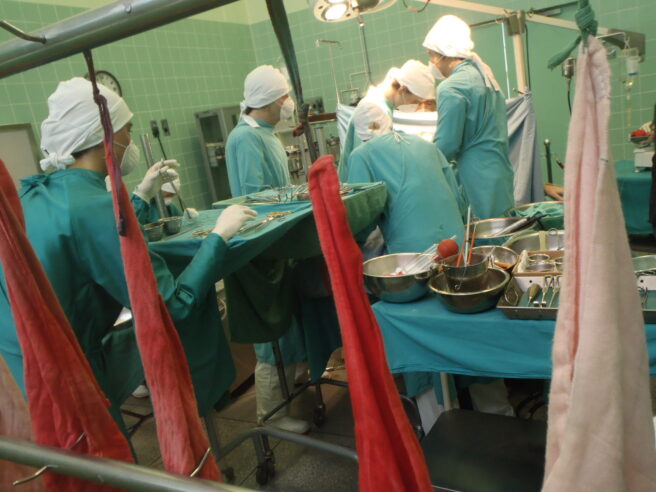
Re-enactment of the first heart transplant.
The story in The Times is by Brian M. Rosenthal and Mark Hansen. Perhaps there should be a market in human organs, one might muse. That way, the organs would go to the people who value them most at a price determined by market forces, generating optimal revenues that medical professionals and medical institutions could use to support worthy causes such as the advancement of medical science or the just remuneration of the skilled professionals who make organ transplants possible.
Good news, law and economics folks: there is a market in human organs! But perhaps the form it takes supplements market forces with a great deal of random corruption. The Times reports that hospitals are giving priority to rich foreigners while Americans die awaiting their chance at a life-saving transplant. The Times’ story begins with an anecdote about the wife of a Japanese hotel magnate who got a heart transplant, apparently in exchange for a donation from the magnate’s charity to a non-profit group run by the surgeon’s wife. The Times presents this as though it is obviously some sort of a bribe, but is it? It is conceivable that the magnate was grateful to the surgeon for the care he showed for the magnate’s wife. He wanted to make a special gift to the doctor and do it in a form that would not make it seem like the doctor was unjustly enriched. Donating to a person’s favorite charity is a way to do that. What’s the harm?
Hospitals court foreign clientele. An international transplant patient can bring in up to $2 million, which is more than Americans with private insurance or Medicare will pay. The numbers aren’t huge — just over a hundred foreign patients a year — but The Times thinks it has caught the practice on an upward trend, especially at certain hospitals.
International law frowns on such practices, but the United States still allows organ donation tourism. The hospitals engaged in the practice don’t have much to say. It’s all perfectly legal. “Our medical center doesn’t expedite listing evaluations for any patient,” the University of Chicago said. But The Times also found this text message: “We will do him,” one [hospital worker] said, “he is international 🤑.”

Professor Krawiec’s position is decidedly more nuanced than the emoji quote. It is not entirely clear how The Times arrived at its conclusion that international organ donors receive their transplants more quickly. Moreover, Professor Krawiec and her co-author Alvin Roth have argued in favor of international organ donations. Of course, it is one thing to favor systems that do not discriminate based on nationality and quite another to have a system that discriminates based on wealth. Moreover, as I said at the top, it might be okay to have a regulated market in organ transplantation that uses the proceeds to promote more organ transplantation or other medical advances. I don’t think anyone would design a system in which the proceeds go to the surgeon’s pet charity.