
Sid DeLong on Legal Fictions
Telling a Pickaxe From a Case-Knife or How to Recognize a Legal Fiction When You See One.
Sidney W. DeLong
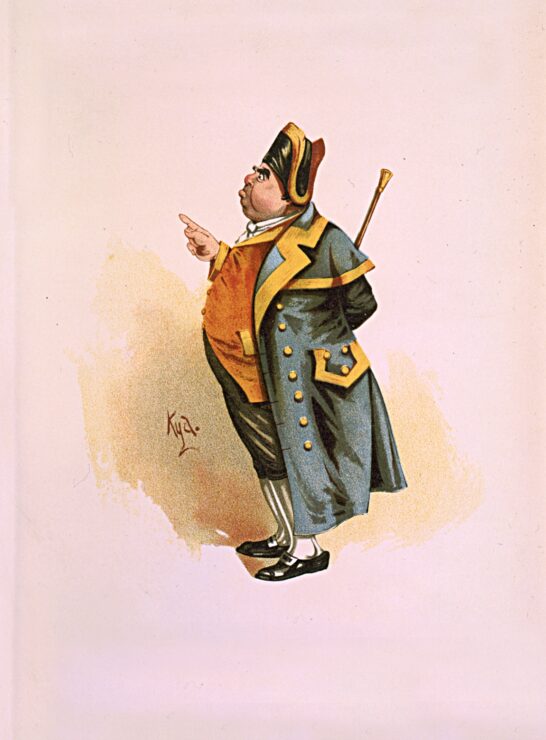
When Mr. Bumble (below) n Oliver Twist was told that he was legally responsible for the debts of his wife because “the law supposes that your wife acts under your direction,” he replies, “If the law supposes that the law is a ass, a idiot. If that’s the eye of the law, the law is a bachelor.”
Mr. Bumble had encountered a legal fiction. The legal historian Henry Maine defined legal fiction as any assumption which conceals “the fact that a rule of law has undergone alteration, its letter remaining unchanged, its operation being modified.” Jeremy Bentham despised legal fictions as “the most pernicious and basest form of lying.” Yet, as Lon Fuller recounts in his monograph Legal Fictions, legal fictions are essential to the smooth operation of justice.
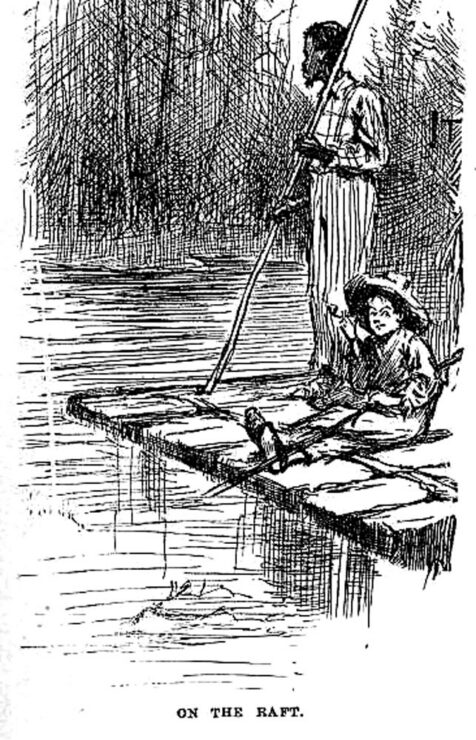
Harvard Law School Dean Roscoe Pound dramatized the importance of legal fictions by using a passage from Mark Twain’s The Adventures of Huckleberry Finn. In the excerpt quoted below, Tom Sawyer and Huck Finn are trying to rescue Huck’s friend Jim, who had escaped from slavery only to be recaptured and imprisoned in a locked cabin with a dirt floor. Unlike Huck, Tom has read a lot of adventure fiction and is familiar with stories of jailbreaks like the one they are planning for Jim. Pound begins:
When Tom Sawyer and Huck Finn had determined to rescue Jim by digging under the cabin where he was confined, it seemed to the uninformed lay mind of Huck Finn that some old picks the boys had found were the proper implements to use. But Tom knew better. From reading he knew what was the right course in such cases, and it called for case-knives [A case-knife is a knife kept in a sheath or case].
“It don’t make no difference,” said Tom, “how foolish it is, it’s the right way — and it’s the regular way. And there ain’t no other way that ever I heard of, and I’ve read all the books that gives any information about these things. They always dig out with a case-knife.”
Pound continues:
So, in deference to the books and the proprieties, the boys set to work with case-knives. But after they had dug till nearly midnight and they were tired and their hands were blistered, and they had made little progress, a light came to Tom’s legal mind. He dropped his knife and, turning to Huck, said firmly, “Gimme a case-knife.” Let Huck tell the rest:
“He had his own by him, but I handed him mine. He flung it down and says, “Gimme a case-knife !”
“I didn’t know just what to do — but then I thought. I scratched around amongst the old tools and got a pickaxe and give it to him, and he took it and went to work and never said a word.
“He was always just that particular. Full of principle.”
Pound continues:
Tom had made over again one of the earliest discoveries of the law. When tradition prescribed case-knives for tasks for which pickaxes were better adapted, it seemed better to our forefathers, after a little vain struggle with case-knives, to adhere to principle — but use the pickaxe.
They granted that law ought not to change. Changes in law were full of danger. But, on the other hand, it was highly inconvenient to use case-knives. And so the law has always managed to get a pickaxe in its hands (though it steadfastly demanded a case-knife) and to wield it in the virtuous belief that it was using the approved instrument.”
Roscoe Pound, Law in Books and Law in Action, 44 Am. L. Rev. 12-14 (1910).
Many casebooks include Sceva v True, which contains a candid judicial acknowledgement of the role of fiction in contract law expressed in what Llewellyn called the “Grand Style” of adjudication:
Suppose a man steals my horse and afterwards sells it for cash. The law says I may waive the tort and recover the money received for the animal of him in an action of assumpsit. Why? Because the law, in order to protect my legal right to have the money, and enforce against the thief his legal duty to hand it over to me, implies a promise, that is, feigns a promise when there is none to support the assumpsit. In order to recover, I have only to show that the defendant, without right, sold my horse for cash, which he still retains.
Where are the circumstances, the language or conduct of the parties from which a meeting of their minds is to be inferred, or implied, or imagined, or in any way found by the jury? The defendant never had any other purpose but to get the money for the horse and make off with it. The owner of the horse had no intention to sell it, never assented to the sale, and only seeks to recover the money obtained for it to save himself from total loss.
The defendant, in such a case, may have the physical capacity to promise to pay over to the owner the money which he means to steal; but the mental and moral capacity is wanting, and to all practical intents the capacity to promise according to this duty may be said to be as entirely wanting as in the case of an idiot or lunatic. At all events, he does not do it. He struggles to get away with the money, and resists with a determination never to pay if he can help it. Yet the law implies, and against his utmost resistance forces into his mouth, a promise to pay. . . .
A contract implied by law . . . rests upon no evidence. It has no actual existence; it is simply a mythical creation of the law. The law says it shall be taken that there was a promise, when in point of fact, there was none.
Of course this is not good logic, for the obvious and sufficient reason that it is not true. It is a legal fiction, resting wholly for its support on a plain legal obligation, and a plain legal right. If it were true, it would not be a fiction..
Sceva v True
How to Recognize a Pickaxe When You See One.
It was easy to recognize some early legal fictions. Fuller mentions the pleading that gave the courts of London subject matter jurisdiction to decide disputes arising anywhere in the world by pleading that the event had taken place within the city of London. This could not be traversed.
If you think you have never seen a legal fiction, think again. Legal fictions are not quaint artifacts of our legal ancestors but are common today, as Lon Fuller described in his monograph Legal Fictions.
In today’s legal world, the surest sign that you are in the presence of a pick axe, a legal fiction, is the adjective “’constructive,” as in “constructive contract,” “constructive intent, “constructive notice,” “constructive eviction,” “constructive abandonment or desertion,” “constructive trust,” “constructive condition,” “constructive possession,” etc.
A constructive contract is a fictional contract that a court invents in order to justify imposing an obligation that rests on no promise at all. Constructive notice is fictional notice that will be treated as if it were actual notice, etc. In a legal thesaurus, a perfect synonym for “constructive” is “fictional.”
A more modern form of a legal fiction is the “conclusive presumption” whereby an essential but non-existent legal requirement is conclusively presumed, or “deemed” to exist. A familiar example from the law of secured transactions is the “relation back’ doctrine, whereby a public filing of a notice of a security interest within 20 days after its creation is “deemed” to relate back to the date of the creation and to give “constructive notice” of the filing to any buyer of the collateral who may have purchased it during the 20 day period in ignorance of the interest. Rather like Mr. Bumble, such a buyer may think it irrational that he is conclusively presumed to have had notice of a filing that did not yet exist at the time of his purchase.
Our job as law professors is to persuade our secured transaction students not to sympathize with the unfortunate buyer. Our students must be able to say, as did the White Queen in response to Alice who claimed that one could not believe impossible things:
“I daresay you haven’t had much practice. When I was your age, I always did it for half-an-hour a day. Why, sometimes I’ve believed as many as six impossible things before breakfast.” Part of learning to think like a lawyer is learning to accept legal fictions without a sense of dissonance.
Legislative Legal Fictions. Legislatures have no reason to amend legal rules by legal fictions because they have the power simply to rewrite the rules. Laws rarely contain the indicia of legal fiction such as words like “constructive”, “conclusively presumed,” or “deemed.” If they want to change a rule that relates to farm animals, for example, to extend to domestic pets they can simply change the statutory definition of “farm animals” to include dogs and cats, i.e. by defining a “case-knife” to include a “pickaxe.” Under the UCC definitions, gasoline is classified as a “farm product” [§ 9-102 (34) (C)], a lawyer can be a “merchant,” a “debtor” can be one who is not indebted [§ 9-102 (28) (b)(c)] and “purchase” includes a gift [§ 1-201 (29)]. When the Uniform Commercial Code defined “purchase” to include gift, it gave can give donees the rights of purchasers without changing the law relating to purchasers without acknowledging a change in fundamental law of property. Who reads definitions, after all?
Future posts will address two issues: How have legal fictions permitted the evolution of contract law without acknowledging its fundamental changes? Do legal fictions create non-fictional moral obligations?