
The War on Tenure Arrives in Oklahoma
I have chaired faculty hiring committees at the Oklahoma City University School of Law. I wrote about the experience here and updated that post here. Alas, since the demise of Typepad, none of the links in those posts work, but here’s a summary:

It is extremely difficult to attract qualified applicants to teach law in Oklahoma. For us, many applicants won’t even agree to screening interviews. Others seem enthusiastic at the screening stage but then withdraw before callbacks. It takes some serendipity for us to have a successful national search. In a recent discussion of our search processes, one of my colleagues described our faculty as “a collection of misfit toys.” It is a lovely collection. I am fond of my fellow misfits, but the description is still apt.
My sense, as an outsider, is that OU has better luck recruiting top teachers/scholars but has a hard time keeping them. Reasons vary. Some of those reasons are a product of genuine two-body problems; others stem from ignorance and prejudice. Oklahoma City and Norman are great places to live. But now our state government is conspiring to confirm those prejudices and make it harder than ever to attract academics to the state.
Emma Whitford, writing in Inside Higher Education, reports that Oklahoma Governor Kevin Stitt (below) eliminated tenure at regional and community colleges through an Executive Order. That doesn’t seem entirely accurate to me. What the order does is encourage the Oklahoma State Regents for Higher Education (Regents) to take steps to eliminate tenure. A follow-up Executive Order then directs the Regents to develop performance-based standards for retention of faculty. I may be making a distinction without a difference, as the Governor appoints the Regents, subject to Senate confirmation. The Regents will likely do what they are directed to do, and, as discussed below, the Senate seems inclined, if anything, to go farther than the Governor in the war on tenure.

The Governor’s approach is to retain tenure at research universities, subject to post-tenure review every five years, which is actually a practice that I endorse and which I wish had more teeth than it does. If we had substantive post-tenure review with clear standards at institutions of higher education, that would address the concerns about “tenured deadwood.” Of course, the standards for retaining tenured professors should not be the same as the standards for achieving tenure. Once people are tenured, more of their time is devoted to university service and professional activities and service that do not necessarily result in publications.
The Governor’s plan would preserve existing tenured positions at regional universities and community colleges but permit no new awards of tenure. Rather, the best one could hope for would be a five-year, renewable term. According to Ms. Whitford’s reporting, there are over 400 tenure-track faculty at Oklahoma’s regional universities. On my reading of the Governor’s Executive Order, those faculty members are no longer eligible for tenure. If they were hired for tenure-track positions, that might amount to a breach of contract, but I’m sure working that all out will be complicated. In any case, I would expect that state university administrators, at this point, will be reluctant to grant tenure regardless of merit.
The Governor explained his thinking as follows: “Don’t let someone teach no classes and bring no research dollars in, right? . . . We hear, ‘Well, if we terminate this person, we’ll get sued. It’s not worth it. We’ll just let them do nothing for the next 10 years until hopefully they leave’ … [M]ost Oklahomans think that’s weird, that’s dumb, it shouldn’t happen. Oklahomans will always back excellent faculty, but we should not subsidize systems that put privilege over performance.”
I’ve been in the academy since the 1990s. I have never met an academic who fit Governor Stitt’s description. Maybe somebody who promulgates Executive Orders based on rhetoric and prejudice but no data is prioritizing his own privilege over performance. Study after study shows that people remain as productive post-tenure as they were pre-tenure. And you can’t get the kinds of people who continue to perform based on drive and a sense of professional responsibility to come here (i.e., to Oklahoma) in the first place, if you don’t offer job security. People sacrifice a lot to get academic jobs. My top students make twice my salary in their first year of practice. The kinds of people who have the drive and commitment to make it into the academy are not the kind of people inclined to slack off. And no tenured faculty members are getting rich in the academy. Nor do we have cushy jobs. This week is my Spring Break. I’ve been going to the gym more than I can during a teaching week. Otherwise, I’m catching up on things that are mostly work related. I’ve done some grading, some professional correspondence, I’ve organized a faculty reading group this week. This weekend it will be back to class preparation and getting a start on drafting final exams. Teaching is demanding. I make my own hours, but I still work as much or more than I did when I was in practice.
Academics are not the kind of people who goof off. They are, however, the kind of people who mouth off, and tenure protects, with some noted exceptions, their ability to do so without losing their jobs. Nothing in the two Executive Orders suggests that the preservation of academic freedom is a priority for Oklahoma higher education.
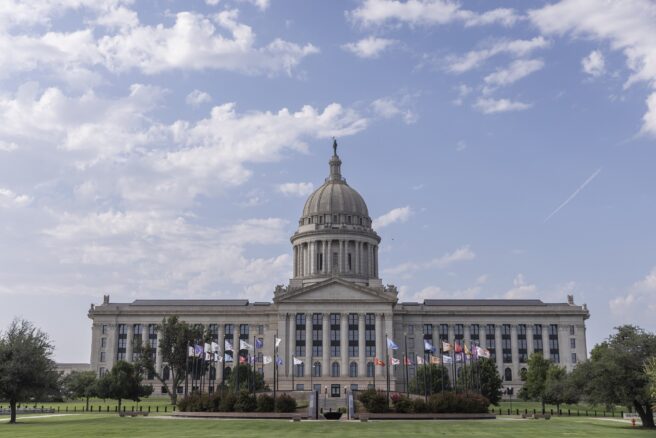
Oklahoma Capitol Building
Now, the legislature wants to finish the job by prohibiting all public higher education institutions from granting tenure, limiting all hires to renewable five-year positions. As Ray Carter reports for the Oklahoma Council for Public Affairs, some people are still mad about their college experiences. According to State Senator Randy Grellner, the sponsor of the new legislation, “When I was going to college … the tenured professor never came in the classroom . . .. It was assistants, graduate assistants. And my kids went through the same thing.”
There is some irony here. According to Wikipedia, Senator Grellner attended Oklahoma State University, so I can understand why he wants to deprive OSU (and perhaps OU) professors of tenure. But perhaps he would have been happier at a community college. I’m pretty sure that the tenured faculty members there, who might have 5/5 teaching loads, enter the classroom. And perhaps instead of going to medical school, he should have gone to law school. Our accreditors require that full-time faculty members (mostly tenured) teach a certain percentage of our classes, including the entire first-year curriculum. My Associate Dean teaches Property and Torts. She does it because, like many of us, she regards being in the classroom as the best part of the job.
But Senator Grellner, if your educational experience was so bad, why did you send your kids to the same kind of institution. I went to private university, but I can remember only one course taught by a graduate student. She was terrific, and she soon landed a tenure-track job at Duke. I was taught economics by a tenured faculty member who won the Nobel Prize for economics, and as a freshman, I was taught by the former dean of the college who went on to be the President of Amherst College. It’s just bizarre to destroy institutions for others because you made a bad choice of colleges or majors.
If it is indeed the case that tenured faculty at Oklahoma research universities never set foot in the classroom, that is a serious problem. The solution is not to eliminate tenure. Nationally recognized scholars are not going to re-locate to Stillwater for five-year gigs. Oklahoma may still attract legal talent to teach in their programs, but they will still never set foot in a classroom, as they will likely bargain for the ability to teach exclusively in online programs, which are coming whether we want them or not, so that they don’t have to uproot their families.
Come to think of it, I have heard of university employees who get paid to do nothing. They are dismissed head coaches whose contracts guarantee their salaries if they get fired not-for-cause. One possible upside of Senator Gellner’s proposed bill: If no employees of public universities can have contracts of longer than five years in duration, head football coaches and basketball coaches at Oklahoma universities will also be limited to five years. I am undoubtedly missing an angle here, or if I’m not, I’m sure the law will be revised to protect the only people who get rich working at public universities and who are also the only university employees who might get paid to do nothing. Or we can get creative and structure long-term faculty contracts as head coaches’ contracts are structured — five years, but they renew every year so that you are perpetually in the first year of a five-year contract.