
Waiver of a Jury Trial Outside of the Arbitration Context
This is a case about a planned subdivision that fell victim to an economic downturn. Bushkill Preserve, LLC (“Bushkill”) and Stone Gate Real Estate, LLC (“Stone Gate”) (collectively, the “Borrowers”) planned a 135-unit manufactured home community. For that purpose, they took out a loan in 2006 from Fulton Financial Corporation (the Bank) through its various entities. A little over decade later, only one-third of the units had been sold, and in 2017, with the Borrowers in default, the Bank sought repayment of the loan.
In 2018, the Borrowers initiated suit, and the Bank counterclaimed. There are lots of issues, but the one that interests us is the question of waiver of the right to a jury trial. Blackstone called the civil jury “the glory of the English law,” and the Framers of the U.S. Constitution placed a similarly high value on the protection of the right to trial by jury. You would never know it if you looked at the cavalier manner with which once-cherished rights are now sacrificed on the alter of mandatory arbitration. This is an unusual case, in that the culprit is not some form agreement in which a well-resourced party insists on a waiver of the right to a jury trial to which the counterparty manifests assent without any actual awareness. Here, we are dealing with two relatively sophisticated parties, although the Bank likely is better-resourced.
A trial court determined that the Borrowers had waived their right to a jury trial and reached a judgment in favor of the Bank for just under $8 million. In an unpublished opinion captioned Pheasant Ridge Development Corp. v. Fulton Financial Corporation, the Superior Court of Pennsylvania affirmed.

The opinion begins by noting that, in the Commonwealth, “the right to a trial by jury in a civil action is fundamental to our system of law” and that “A party may waive its right to a jury trial by conduct or express statement.” The Borrowers had procedural objections to the trial court’s determination that they waived their right to a civil jury, but they also claimed that the waiver was not knowing and intelligent. The Borrowers claimed that their attorney, Craig Dally, had a conflict of interest because he had served as a director for the Bank. That same attorney later became Judge Dally, sitting on the very court in which the case was to proceed. On a motion from the Bank, all of the county judges recused themselves from the case, and a judge from a neighboring country was brought in. Borrowers objected to this as somehow rendering their waiver ineffective. The Court rejected both arguments as without legal support. The principals of the Borrowers and Judge Dally were all sophisticated business men who had worked with the Bank before.
The Court found that the contracts at issue clearly and explicitly informed the Borrowers that they were waiving their jury trial rights, and the Borrowers did not dispute that the waiver applied to this case. As a matter of black letter law, this conclusion seems unassailable. As a matter of public policy, I’m not sure why it is a good thing to let powerful financial entities routinely escape the judgment of a civil jury.
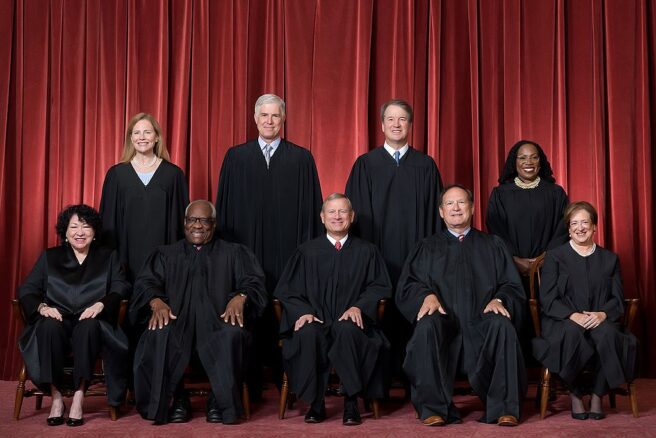
The Supreme Court as it was been comprised since 2022
Credit: Fred Schilling, Collection of the Supreme Court of the United States.
Given the recent Supreme Court decision in Jarkesy, in which the Court held that SEC administrative proceedings violate the right to a jury trial, business entities may be having their cake and eating it too. I don’t know whether the practice of demanding that borrowers waive their right to a jury trial is widespread. If it is, then it is highly ironic that business entities want to avoid juries in the civil context but demand them when facing civil sanctions for SEC violations, as was the case in Jarkesy.