
Ninth Circuit Affirms District Court, Refuses to Enforce Justanswer’s Terms of Service
For many years, I taught Berkson v. Gogo, LLC, even though the original opinion was 83 pages long. I just loved that Judge Jack Weinstein, then in his 90s, was still writing cutting-edge opinions about electronic contracting. I also loved that he wrote a really smart opinion, and a lot of the smarts came from Wrap Contracts, a book by our co-blogger, Nancy Kim. The case was about whether users of a website could be bound by terms of use and automatic subscription renewal when they were not on notice that they were agreeing to pay for anything more than one-time use. Judge Weinstein held that consumers could not be bound by a vendor’s terms of service in those circumstances.
And the case is still good guidance. A recent opinion from the Ninth Circuit in Godun v. JustAnswer LLC seems quite simlar, although it does not cite Judge Weinstein. The plaintiffs in this putative class action went onto JustAnswer’s website and paid between $1 and $5 to get answers from subject-matter experts to specific questions. By agreeing to JustAnswer’s terms of service (ToS), they were registered for a monthly subscription to JustAnswer, which cost between $46 and $60 per month. They sued, citing various state and federal statutes, but JustAnswer cited its ToS, to which plaintiffs had allegedly agreed, and moved to compel arbitration.
Different plaintiffs saw different screens. The opinion provides some examples. This one is typical:
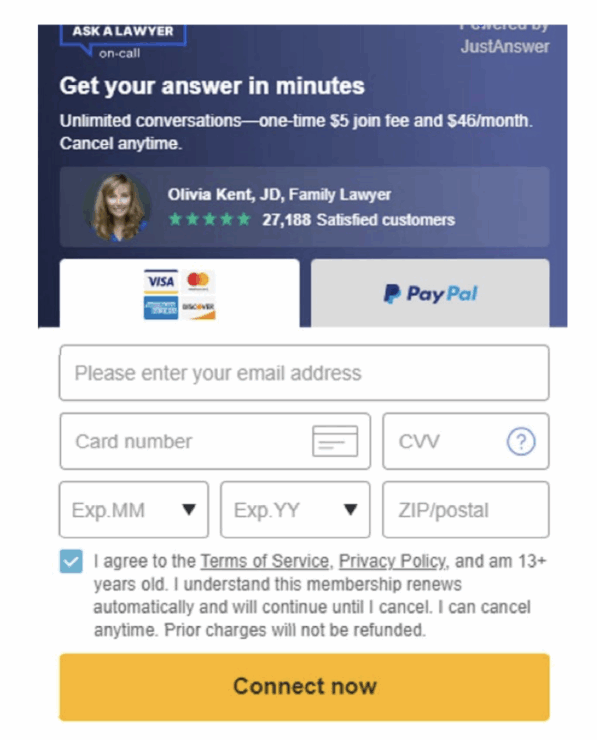
Significantly, the blue-checked box came pre-checked on the website. With respect to some of the plaintiffs, the task for the District Court was made quite easy because the Ninth Circuit had already refused to enforce JustAnswer’s ToS in a 2021 case in which the payment pages were not “legally distinguishable” from the pages at issue here. As to others, the District Court concluded that the “advisals” to plaintiffs that they were assenting to JustAnswer’s ToS were not sufficiently conspicuous. The hyperlinked terms were not highlighted or set apart from other text. There was insufficient warning to plaintiffs that by clicking a button they were agreeing to terms.
As was the case in Berkson, we are dealing here with “sign-in wrap.” Sign-in wraps do not require users to read or specifically agree to terms. Rather, they are bound when they click some other button, which they have to click to proceed with their purchase. The Court applies the appropriate test, inquiring into whether the “the website provides reasonably conspicuous notice of the terms to which the consumer will be bound” and whether the plaintiffs unambiguously manifested assent to terms.
This case is more complicated than most because plaintiffs encountered different sign-in screens when they used JustAnswer. However, the bottom line is the same:
Some Plaintiffs were presented with advisals that were insufficiently conspicuous to put them on inquiry notice. Others weren’t explicitly advised of what actions would be taken to signal assent to contractual terms.
Either way, plaintiffs did not agree to terms and so did not agree to arbitrate their claims.