
A Typical Waiver Form (and Relevant Related Conduct)
I went on a cruise to Alaska last month. I highly recommend it. This was a new experience for us, and part of the cruise experience is “excursions,” where one pays extra for experiences on shore. We went rafting on the Chilkat River near Haines, Alaska. We paid for the excursion through our cruise company, but then when we arrived pier-side to get bussed to the put-in spot, the excursion company presented us with waiver forms that they described as “your ticket to get on the bus.” If you don’t sign, you can’t get on the bus, they warned us.
The forms were presented to us on clipboards with the signature page facing up. I think I was the only person to remove the form from the clipboard and have a look at what I was signing, so this is what is what was presented to my cruise-mates for signature. I apologize for the quality of the image
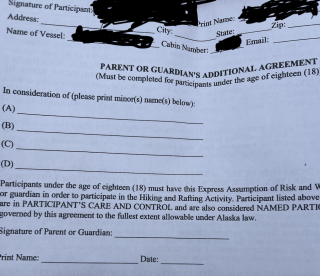
“How would you rate our waiver?” asked the twenty-something guide. “I rate it unenforceable,” I responded. Not the response he was expecting, I imagine.
He said something like, “Well, I don’t have anything to do with the waiver forms; I just pass them out.” When we handed back the forms, they collected them signature side up, so if a customer happened to cross out all of the objectionable language, nobody would have been the wiser.
Here’s what we were expected to agree to: 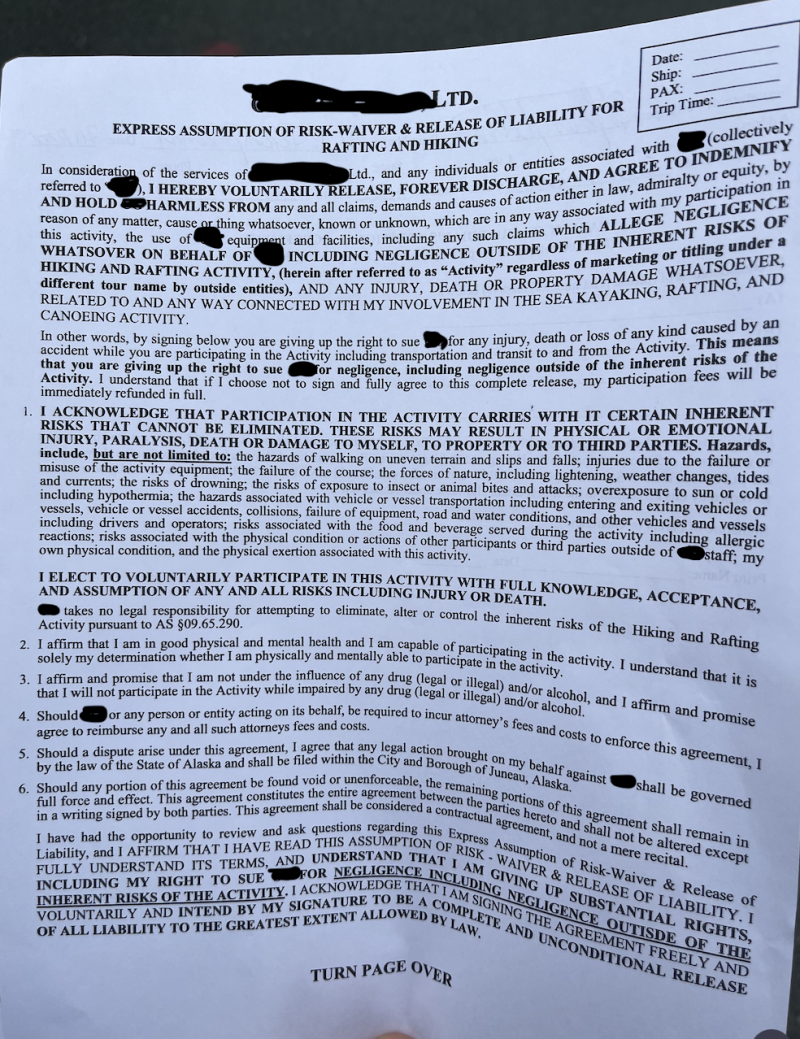
- We start with me, a passenger, promising to indemnify the company for every imaginable harm that might occur on the trip, including harms unrelated to the purposes of the trip. So if, for example, I drop my phone on the bus ride to the river and it slides to the front of the bus, distracting the driver who was already driving negligently, causing him to jerk the wheel a drive the bus into a ditch, causing injury to multiple people. It appears I would bear all costs of the accident, even though the company, one would think, has insurance for such hazards, and I have none.
-
I also agree not to sue for negligence, even resulting in death, which is, as I’ve said before, just odd, because we should want to incentivize companies that take people on excursions to take reasonable precautions against the kinds of hazards that reasonable care would avoid. This language releases them from the obligation to take reasonable precautions even though, once again, they have insurance, and I have only one life.
- They say that if I refuse to sign, my participation fees will be immediately refunded in full. It would be interesting to test out how that works. We signed up for the excursion through the cruise company and paid the cruise company. So how do we get our immediate refund from the excursion company? Somehow, I don’t think the twenty-something who handed me the waiver has a wad of cash available for reimbursements. In any case, the time to present me with a waiver was some time before I traveled thousands of miles to go rafting on a river in Alaska.
- There is a long but non-exclusive list of hazards for which the company will not be liable, even if caused by its or its employees’ negligence. If you get food poisoning at a restaurant, you can sue, but not, apparently, if you ate food offered to you by an excursion company, which could and no-doubt does insure against the risk.
- I agree to pay the company’s legal fees, apparently even if I am alleging injury based on gross negligence or an intentional tort. This strikes me as unconscionable and unenforceable as written.
- The waiver has a serverability clause, so that its unenforceable provisions can be excised. The waiver purports to be an integrated agreement with a no-oral-modifications clause.
- Finally, the signer of the form purports to acknowledge that they had opportunities to ask questions about the form, but that is manifestly untrue. Nobody from the company was available or reasonably could be made available to answer questions, unless one considers the response, “Sign or you can’t get on the bus” an explanation.
Of course, the trip was fine. Nothing happened. The guides were skilled, cautious, and solicitous. Alaska is endlessly beautiful (above right), and we were blessed with nice weather. Companies actually do take the precautions that they need to take. The point is, if they didn’t, the law should not allow legal waivers and exculpatory agreements to protect them from being bankrupted by the negligence suits for which they have to answer or by their inability to acquire insurance because they have a reputation for causing harms through negligence.