
Update on Academic Freedom and Professor Maura Finkelstein

Maura Finkelstein (left) was, until recently, a tenured anthropology professor at Muhlenberg College. She is Jewish, but she is also fierce critic of Israel and a supporter of Palestinians. Her Twitter and BlueSky accounts are about little else. As far as I can tell, her scholarship is about other things, but she taught courses at Muhlenberg College on Palestine, so her commitment to Palestine did not prevent her advancement, even at a college whose student body is 20% Jewish.
According to Ryan Quinn, writing for Inside Higher Education, in May, Professor Finkelstein became the first professor to be fired for pro-Palestinian speech since October 7th. She is appealing the decision and is still being paid by the College. The speech occurred on Professor Finkelstein’s Instagram page in January. She reposted the following statement by a Palestinian poet:
Do not cower to Zionists. Shame them. Do not welcome them in your spaces. Why should these genocide loving fascists be treated any different than any other flat out racist. Don’t normalize Zionism. Don’t normalize Zionists taking up space.
There seems to have been a coordinated campaign against Professor Finkelstein. The College came under pressure from multiple directions. A complaint, referencing Professor Finkelstein, was filed against the College with the Department of Education. The College and media outlets were deluged with thousands of automated e-mails about Professor Finkelstein.
Sarah Viren has a lengthy update in The New York Times. The case encapsulates much the challenges of teaching in the current socio-political environment. Professor Finkelstein made clear that she does not support Hamas and condemns violence. She denounced the October 7th attacks. Nonetheless, students came away with the impression that she thought that Hamas was doing work necessary to the goal of liberating Palestine from its colonial occupation. The students alleged that she made students uncomfortable in her classroom. Students on campus who did not have any personal contact with Professor Finkelstein expressed concern that she was “brainwashing” students with anti-Zionist propaganda.
It is a hard thing to say in the current environment, but we used to recognize the value in making students feel uncomfortable. Educators used to challenge students’ unquestioned assumptions. And students used to actively seek out classes that would force them to confront challenges to their belief systems. When I was in college, I took a Hebrew class in which the professor and I were the only people who were critical of Israel’s government. I knew this, because the professor would often encourage us to talk about contemporary affairs to develop our skills in spoken Hebrew. She voiced her views, which favored territorial compromise and the need for a Palestinian state. My classmates did not feel “brainwashed.” They had brains, and they used them to make counterarguments. That’s what college is for. You think a professor is brainwashing your classmates? Argue with her. If you think you don’t know enough to argue with her, hear her out and then go to the library. Maybe she has some points; maybe it’s all nonsense. You are in college to learn how to tell the difference.
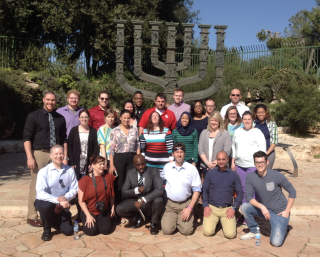
When I taught at the Valparaiso University Law School (RIP), I organized a study abroad course called “The Law of Armed Conflict in Israel and Palestine.” I worked with an Israeli law professor. Our students included American Jews, Israeli Jews, Palestinian Americans, Israeli Palestinians, American Christians, and American Muslims. We hired a “dual narrative” touring company, which provided us with one Jewish Israeli and one Arab Israeli guide. The program was fabulous for my American students. Some of them have continued to reach out to me since the program ended to tell me how profoundly affected they were by it. Their reactions included great enthusiasm for what the state of Israel has accomplished and profound alarm about the plight of the Palestinians.
Working with the Israeli Jews was a challenge for me. They regarded me with skepticism when I lectured on the history of Zionism, a topic they thought they knew, and on the history of the Palestinian national movement, a topic in which they had no interest. I noticed that my American students asked me questions because they wanted to learn the answer. My Israeli students asked me questions to see whether I knew the answer. Some simply refused to read the materials written by Palestinian authors and muttered or talked to one another when we heard from Palestinian guest speakers. They could not tolerate having to learn a new perspective on their national history
I have had experiences on the other side as well. I once had a student complain to my law school administration about how I taught the question of Palestinian statehood. It’s a really great case study in the recognition of new states under international law. There are two tests, and arguably one could arrive at different results depending on which test one applies. The student wasn’t interested in the tests. They were outraged that I was presenting arguments for why one might arrive at the conclusion that, as a matter of international law, Palestine was not a state. I also presented arguments for why, as a matter of law, Palestine was a state, but that did not register.
Some of my American students on the study-abroad program told me that they came on the trip thinking they were pro-Israel, and after the trip, they just didn’t know where they stood. I considered that an educational coup. It’s not that I want to dissuade people from Zionism or from being pro-Palestinian. I just want them to appreciate the complexity of the conflict and to appreciate that all involved have bases in history and personal experience for their perspectives. The situation is complicated, and we as outsiders should not think we know all the answers. I’ve been struggling with these issues all my life and my views continue to evolve.
Sarah Viren’s New York Times story picks up Professor Finkelstein’s story where we left off. It does not have a happy outcome for academic freedom or for the power of contracts and tenure to protect people who work at the United States’ colleges and universities from viewpoint discrimination. The AAUP intervened and provided a report advocating that Professor Finkelstein be reinstated. Bot the AAUP and an outside investigation firm hired by Muhlenberg College faulted the College for whipping up student animus towards Professor Finkelstein. A faculty committee unanimously recommended that Professor Finkelstein be reinstated.
She has not been. She resigned. At the time she did so, The Times reports, Muhlenberg’s president was prepared to reject the recommendations of the faculty committee and the AAUP. I expect that the combined pressure of the current administration’s campaign against the pro-Palestinian movement on college campuses and threats from donors was a factor. The AAUP has censured the College for its handling of the matter.
It may be a happy outcome for Professor Finkelstein, who can continue to do the work she loves outside of the academic setting. She is a brave person with extreme anti-Zionist views, and this is not an easy environment in which to be that person. More generally, it is not an easy environment in which to teach on any topic about which students might have passionate views, and if we cannot teach such subjects without threats to our careers, those views will just become increasingly passionate and increasingly ill-informed.