
Is a Farmer a Merchant? Thomas Hardy Weighs In
My emotions are mixed because, I surmise, the courts are trying to help the farmers by not imposing on them the constructive knowledge or special obligations that attach to merchant status. As between farmers and agribusinesses, my inclination is to want the farmers to win. On the other hand, it strikes me as condescending nonsense to pretend that farmers are not merchants for the purposes of selling their crops. Any Jared with a plaid shirt and some hops becomes a “master brewer” as soon as he opens his craft beer shop. How can it be that farmers, who may have worked their lands for generations and no doubt have organized their farms as business entities, are not merchants? My politics and my belief that courts ought to be guided by facts collide on this matter.
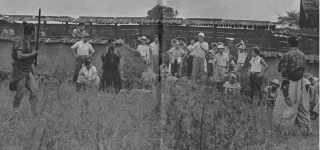
Thomas Hardy provides a wonderful illustration, in Chapter XII of Far from the Madding Crowd, of the wiles of the ordinary farmer when he has his protagonist, Bathsheba Everdene, suddenly emerge at the Casterbridge corn market selling the products of her lands. The scene is worth quoting at length.
The first public evidence of Bathsheba’s decision to be a farmer in her own person and by proxy no more was her appearance the following market-day in the cornmarket at Casterbridge.
The low though extensive hall, supported by beams and pillars, and latterly dignified by the name of Corn Exchange, was thronged with hot men who talked among each other in twos and threes, the speaker of the minute looking sideways into his auditor’s face and concentrating his argument by a contraction of one eyelid during delivery. The greater number carried in their hands ground-ash saplings, using them partly as walking-sticks and partly for poking up pigs, sheep, neighbours with their backs turned, and restful things in general, which seemed to require such treatment in the course of their peregrinations.
During conversations each subjected his sapling to great varieties of usage—bending it round his back, forming an arch of it between his two hands, overweighting it on the ground till it reached nearly a semicircle; or perhaps it was hastily tucked under the arm whilst the sample-bag was pulled forth and a handful of corn poured into the palm, which, after criticism, was flung upon the floor, an issue of events perfectly well known to half-a-dozen acute town-bred fowls which had as usual crept into the building unobserved, and waited the fulfilment of their anticipations with a high-stretched neck and oblique eye.
Among these heavy yeomen a feminine figure glided, the single one of her sex that the room contained. She was prettily and even daintily dressed. She moved between them as a chaise between carts, was heard after them as a romance after sermons, was felt among them like a breeze among furnaces. It had required a little determination—far more than she had at first imagined—to take up a position here, for at her first entry the lumbering dialogues had ceased, nearly every face had been turned towards her, and those that were already turned rigidly fixed there.
Two or three only of the farmers were personally known to Bathsheba, and to these she had made her way. But if she was to be the practical woman she had intended to show herself, business must be carried on, introductions or none, and she ultimately acquired confidence enough to speak and reply boldly to men merely known to her by hearsay. Bathsheba too had her sample-bags, and by degrees adopted the professional pour into the hand—holding up the grains in her narrow palm for inspection, in perfect Casterbridge manner.
Something in the exact arch of her upper unbroken row of teeth, and in the keenly pointed corners of her red mouth when, with parted lips, she somewhat defiantly turned up her face to argue a point with a tall man, suggested that there was potentiality enough in that lithe slip of humanity for alarming exploits of sex, and daring enough to carry them out. But her eyes had a softness—invariably a softness—which, had they not been dark, would have seemed mistiness; as they were, it lowered an expression that might have been piercing to simple clearness.
Strange to say of a woman in full bloom and vigor, she always allowed her interlocutors to finish their statements before rejoining with hers. In arguing on prices, she held to her own firmly, as was natural in a dealer, and reduced theirs persistently, as was inevitable in a woman. But there was an elasticity in her firmness which removed it from obstinacy, as there was a naïveté in her cheapening which saved it from meanness.
Those of the farmers with whom she had no dealings (by far the greater part) were continually asking each other, “Who is she?” The reply would be—
“Farmer Everdene’s niece; took on Weatherbury Upper Farm; turned away the baily, and swears she’ll do everything herself.”
Of course, the context of the caselaw is different. There is no market. The goods are bought and sold unseen, in bulk, and likely prior to harvest and perhaps prior to planting. No matter, I think. It is just peculiar for courts to pretend that the typical farmer could not, if the situation arose, bargain with the same commercial finesse as Bathsheba Everdene exhibits.