
Reviewing Larry DiMatteo, Principles of Contract Law and Theory, Part VII
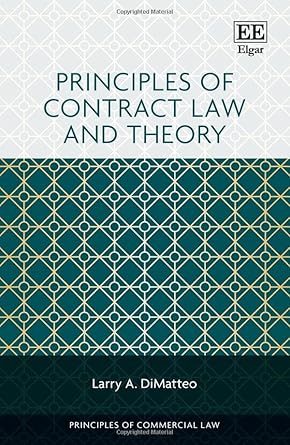
This is the sevevnth post in my series on Larry Di Matteo‘s Principles of Contract Law and Theory (Principles). The aim is to call some attention to this book while using it to stimulate my thinking as I once again consider how to teach contracts law to first-year students. Principles is a scholarly textbook addressing advanced topics at a very high level of sophistication.
Many of the doctrines treated here, mistake, duress, undue influence, and misrepresentation (162-67), operate in similar manners in the U.S. and the UK. The paths diverge on policing unfair contracts. While the U.S. has developed unconscionability doctrine, the UK arrives at the same place with special protections for consumer contracts and courts’ abilities to strike down contracts that are fundamentally unfair. (167-72) The 2015 Consumer Rights Act provides a fairly comprehensive list of terms that may be regarded as unfair and provides for a set of remedies for consumers who are subjected to unfair terms. (172-76) Professor DiMatteo notes the lack of a comparable federal consumer protection statute in the United States. There are targeted laws, such as Lemon Laws and the Magnusson-Moss Act. I think Professor DiMatteo downplays elements of consumer protection in the UCC, although he does touch upon some of those protections in the section on warranties. (180-82) However, he is correct that, for the most part, the regulation of unfairness in consumer contracts is left to the states.
On the duty of good faith, England seems to be a doctrinal, if not a substantive, outlier. Courts have recognized such a duty in contracting in the U.S., Australia, Scotland, and Canada. The UK recognizes no such general duty, but judges will imply good faith as a term when the circumstances seem to call for it. (176-78)
Professor DiMatteo provides an all-too-brief discussion of the question of fault in contract law. (178-80) This fits within his theme of “regulation” as a check on restrained freedom of contract. As I have noted before, Professor DiMatteo is more inclined than I am to blur the lines between contract and tort, and so he sees in numerous doctrines (unconscionability, implied duties, affirmative defenses) evidence that liability or enforceability can be, in some circumstances, linked to moral culpability. Following Judge Posner, I think one can, for the most part, justify these doctrines based on sound commercial principles. The difference between my position and Professor DiMatteo’s is, as George Cohen eloquently remarked, a matter of where one places the emphasis.
Two significant gaps in the chapter are employment law and arbitration clauses, two areas where claims of unfairness or unconscionability often arise. My understanding is that, once again, there are statutory protections in the UK that are lacking the U.S., but Professor DiMatteo likely would have more to say about those topics if space allowed.
The first post in this series can be found here
Part II is here.
Part III is here.
Part IV is here.
Part V is here.
Part VI is here.