
Reviewing Larry DiMatteo, Principles of Contract Law and Theory, Part VI
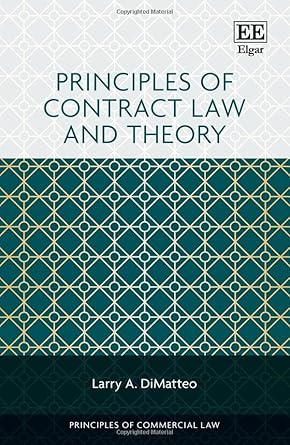
This is the sixth post in my series on Larry Di Matteo‘s Principles of Contract Law and Theory (Principles). The aim is to call some attention to this book while using it to stimulate my thinking as I once again consider how to teach contracts law to first-year students. Principles is a scholarly textbook addressing advanced topics at a very high level of sophistication.
The discussion begins with a section on extraordinary remedies, with a brief reminder of their origins in Chancery courts. (135-36) In keeping with his comparative theme, Professor DiMatteo notes that specific performance is extraordinary in common-law jurisdictions but ordinary in civil law jurisdictions and also among the Scots. In a laconic parting shot, citing his own co-authored work on China, Professor DiMatteo notes that the difference may be more theoretical than practical, given the inconvenience of policing orders of specific performance. (137-38) The book sometimes teases us with the hidden depths of Professor DiMatteo’s expertise.
On the whole the section on damages is concise yet fairly comprehensive. Foreseeability (146-48), mitigation (148-49), and certainty (149-50) are illustrated with detailed summaries of cases. Those are useful, but as the doctrines are multi-faceted, it is hard to illustrate them using just a handful of cases.
The discussion of compensatory damages includes a tantalizing mention of a Lord Denning opinion from 1972 allowing for the recovery in contract for “disappointment and distress.” (140) Such recovery is at odds with the requirement that damages be calculable with reasonable certainty. Lord Denning thought that, if the calculations are possible for torts claims, why not also for contracts claims? I would like to know more of the post-1972 development of English law on the topic. The mention of Lord Denning comes in the context of a discussion of how contracts damages are often under-compensatory. True enough, but nothing prevents a plaintiff from claiming negligent or intentional infliction of emotional distress along with breach of contract. This might have been an opportunity to go back to a point that Professor DiMatteo made in Chapter 2: while different legal traditions part ways on matters of doctrine, they often arrive at very similar substantive conclusions.
I get the sense that Professor DiMatteo is more sympathetic than I am to a blurring of the lines between the sorts of damages available for breach of contract and in tort. He writes that punitive damages are sometimes available for breach of contract where the party acted “willfully, maliciously, or fraudulently.” (143) I would say, at least as a matter of U.S. common law, punitive damages are available if a breach of contract is accompanied by an independent tort, such as the tortious interference claim in the notorious Pennzoil v. Texaco case, (143-44) but not as a remedy for breach of contract unless exemplary or punitive damages are made available through statute. The difference is technical, as there is a plethora of such statutes (and yes, by “plethora,” I do mean an unhealthy excess). Our retributive instincts have made U.S. criminal law a horror; I see no need to import such venom into commercial law, but legislators gonna legislate.

The section on excuses (150-55) makes for nice reading. Much of the doctrine, even as taught in U.S. schools, builds on fun old cases about cancelled coronations and surprise closings of the Suez Canal. Professor DiMatteo is an excellent guide through the material. He defers discussion of allocation of risk to the end of the section (154-55), as is appropriate, as the earlier English cases do not expressly address the topic. Nonetheless, one can make sense of the earlier cases in terms of allocation of risk, as does Judge Posner when he reviews the earlier cases in NIPSCO v. Carbon County Coal.
The brief discussion of privity (156-57) touches on some interesting contemporary challenges to the doctrine in the context of blockchain technology and network contracts. In my teaching, privity comes up mostly in connection with warranties and related discussions of strict liability under § 402A of the Torts Restatement. Professor DiMatteo addresses warranties in the next chapter, but the decision to discuss privity in this chapter makes sense because it provides a segue to the discussion of third-party beneficiaries and assignment and delegation with which Chapter 6 concludes. (157-59)
The first post in this series can be found here
Part II is here.
Part III is here.
Part IV is here.
Part V is here.