
Sid DeLong, Hillbilly Equity
HILLBILLY EQUITY: Woollums v Horsely as Mountain Melodrama
Sidney W. DeLong
When I began teaching contracts, I used the Dawson, Harvey, and Henderson Contracts casebook. As do many casebook authors, Dawson chose cases whose entertainment value enhanced their pedagogical effects. The defense of unconscionability was illustrated by Woollums v Horsley, 20 S.W. 781 (Ky. App. 1892), a masterpiece of the melodramatic genre of appellate opinion-writing,
The parties were introduced with a few deft strokes:
In August, 1887, the appellant, John Woollums, was living upon his mountain farm of about 200 acres in Bell County. He was then about 60 years old, uneducated, afflicted with disease disabling him from work, owned no other land, and but very little personal property. He knew but little of what was going on in the business world owing to his situation and circumstances in life. He moved in a small circle.
He moved in a small circle. That’s the line that got me. Woollums is the perfect victim, a lamb waiting for the wolf to appear. On cue, the villain made his moustache-twirling appearance:
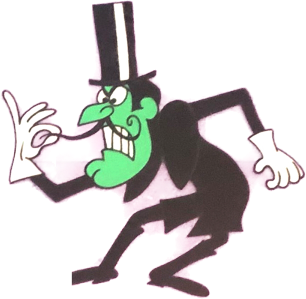 Horsely, as portrayed by Snidely Whiplash
At this time the appellee, W.J. Horsley, who was then a man of large and varied experience in business, who was then buying mineral rights in that locality by the thousands of acres, and who was evidently familiar with all that was then going on and near at hand in the way of business and development . . . through his agent entered into a contract with [Woollums], which was signed by [Woollums] only, by which he sold to Horsely all the oils, gases and minerals in his land with customary mining privileges, for $0.40 per acre.
This melodrama was set in Bell County, a sparsely populated corner of eastern Kentucky that borders both Tennessee and North Carolina. It is in the heart of the Eastern Kentucky coal belt, which supplies its only income.
Horsely had designs on Woollums’ only asset, his modest mountain “farm,” whose commercial value lay in its coal deposits. Evidence showed that its mineral rights were worth $15 per acre. Horsely’s agent thus snagged Woollums’ $3,000 farm for $80. He persuaded Woollums to sell by assuring him that the mineral rights would never be exploited during Woollums’ lifetime. As the court put it: “He was lulled in the belief that the Rip Van Winkle sleep of that locality in former days was to continue; and the grossly inadequate price of this purchase can only be accounted for upon the ground that the appellant was misled and acted under gross misapprehension.”
In the Second Act, Woollums finally woke up and refused to convey the land. Horsely sued for specific performance, a remedy that is generally available to enforce contracts for the sale of land. In place of the mortgage foreclosure that figured so prominently in melodramas, Horsely brandished a contract for mineral rights that would have permitted the family farm to be strip-mined out from under its owners. The trial court duly granted the order and Woollums appealed, seeking the protection of Equity.
Although it is a common remedy for refusal to perform a contract for the sale of land, specific performance is an equitable remedy and will not be ordered if it would be unfair to do so. After a review of the circumstances of the transaction, the Kentucky appellate court dismissed the bill on grounds that equity would not enforce such a grossly unfair bargain. The gross inadequacy of the consideration coupled with the gross disparity in knowledge and sophistication of the parties made its decision easy. In essence, the court refused to assist Horsely in his legal depredations of local citizens.
It has long been popular among legal realists to deprecate the unsystematic reasoning of courts of equity, where outcomes are thought to rest on unreviewable and unsystematic judicial idiosyncrasy, “the length of the Chancellor’s foot.” Yet, I found the court’s holistic account to be far more compelling than a contemporary, rule-bound analysis of unconscionability.
Unconscionability is loosely defined in Restatement (Second) of the Law: Contracts § 208 and in the Uniform Commercial Code in § 2-302. Unconscionability is to be determined by the court, not a jury. Under the U.C.C., a court may, upon a finding of unconscionability, refuse to enforce a contract or enforce it without the unconscionable term.
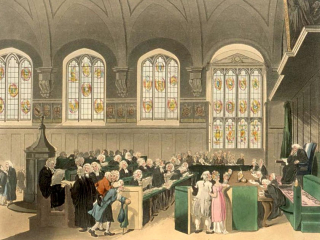
A strong common law tradition follows the analysis of Professor Arthur Leff in requiring both procedural and substantive unfairness as prerequisites to a finding of unconscionability. Although the Woollums contract exhibited a sufficient substantive imbalance, it is a close question whether a contemporary judge would find sufficient procedural unconscionability, absent fraud, duress, or abuse of a confidential relationship. Today’s legally-competent adults with terrible judgment are bound by contracts even more one-sided than Woollums’. Equity may have been more protective in the nineteenth century, at least at a local level.
But even though he lost on the order of specific performance, Horsely had not yet lost the case. Unconscionability was a defense only to equitable actions, not to legal claims for damages. Woollums remained liable to Horsely for the lost benefit of the bargain, the difference between the contract price ($80) and the value of the land ($3,000). Horsely would have been entitled to a money judgment against Woollums for that amount.
As an aside, the reader may wonder how Woollums, who had “but very litte personal property,” could have paid a judgment for $2,920? Re-enter the melodramatic villain, this time with a judgment instead of a mortgage to enforce. As an unpaid judgment creditor, Horsely, like a mortgagee, could force an auction of the farm at which he very likely would have been the only bidder. If the Law had taken its course, the one-sided contract would have been enforceable despite its lack of Equity.
But Dawson’s casebook posed the following question after the opinion: “It appears that John Woollums was not much of a traveler, so that any suit against him for damages would probably have to be brought in Kentucky in the county of his residence. Would you advise Horsley to bring such an action?”
I loved this classroom question. In addition to forcing law students to see themselves as attorneys for the unpopular litigant – stretching their legal imaginations – a complete answer to this question introduces them into the ways that the world of legal practice can sometimes provide a route to justice that the world of legal theory cannot. Even though the Chancellor had exhausted his institutional power to protect Woollums from Horsely’s over-reaching, the jury system offered one last line of defense. Woollums’s circle of friends may have been small but, in the land of moonshine and jury nullification, his friends and neighbors could give him more protection from Horsely than Equity could.
As the curtain drops and the credits roll, the farm is saved, the villain is foiled by Hillbilly Equity, and the circle, though small, is unbroken. That at least is how I would have written the ending. Cue the banjo.