
Securities Law Suit Against Winkelvoss NFT Entities Sent to Arbitration
In early 2021, John Hastings bought non-fungible tokens (NFTs), digital assets, in this case in the form of digital art works called “Nifties,” from an entity called Nifty Gateway, LLC (Nifty). Nifty is owned by the Winkelvoss twins (right). In December 2022, apparently disappointed in the Nifties as investment vehicles, Mr. Hastings sought to bring a class action complaint against Nifty for violations of the 1933 Securities Act, deceptive practices under New York law, and unjust enrichment. Nifty moved to compel arbitration.
In Hastings v. Nifty Gateway, LLC, the District Court for the Southern District of New York granted Nifty’s motion to compel arbitration. As usual, the question is whether a reasonable user would be put on notice that by creating an account with Nifty they were agreeing to Nifty’s terms and conditions. The court provides an image of Nifty’s sign-in page (reproduced below). As you can see, the page provides notice that by signing up for a Nifty account one is agreeing to Nifty’s terms and conditions, and the page then provides a hyperlink to those terms and conditions. Those terms and conditions included, you guessed it, an arbitration provision.
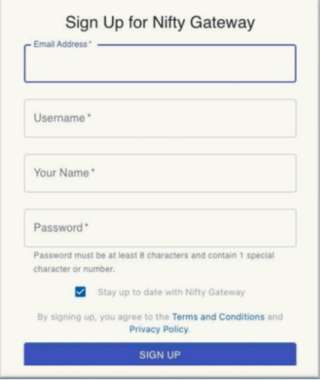
The court found that Mr. Hastings had reasonable notice of Nifty’s terms and that he had unambiguously assented to those terms when he created not one by three Nifty accounts. In addition, because the arbitration clause unambiguously delegated to the arbiter the authority to determine the scope of the arbitration clause, the court must allow the arbiter to decide whether Mr. Hastings’ claims fall within the scope of the arbitration agreement.
Finally, Mr. Hastings argues that Congress, in passing the Private Securities Litigation Reform Act (the “PSLRA”) supersedes the Federal Arbitration Act (FAA) by guaranteeing that plaintiffs can pursue their securities claim in federal court, including by class action. This argument is foreclosed by many decisions finding that, absent some express statement indicating Congressional intent to override the FAA, courts should not “conjure conflicts” between it and other statutes. Although the court makes no mention of it, that the arbitration provision at issue does not seem to prohibit class arbitration. That means that there would seem to be less of a conflict between arbitration and the PSLRA in this instance. In some future case a plaintiffs might claim that the conflict is not between the FAA and the PSLRA but between a contractual term (a class-action waiver) and a federal statute. Absent some change in the Supreme Court’s personnel, that argument would also likely fail.
In any case, in this case the court granted Nifty’s motion and stayed the proceedings pending arbitration.