
Fintech Class Action Sent to Arbitration
In December, 2020, Najah Edmondson made use of Klarna’s buy now, pay later product. Between December 2020 and April 2021, she made several further purchases using the Klarna App, which she had downloaded. On two occasions, when Klarna attempted to automatically deduct the payments from Ms. Edmondson’s account, her account had insufficient funds. Ms. Edmondson’s bank charged her $70 for the overdrafts, and she wanted to sue Klarna on behalf of a similarly-situated purchasers, alleging common-law fraud and violations of Connecticut’s Unfair Trade Practices Act. Klarna moved to compel arbitration, and the District Court rejected that motion, finding that Ms. Edmondson never received reasonable notice and never gave knowing assent to the arbitration agreement.
In Edmondson v. Klarna, Inc., the Second Circuit reversed. The Second Circuit noted that Ms. Edmondson had multiple opportunities to familiarize herself with Klarna’s terms. The District Court found that Klarna had not provided adequate notice on its Pay-With-Klarna screen because the screen was too cluttered. The District Court found the App’s LogIn screen similarly defective. Although Ms. Edmondson was presented with hyperlinked language stating, “I agree to the payment terms,” the District Court found that “[t]here is nothing anywhere on the screen that would alert a reasonable user to the fact that clicking ‘confirm and continue’ has any contractual significance at all, much less acceptance of a contract that includes an arbitration agreement.” Although the Login screen instructed users to “sign up” or “log in,” the District Court found it insufficiently clear that doing so entailed agreement to terms.
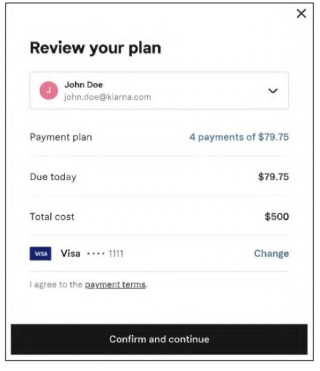
The test is quite fact specific, and the Second Circuit did undertook several comparison’s of Klarna’s web interface with those that had been found wanting or sufficient in prior cases. In short, the Second Circuit concluded that the Klarna check-out “widget” (left) provided sufficient notice of its terms. As you can see, the screen is relatively uncluttered, and a the court found that a reasonably prudent web browser or App user would have been on notice that the hyperlinked terms were connected to a purchase of Klarna’s products. Edmondson manifested unambiguous consent to Klarna’s terms when she clicked on “Confirm and continue” to finalize her purchase in December 2020.
The Second Circuit thus reversed the District Court’s denial of Klarna’s motion to compel arbitration and remanded the case with instruction to grant that motion.