
Nick Mouttotos (U. Bremen) & Dan Barnhizer, Summary of the Informed Consent Conference in Bremen
Insights from the Institute for Commercial Law
Informed Consent to Dispute Resolution Agreements Conference
Universität Bremen, Bremen, Germany 20-21 June 2024
Introduction by Daniel Barnhizer (left)

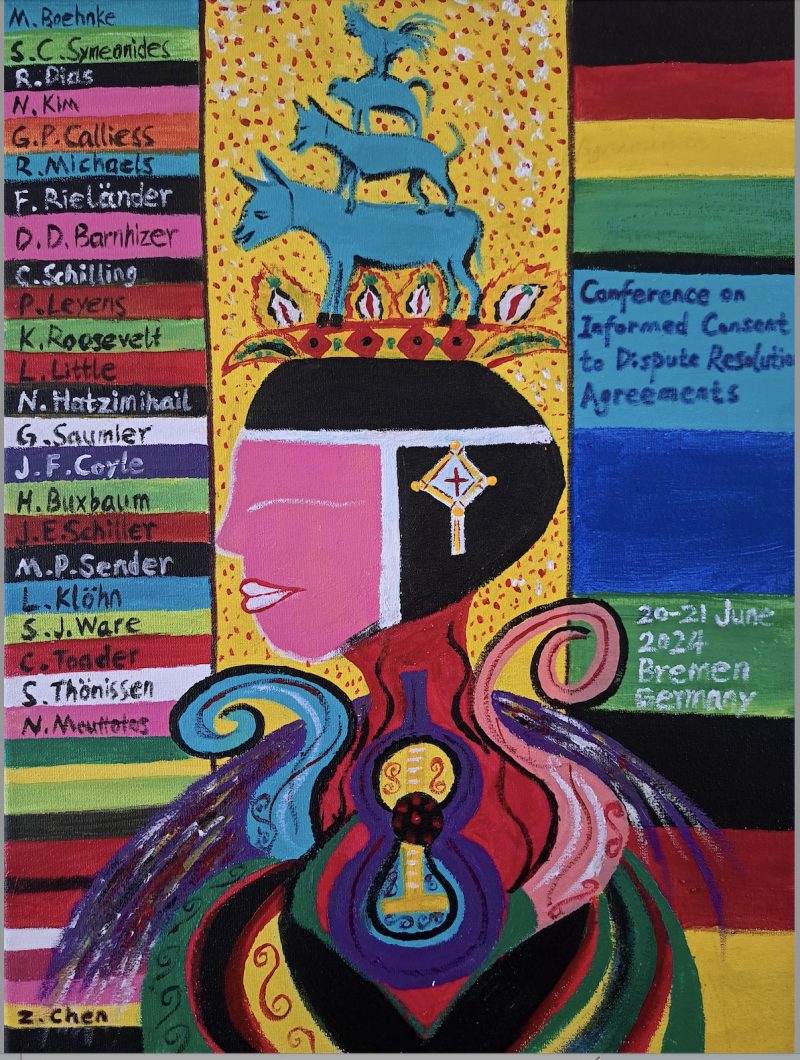
As an initial matter, I would like to express my sincere and heartfelt appreciation to Prof. Dr. Gralf-Peter Caliess and Dr. Nicholas Mouttotos for organizing this conference. Additionally, Margit Knipper was absolutely amazing in handling the administrative details for this conference. And finally, many thanks to Zhen Chen for developing and gifting the participants with the conference poster appearing below:
Conference Summary by Dr. Nickolas Mouttotos (below right)
The conference was organized as a moderate split between history (particularly Symeonides), general contract theory, and choice of law / choice of forum scholars. Literally every presenter was fully engaged with the attendees – and for every panel there were more questions and comments raised by the attendees and participants than would fit within the permitted time. Seriously robust, this conference was something to which academia should aspire.
Day One: Party Autonomy and Contract Law
The conference commenced with a keynote speech by Symeon C. Symeonides, the Alex L. Parks Distinguished Professor of Law and Dean Emeritus at Willamette University, who recently celebrated 50 years of contributions in the US conflict of laws field. Symeonides’ address, titled “Party Autonomy: Then and Now,” provided a historical and contemporary analysis of the principle of party autonomy, highlighting its evolution from the Decree of King Ptolemy VIII in 118 B.C. until its modern adoption in 152 countries, signifying its universal acceptance. Symeonides addressed the principle’s current challenges in delineating the modalities, scope and limitations.
The second session, chaired by Professor Ralf Michaels from the Max Planck Institute for Comparative and International Private Law, explored “Standard Form Contracts and Unfair Terms.” Frederick Rieländer, Professor of Law at the University of Bremen compared the Unfair Terms in Consumer Contracts Directive (93/13/EEC) with the US Restatement of Consumer Contracts, providing a transatlantic perspective on consumer protection. Rieländer highlighted the limited effectiveness of the assent doctrine and disclosure requirements under the Restatement of Consumer Contracts and the contrast with the Unfair Contract Terms Directive in the EU that is more focused on transparency. Professor Daniel Barnhizer from Michigan State University discussed “Assent under Adhesion Contracts and the Doctrine of Unconscionability,” stressing the nuances of consent in standard form contracts and offering a reimagining in the age of generative artificial intelligence. Barnhizer’s view of a future contract law imagines artificial intelligence as assisting in abandoning the current model of policing assent through proxy in favor of a ‘persuaded assent’ model with AI Shopping Assistants, for example. Dr. Peter McColgan from Humboldt University of Berlin also argued for a new model, one that is based on control with increased scrutiny of mass contract terms, breaking the information bottleneck. McColgan’s presentation was titled “A Farewell to the Information Model in the Law of General Terms and Conditions?” since he favors the complete abandonment of the current model that leads to consent being a legal fiction.
The day wrapped up with a conference dinner at the historic Bremer Ratskeller, where Dr. Claudia Schilling, Senator of Justice and Constitution of the Free Hanseatic City of Bremen, welcomed the attendees.
Day Two: Deliberations on Choice of Law, Jurisdiction, and Arbitration
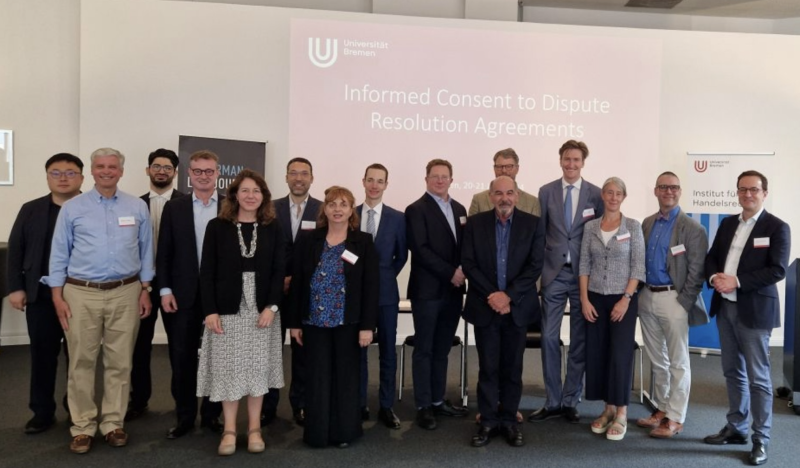
Day two began with a session on “Choice of Law,” chaired by Professor Patrick Leyens from the University of Bremen. Professor Laura Little from Temple University provided insights into the elaboration of the provisions on choice of law found in the Draft Restatement (Third) of Conflict of Laws, in which she serves as an associate reporter. Little emphasized that the Restatement strives for a balancing of various competing values such as liberty, party autonomy and economic efficiency on the one hand, and protecting state interests, reliance on established law and constraining misuse of superior power on the other hand. Professor Kermit Roosevelt III from the University of Pennsylvania, the reporter of the new Restatement of Conflict of Laws, explored the intricacies involved in the choice-of-law analysis and argued that courts confronted with a choice-of-law clause should consider the interests and policies of the state whose law has been selected.
The subsequent session on “Choice of Jurisdiction,” chaired by Professor Geneviève Saumier from McGill University, featured Professor John F. Coyle from the University of North Carolina, who discussed the enforceability of choice-of-jurisdiction clauses in the US and the conflation by courts of the notion of notice with consent. Professor Hannah Buxbaum from Indiana University – Bloomington examined the impact of statutory anti-waiver provisions, noting the problems in enforcing such pre-dispute resolution agreements in the consumer context but also their importance in establishing a functioning online dispute resolution mechanism. Professor Marta Pertegás Sender from Maastricht University addressed consent to jurisdiction under the EU Brussels Ia and Hague Choice of Court regimes, noting the absence of the term ‘consent’ in the Brussels Ia Regulation and the emphasis on satisfying the written form requirement found under Article 25.
After lunch, the focus shifted to “Arbitration Agreements” potentially the most controversial of dispute resolution agreements, particularly for consumer contracts. Chaired by Professor Ulrich Schröter from the University of Basel, this session included Professor Stephen J. Ware from the University of Kansas, who spoke on “Contracting Away Constitutional Rights in the United States,” and Professor Camelia Toader from the University of Bucharest, who analyzed the legal landscape in Europe with regard to arbitration agreements, providing comparative remarks on how different European countries regulate such agreements. Ware noted the different consent standards that govern various types of dispute resolution clauses in the US, with bench trial clauses usually requiring a higher threshold for establishing consent.
The conference concluded with a wrap-up session chaired by Professor Gralf-Peter Calliess, featuring Dr. Nicholas Mouttotos from the University of Bremen. Mouttotos’ presentation, “Towards a Coherent Regulation of Dispute Resolution Clauses?” encapsulated the key themes and discussions of the conference, leaving attendees with much to ponder. Mouttotos highlighted that balancing party autonomy with protecting rights and ensuring fair and informed consent is an ongoing challenge that requires a refinement of our understanding and approach to consent in dispute resolution agreements in particular.
Conclusion
The Institute for Commercial Law conference was a remarkable event that fostered deep discussions on critical aspects of contract and commercial law. It provided a platform for sharing perspectives between the US and Europe, identified challenges in addressing choice of law and choice of forum clauses in adhesive contracts, and explored innovative ideas for dealing with the problem posed by standard form contracts in identifying assent. The diverse range of topics and the high caliber of presentations made it a significant contribution to the field. The proceedings of the conference will be published as a Special Issue at the German Law Journal, an open access journal of the Cambridge University Press, in early January 2025.