 Two years ago, I got a prize in my cereal. I don’t have much use for toys, and my daughter was away at college. I decided I would give the toy to a student as a prize for a successful Socratic exchange. I don’t remember what prompted the award, but I gave it to a student, and she beamed. As I recall, she attached the trinket to her computer as a badge of honor. Happy with the exchange, I looked around my office for other small tokens with which I could happily part, and I occasionally gave out prizes to students. Eventually, I found ways to hold mini review sessions in which everybody got the opportunity to win a prize. In general, the prizes are random appreciations for successful responses to cold calls. I don’t want to be singling out students for excessive praise. Once one student gets a prize, they should all get rewarded eventually.
The exception was that I gave two students cara cara oranges in Sales last year. One because the student successfully remonstrated with me that there may have been two correct answers to one of my multiple choice questions. The other was because the student corrected my reading of a UCC section. I wrote on the peels, “You were right; I was wrong.” And I signed it. I think one of them said, “I’m showing this to my mom!” I do want to highlight and reward vigorous advocacy. On the whole, my students need to practice respectful disagreement with authority figures, starting with me, and hopefully working their way up to zealously advocating for their clients.
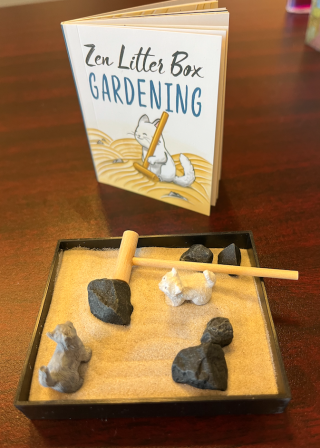
 I have neglected the gift-giving tradition this year. I just haven’t gotten my act together to gather the prizes, but a recent exchange with the original award winner persuaded me that I need to revive it. And I know just the thing. Last year, we gave students fidget toys around finals, and they were a huge hit. You can get a big pack of them (left), they are cheap, and students, I have learned, have very particular and individualized preferences when it comes to fidget toys. I thought everyone would fight over what I thought were the best toys, but everyone has their own itch to scratch, and so the toys found their way into the right hands. Very few toys went unclaimed. A few found their way to my desk, and now students have fidget toys to play with which they talk to me. For some reason, only my Associate Dean tends to my Zen litter box (below right), and that’s fine, because she keeps it looking its best. When we are chatting in my office and I point out that the litter box needs tending. She gets this intense look in her eyes as she surveys and strategizes. Then she sets to work as we continue our conversation.
 I was reminded that I have been remiss about gift-giving because I did a little quiz bowl session with my Sales students and I gave out candy for correct answers. The topic of gift-giving came up, and I remembered that the one of my Sales students was the student to whom I gave my little cereal trinket. I asked her if my memory was correct, and she said, “Oh, yeah, I still have it!” (top right) I told her I remembered it because I was surprised by how happy she was to get the little prize. She told me (and the class, and she has given me permission to share the story here) that she had been going through a rough patch in law school, and she was not feeling confident about speaking in class. That little affirmation was just the thing she needed. It turned out that my small gesture helped my student get over a hump. It cost me nothing, but it had great value for her. And that’s a reason to keep engaging in ordinary acts of kindness.
When I asked the student for permission to share her story, she reminded me that there was a time that I told her a variation of something that I often tell students whom I suspect are suffering from imposter syndrome. It is something I say to students regularly, and I always believe it when I say it. I don’t say it if I don’t believe it. Fortunately, we admit very few students to whom I could not deliver a version of the following:
We admitted to you because we think you belong here. Now you’re here, and we still think you belong here. You are exactly where you ought to be, so don’t let a disappointing Socratic exchange or a marked-up legal writing draft make you think otherwise. Most of your peers are experiencing the same roller-coaster ride that you are. And nobody, including me, thinks twice about anything you say in response to Socratic questioning. Your classmates are too worried about what they are going to say, and I am satisfied so long as you manage to produce words that are arguably responsive to my question. Keep working at it, and it comes more easily.
I have come to believe that we law professors sometimes take ourselves too seriously, e.g., when we think that a well-placed law review article will be the lever with which we can move the world. But I have also come to realize that we don’t take ourselves seriously enough when it comes to how important it can be to students to receive encouragement and affirmation from us.
