
Teaching Assistants: Corbin on the Parol Evidence Rule
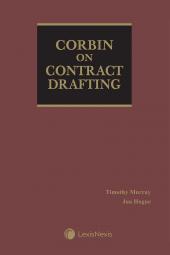
I highly recommend this chapter to instructors and students. The division of the material into ten short sections makes the doctrine easy to follow, analyze, and digest. The Authors provide helpful case studies that illuminate their points, and the material on drafting can help students understand both how the doctrine works and how to think about its operation in practice.
The Authors make the valuable point that integration and interpretation are separate matters. An agreement is integrated if it constitutes the entirely of the agreement between the parties. The PER will not bar the admission of prior agreements that are outside of the scope of the integration. But even if the evidence relates to subject matter that is within the integration, the parol evidence does not bar evidence related to interpretation. The question of integration must come first. Otherwise, a court might determine that the contract is unambiguous and bar admission of evidence relating to a subject matter that the contract does not address.
The Authors’ discussion of merger clauses is highly instructive, but the material highlights what I hate most about the PER. As the Authors note, some courts treat merger clauses as conclusive evidence of integration, but most people who enter into agreements through form contracts never see the merger clause or, if they do see it, they have no idea what it means. The Restatement notes that a merger clause is a “clear sign” of integration. Cases then might turn on whether the written agreement is a complete or a partial integration (see R.2d § 213, illustration 4), but courts are pretty much on their own to determine whether the integration is partial or complete. While it seems to be universally accepted that judges, rather than juries, decide the issue of integration, there is no agreement on how to do so. The R.2d follows the Corbinian approach of consulting parol evidence on the issue of integration, but many courts still apply a more formalist approach.
I see no reason for such harsh characterizations. I think the real problem with Mitchill is that Judge Cardozo didn’t write it. If he did, I’d like to think he would have pointed out that, notwithstanding the Court’s finding that the promise about the icehouse was collateral to the agreement to convey the property, it nonetheless was part of the integrated agreement because there was no separate consideration relating to the removal of the icehouse. For that substantive reason, the promise to convey the icehouse should have been part of the written agreement and was not a “natural omission,” even if it was outside the “scope” of the written agreement.
The Authors helpfully explicate the UCC’s avoidance of the term “integration” in Article 2’s PER provision § 2-202. The doctrinal challenges resurface however, as § 2-202 speaks of a “final expression of agreement” and §2-202(b) speaks of “a complete and exclusive statement of the terms.” The former becomes a rough analogue of partial integration, while the latter corresponds to “complete integration.” Contradiction of a written agreement is always impermissible. However, parol should be admitted to supplement a final agreement but not a “complete and exclusive” agreement. Other forms of extrinsic evidence (trade usage, course of performance, course of dealing), which the Authors call “invisible evidence,” is admissible, unless “carefully negated.” An ordinary merger clause will not negate such evidence.
In a negotiated contract between sophisticated parties, I have no problem with the operation of merger clauses, but they are an outrageous trap for the unwary if there are bargaining asymmetries.

If I were not a contracts professor, the merger clause would have meant nothing to me, but even knowing what I know, I think the options are limited. I could have explained to the installer that I’m not comfortable with the merger clause, which does not reflect our oral agreements. He’s not an attorney, so he might happily rip it out. In the alternative, not being an attorney, he might think, “I don’t know what this thing does, but I know I need it.” If he was able to consult with the lawyer who drafted it, the lawyer would likely insist on keeping it in. Or, if the lawyer were more enterprising, they might offer to draft language reflecting all of our various oral agreements. The lawyer could earn a good income through such means, but the parties would not really be better off than we would be in a CISG world where evidence is admitted and given the weight that it is due. Contracts law assumes that writings are more authoritative than oral agreements. But we know that most people do not read form contracts, but they give a lot of weight to oral agreements or representations.
That said, Corbin on Contract Drafting is very up-to-date. It includes a section on the new Restatement of Consumer Contracts Law § 8, which provides that a standard contract term is not a final expression of the agreement if it “contradicts, unreasonably limits, or fails to give the reasonably expected effect to a prior affirmation of fact or promise by the business.” The Authors note that Comment 1 to the Restatement indicates the Reporters’ intent to replicate the impulse of R.2d § 211, which bars the enforcement of terms where a drafting party has reason to believe that the other party would not have manifested assent if they knew that the writing contained that particular term. I think the Restatement of Consumer Contracts goes beyond the R.2d and may be helpful to consumer advocates. As the Authors note, only Arizona has followed R.2d § 211. Time will tell if the new Restatement moves the ball at all.
One of the challenges in teaching the PER is that evidence of an affirmative defense or of a condition precedent is admissible notwithstanding the PER. The problem is that I have not taught defenses or conditions precedent by the time I get to the PER. If I introduce those topics so that students will have a complete version of the rule, they will want to talk about legal doctrines that they have not yet learned in answering questions about the PER. That’s a significant danger, as students love to talk about fraud, but their discussions are rather a mess if they don’t know the elements of the defense as a matter of contracts law. But the alternative is also problematic. If I don’t mention those limitations to the scope of the PER, they haven’t learned the complete doctrine. Damned if you do; damned if you don’t.
On the subject of the fraud exception to the PER, the Authors include a rather lengthy section, with several case studies addressing attempts to contract around the fraud exception. These clauses are called “no reliance provisions,” and fortunately, it seems that court regard them with great skepticism.
I recommend this chapter to folks who, like me, struggle each year to present the PER in a way that students can follow. It is clear, comprehensive, and up-to-date. It presents the material in a way that is easy to follow, which is very high praise, given the complexities, nuances, and layers of the material.