
Teaching Assistants: Understanding Contracts by Jeffrey Ferriell
I have previously shared here general advice that I communicate to my students about outside materials. Part I of the advice is herehere. The short version is as follows: you don’t need to consult outside materials to do well in my course. I provide reading materials adequate for everything I cover in the course. In addition, I provide practice multiple choice, practice short answer questions and essay questions, including questions from past exams.
However, some students want more, and so they want me to recommend study guides. I don’t use study guides, I tell them, so I don’t know which to recommend. To the extent that I look into them, they all seem good, but they also organize the material differently from how I do, and they cover things that I don’t cover. I worry that students working on their own might panic, thinking they missed some vital portion of the course, when in fact, the study guides tend to be more comprehensive than I can be or choose to be.
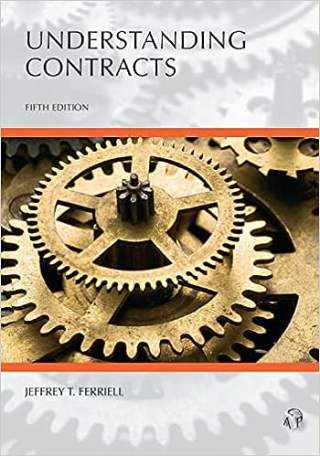
I could recommend this book to my students with the utmost confidence that they would learn a great deal from it, and it would help them to firm up their grasp of contracts doctrine. I would however caution them that it covers a lot of material that I don’t cover or don’t test on. They should, for example, read the book’s introduction only when they are preparing for exams, as it references a lot of doctrine that they won’t understand until they are near the end of the course. They can skip the very interesting part of the introduction about the history of contract law, unless they want to read it for their own edification. I will not be testing their knowledge of Roman law or of common law writs. A lawyer speaking in the presence of a judge, a supervising attorney, or a client usually wants to come off as the second-smartest person in the room, perhaps with some relevant specialized knowledge that the smartest person in room will easily grasp. Armed with all the knowledge that Professor Ferriell has to share, students might come off as, hands down, the smartest person in the room, and who wants that?
Topics are handled with scrupulous comprehensiveness. So, for example, Professor Ferriell does not treat the Restatement’s approach to consideration as the only relevant approach. Courts, he observes, will still look for a benefit or a detriment to each party, even though the Restatement tells us that all we need for consideration is a bargained-for exchange. The book covers subject-matters that I don’t but that may serve students well in their preparation for the bar exam. For example, it discusses accord and satisfaction, recitals, and guaranty contracts, as well as consideration in connection with topics like conditions that I would reserve for separate treatment. The result is a weighty sixty-page chapter on consideration. It’s a great read for me. I would want to go through it with a student and highlight the parts they can skip. And if they tried to read it in connection with my very brief presentation of consideration, they would understand very little of it, but they could come back to it and profit at the end of the course. Similarly, I would advise my students that they can skip the first eight pages of the thirty page chapter on promissory estoppel.
Because the bar exam loves exploring the details of formation, the statute of frauds, and the parol evidence rule, the loving attention that Professor Ferriell lavishes on those topics in Chapters 4-6 repays careful reading. He also devotes some attention in Chapter 6 to other interpretive issues, including canons of construction. I spend a day on canons of construction in my contracts course, and many students struggle, in part because of their aversion to Latin. But they sometimes tell me that the introduction to the canons helped them when they took Legislation and Regulation, so I am glad that Professor Ferriell devotes six economical pages to that topic.
The fifty-plus page long chapter on warranties, including warranties of title and habitability suggests that this book can be used with Sales courses as well as with the first-year contracts course. Many standard casebooks for the first year course leave out warranties entirely and certainly don’t cover title or habitability. Again, it is wonderful to have all of this material, well -organized and well-presented in one handy book. Students need to be able to distinguish topics they need to know for a course and topics they will want to know for a full life in the law.
The remainder of the book proceeds more or less as one would expect, with chapters on conditions, performance and breach, defenses, excuses, expectation damages, reliance and restitution damages, agreed-upon remedies and limitations on remedies, equitable remedies, third-party beneficiaries, and assignment and delegation. All of the chapters are comprehensive in scope; all are much more than a student would need to prepare for a standard contracts course.
None of this is meant as a criticism of the book. I read it both with admiration and with an eye to how my students could use it. From the perspective of a contracts teacher, I am happy to have the book in my library. In addition to being an excellent and detailed compendium of contracts doctrine, the book also provides useful examples, some drawn from case law, some hypothetical, and one can always use a fresh case or hypo to help illustrate some nook or cranny of a well-traveled doctrine.